


 Francais
 Deutsch
 Italiano
Refine Your Search
Long Binh Vietnam 1967 stock footage and images
- Showing 2329 to 2334 of 5994 results more
more Hide
Hide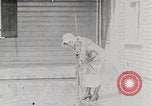
Woman pumping water from well and bringing it into kitchen of a house in early 20th century, United States
A young woman in long-sleeved dress, wearing high button shoes and a cotton bonnet, fills a metal bucket with well water using a hand pump outside her house. When a young man in overalls and a hat, carrying his own bucket, approaches, the woman shakes her fist at him, and then takes her bucket of water into the house. The young man begins to pump water into his bucket. Scene shifts to the kitchen of the house, into which the young woman carries her bucket of water. She speaks with an older woman who is drying a glass. Other glass items sit on the kitchen table. The woman drying the glass is startled and drops it when the young woman begins to pour water directly from her bucket into a tea kettle on their wood-burning cooking stove. The kitchen decor is typical for the early part of the 20th century. The wall is covered in wallpaper. A decorative calendar and a dustpan hang on the wall. A large coffee pot sits on the very top of the stove.
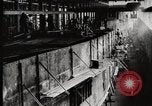
Men work on building military ships at a ship building yard during World War I in the United States
Men work on a long line of military ships in construction at a ship building yard during World War 1. Captain and crew on a new ship with bunting as it emerges from production and readies for launch. Newly built ship at ship commissioning ceremony.
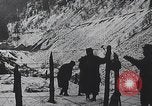
French soldiers preparing barbed wire barriers on the Western front in World War I
French soldiers use long handled hammers to set poles in the ground for barbed wire barriers, as others begin stringing the barbed wire, during World War 1. A steep snowy hill or mountain side is beside their position, and woods, with snow on the ground, behind them.
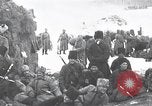
The Caucasus Campaign in World War I. Russians taking Turkish prisoners of war
Slate refers to Russian troops turning Turkish Flank. Russian troops assembled and relaxing outdoors on snow-covered terrain, during World War 1. Next, they are seen marching in loose column of fours, behind officers on horseback, along a muddy road between snow-covered fields. They proceed up a long hill. Turkish prisoners of war walk past the camera, and move along a snow-covered path, under Russian guard. Russian troops load bundles into a wooden sledge. A column of Russian supply wagons (and a sledge) being pulled by oxen.
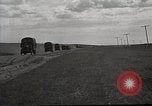
The 1919 U.S. Army Motor Transport convoy crosses the Continental Divide in Wyoming
Trucks of the 1919 U.S. Army Motor Transport convoy from Washington, DC to San Francisco, California, roll along the dirt road of the Lincoln Highway, crossing the Continental Divide, in Wyoming. Behind them, soldiers walk near a slow moving truck with sign painted on its back reading: "Coast to Coast Machine Shop, Service Park Unit 595." Another truck slowly passes the same point, where there is a downhill grade. A dwelling is at the side of the road, and others are seen in the background. The road is dry hard-packed dirt. Next, trucks of the convoy are seen driving on a road parallel to a railroad on which a steam locomotive is pushing a long train of freight cars in the same direction as the trucks. View of trucks driving past extended snake rail fencing.
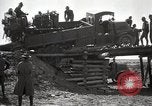
A truck in the 1919 U.S. Army coast-to-coast motor convoy breaks through a wooden bridge in Wyoming
A truck in the U.S. Army 1919 motor convoy, across America, is seen with its right rear wheel broken through the road bed of a wooden bridge across a dry creek, in Whyoming. The truck was heavily laden, carrying a Holt tractor in its bed. Soldiers stand about as an operator backs the tractor out of the truck. They then examine the situation. Closeup of the truck wheel broken through wooden floor boards of the bridge. They hook the rear of the truck to the Holt tractor and pull it out of the hole in the bridge. Next, the convoy is seen stopped at the bridge and for a long way in the distance, as soldiers lay coiled planking (sort of pre-fabricated corduroy road) at the dry creek to facilitate passage by trucks around the wooden bridge. A truck begins to drive up the embankment on the planking, with difficulty, as soldiers help push it. Scene shifts to two trucks slowly climbing a narrow dirt road.
CRITICALPAST.COM: About Us | Contact Us | FAQs - How to Order | License Agreement | My Account | My Lightboxes | Shopping Cart | Advanced Search | Featured Collections | Website Terms & Conditions | Privacy Policy ©2026 CriticalPast LLC.
License Agreement |
Terms & Conditions |
Privacy Policy
©2026 CriticalPast LLC.