


 Francais
 Deutsch
 Italiano
Refine Your Search
Long Binh Vietnam 1967 stock footage and images
- Showing 2671 to 2676 of 5994 results more
more Hide
Hide
A mammoth Studebaker "Giant Car" roadster is seen in South Bend, Indiana.
In South Bend, Indiana, views of a "Giant Car" Studebaker roadster built by a group of 60 craftsmen working under Studebaker's Paul Auman. This giant scale version 1931 model 80 Studebaker Four Season Roadster was used in the film "Wild Flowers." The Giant Car is 41 feet long with a wheel base of 325 inches. It is 13 1/2 feet high, 15 feet wide, and weighed 5 1/2 tons. Men drive up beside the giant President roadster in a normal vehicle. Some use a rope ladder to climb up into the giant car and others climb up the wheel fender and then onto the hood. A boy is shown trying unsuccessfully to climb up a giant wheel of the car (each wire wheel was 6 feet 8 inches in diameter and weighed 600 pounds). The boy's small pedal car is seen beside the Giant Car tire. A police officer in a motorcycle rides up beside the giant car. He places a board-style 'Police Ticket' on the running board and then climbs up onto the running board to present the ticket to a woman who is behind the wheel of the giant roadster.
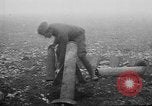
A member of the American Expeditionary Force disarms a German 105 mm gas shell in France during World War I.
Chemical warfare activities of the AEF (American Expeditionary Force) in France during World War I. A member of the American Expeditionary Force disarms a German 105 mm gas shell. A U.S. soldier places gas cylinders into long pipes on the ground. A number of pipes facing upwards.
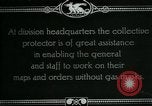
U.S. soldiers at Division Headquarters and in the field train for defense, disposal, and clean up of chemical warfare agents
A United States Army training film about defense against chemical warfare during World War I. The "Collective Protector" enables a general and the staff to work on their maps and orders without gas masks at the Division Headquarters. Two soldiers outside the headquarters wearing gas masks. They guard a low entrance doorway and enclosed tunnel with a heavy, flexible door designed to keep out gas. A soldier lifts the flap of the door and enters. Officers converse with each other while looking at a map on a wall. Soldier stands by rotating a handle on a device continuously. It has a long wide pipe connected to it, perhaps managing fresh air intake or air exchange. U.S. soldiers wearing gas masks load ammunition onto trucks. "Enemy" aircraft flies overhead throwing a cloud of poisonous gas that quickly envelops the area. A soldier wearing a gas mask fires his rifle into the air at the aircraft, through the heavy smoke screen. Gas sentries neutralize the gas around a dump. They dig in the ground with pick axes and mattocks, and then spread a white powder over the area. They then cover the area with a thin layer of the dirt they had dug up.
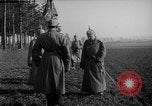
German Kaiser Wilhelm II meets with officers and reviews German troops in a forest area of Europe during World War I.
Scenes of German Kaiser Wilhelm II with German troops in a forest area of Europe. The Kaiser stands with a number of officers and talks to them. He is seen smiling and laughing while talking to one officer. He reviews long lines of troops as they march with rifles in hands. He salutes. Officers standing next to the Kaiser salute, as battalions march past them.
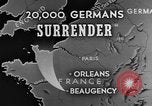
German General Erich Elster surrenders 20,000 troops and equipment to General RC Macon at Beaugency, France (WW2)
20,000 German soldiers surrender to Allied forces in France during World War II. German General Erich Elster surrenders himself and 20,000 troops to Major General Robert C Macon of the U.S. Ninth Army and to Major General OP Weyland, Commanding General of the XIX Tactical Air Command, on September 16. The formal surrender took place at the Beaugency Bridge on the Loire River. Long columns of Germans file into the city and lay down their arms. Numbers of items like trucks, civilian carts, horses, weapons and bicycle surrendered. View of surrendered rifles, pistols, machine guns, tucks and bicycles. 19360 Prisoners of War come down. View of Prisoners of War Camp and surrendered equipment.
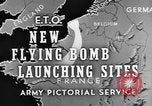
Canadian troops occupy a German flying bomb launching site and describe launching apparatus in Flanders, France.
Canadian troops occupy a German flying bomb launching site in Flanders, France. Map of France. Long rocket launching ramp. View of pistons that propel buzz bomb during take off. Allied pilot takes photographs. Canadian troops inspect the ramp mounted with a 400 pound piston. Canadian troops carry V-2 bombs and load them on to piston. The operation of the V-2 and launching apparatus: Man operates remote control boxes for launching. Soldier handles jet nozzle assembly. Jet propulsion engine is used for fire piston set off explosives. Compressed air bottle supply power for gyro pilots. Servo motors moves radar and elevator. Unexploded head contains explosives for bomb. Diagram shows flying bomb and its parts. View of a bomb site. (World War II period).
CRITICALPAST.COM: About Us | Contact Us | FAQs - How to Order | License Agreement | My Account | My Lightboxes | Shopping Cart | Advanced Search | Featured Collections | Website Terms & Conditions | Privacy Policy ©2026 CriticalPast LLC.
License Agreement |
Terms & Conditions |
Privacy Policy
©2026 CriticalPast LLC.