


 Francais
 Deutsch
 Italiano
Refine Your Search
Long Binh Vietnam 1968 stock footage and images
- Showing 2383 to 2388 of 5711 results more
more Hide
Hide
National Aeronautics and Space Administration (NASA) investigation of Apollo 1 disaster in United States.
NASA investigators pore over data related to the Apollo 1 command module fire on January 27, 1967. They discuss computer printouts showing graphical depictions of conditions during the event. Document control practice is shown with persons logging them in and out with a custodian. Engineers place long computer printouts on a white board. Many make notes and annotate documents.
Holland type submarine of the Plunger class being tested by civilian technicians of Electric Boat Company.
Holland type submarine of the Plunger class tied up at the Electric Boat Company at New Suffolk, Long Island , New York circa 1902. Civilian technicians standing on deck of the boat.. They load a torpedo aboard, using a block and tackle.. It goes down into the hull of the submarine. The Holland type submarine running at periscope, fires the torpedo. The torpedo runs just below the surface, leaving a visible wake. The submarine rises and runs along a conning tower depth. It dives again and rises again.
Holland type submarine of the Plunger class undergoing trials at Electric Boat Company
Holland type submarine of the Plunger class undergoing trials at the Electric Boat Company, New Suffolk, Long Island, New York. Submarine running along at periscope depth. Periscope of the submarine. Several times the boat disappears below surface and rises again (porpoising). It makes way on the surface. Civilian testing crewmen in business attire climb out of conning tower and walk on the deck. They start back down into the conning tower. Men on the deck as the submarine runs along the surface. Submarine tied up at the pier, men walking around on deck and using a plank to walk to the pier..
USS Tranquility carries Indianapolis survivors at sea in United States.
U.S. Navy hospital ship USS Tranquility carries USS Indianapolis survivors at sea, following the Indianapolis' sinking by Japanese torpedo attack. The ship moored alongside dock. The ship enters Apra Harbor at Guam. Long line of ambulances waits on the dock. Fantail and midships of tranquility alongside dock. Ambulatory causalities from USS Indianapolis line rails. Ramp runs from gangway to platform on dock foe discharge of causalities from ship. Ambulatory causalities file down gangway ladder to ambulances on dock. Stern of the Tranquility with its name written on it. United States flag flying from staff. General activities on dock as men take the survivors on stretchers to ambulances. Gangway ladder as ambulatory causalities descend to dock.
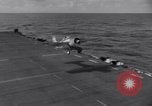
U.S.Navy airplanes crash landing on USS Makassar Strait (CVE-91) during training cruise off Hawaii, in 1944.
Scenes of three Navy Grumman wildcat (F4F) airplanes crash landing on the USS Makassar Strait (CVE-91) during a training cruise off Hawaii, in 1944. One lands long and hot and falls off the end of the flight deck, into the water. Another catches left wing on edge of flight deck. And, still, another noses over and its turning propeller chews up the flight deck. ( A following airplane breaks off its approach at this time.)
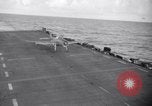
Navy Grumman F4F airplanes in landing incidents on the USS Makassar Strait (CVE-91) during training cruise.
A Navy Grumman F4F makes an inadvertent "touch and go" landing, at sea. It lands long, bounces, and successfully takes off again without further incident, on the USS Makassar Strait (CVE-91) during training cruise off Hawaii, in November, 1944. Two other aircraft make hard landings.
CRITICALPAST.COM: About Us | Contact Us | FAQs - How to Order | License Agreement | My Account | My Lightboxes | Shopping Cart | Advanced Search | Featured Collections | Website Terms & Conditions | Privacy Policy ©2026 CriticalPast LLC.
License Agreement |
Terms & Conditions |
Privacy Policy
©2026 CriticalPast LLC.