


 Francais
 Deutsch
 Italiano
Refine Your Search
Long Binh Vietnam 1968 stock footage and images
- Showing 2569 to 2574 of 5711 results more
more Hide
Hide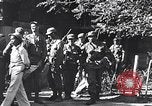
U.S. Rangers and Filipino guerrillas rescue Allied prisoners from Japanese prison camp in Philippines during World War II.
On January 30, 1945, 121 members of the 6th Ranger Battalion and 286 Filipino guerrillas are seen setting out on a 30 mile trek behind Japanese lines, to free Allied prisoners of war (POWs) and civilians from a Japanese camp near Cabanatuan City, in the Philippines, during World War 2. They stretch out in a long, informal column as they traverse low flat lands and ford a wide shallow river. The men carry weapons and supplies (some on their heads) as they move along, almost like a Safari. Scene shifts to rescued prisoner, Major Emil P. Reed, U.s. Army Medical Corps,26th Cavalry. He was the senior officer among prisoners at the Cabanatuan prison camp number 1. He recounts being told by the Japanese Commandant that commencing January 7th, they were free at their own risk, but also assured them they would not be molested by the Japanese if they stayed within their regular camp area. Sergeant Samuel E. Goldy, Signal Corps, also speaks a few words about that period when Japanese were departing. Next the camera records the Rangers and Filipino guerillas returning with the approximately 500 freed POWs. Some Filipino women and children watch them return. At one point, the cadre climb aboard army trucks and continue their journey in a convoy. The POWs climb down from their trucks at the 92nd Evacuation Hospital, in Guimba, Luzon. Some take pleasure is simply lying down on the grass at the site. Many gather around hospital staff handing out packages of treats, including cigarettes, candy and the like. A couple of them express pleasure as they smoke cigarettes. Two frail and injured are seen hobbling with canes. Some appear seriously malnourished. A group are seen trying on new clothes. A British prisoner, Sergeant Robert Bell, Manchester Regiment, British Army, speaks of his experience. He was taken prisoner in Singapore and sent to Thailand where he worked to build a railway for the Japanese. Many prisoners died there from disease and malnutrition. He was one of a small number who survived after being on a Japanese ship with other prisoners when it was sunk by American dive bombers. Sergeant Walter Ring, of San Roque, Luzon, is seated, relaxed on a chair, as he recounts his experiences. Two young Filipino boys sit on the grass at his feet. He reaches to one, whom he says is his son Louis and to the other, his son Sam. His captivity began on Bataan in 1942. Finally, after rest and rehabilitation, the former POWs are seen heading away from the battle fronts to be transported back to the U.S.A.
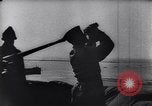
German forces engage American aircraft over skies of Germany during World War 2
German soldier looks through binoculars at American aircraft flying overhead in Germany, during World War II. German Army soldiers receive call about incoming aircraft from within their underground bunker and run, quickly mobilizing out from their bunkers to man their artillery guns. German anti-aircraft long range artillery guns firing at planes of U.S. Army Air Force. Nazi Luftwaffe fighter planes take off and attack United States B-24 and B-17 bombers. Large number off incoming U.S. aircraft in formation. Aerial gun camera views of dogfights between German aircraft and U.S. Bomber aircraft from view of German aircraft, including close-range air combat. United States B-24 is shot by Germans, suffers explosions in mid-air and crashes to the ground.
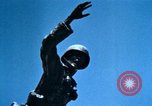
United States Army soldiers being trained at various training centers in United States
Statue of U.S. Army infantryman (called "Follow Me.") is seen at opening of film. Closeups of some trainees crawling under barbed wire as trainers observe them. Others are seen running and jumping obstacles. Trainees on a firing range training with rifles and M60 machine guns. Glimpse of soldier placing a large round into a mortal tube. Soldier firing an M40 106mm recoilless rifle. Infantry advancing across a field. An M48 Patton tank maneuvering. An M109 155mm self-propelled Howitzer. An M113 tracked Armored Personnel Carrier (APC) moving in wooded area. View of Infantry Hall at the U.S. Army Infantry School in Fort Benning, Georgia. The statue of an infantryman, called "Follow Me," stands in front of the building. Infantry training in a rugged area. They wear elements of natural camouflage. A 175mm M107 Self Propelled Gun. Scene changes to U.S. Army Armor Center Headquarters, also at Fort Benning. Tanks are seen maneuvering and raising dust in a lightly wooded area. An M60 tank maneuvering and firing its gun. A 175mm M107 Self Propelled Long Tom gun firing. A Pershing missile slowly being raised toward firing position. Gun crew firing an 8-inch howitzer at zero elevation. Shell exploding in distance. Views of elaborate radar antenna system and of Army technicians monitoring instruments and printers in a control center. Green Berets at the the John F. Kennedy Center for Special Warfare at Fort Bragg, North Carolina. They tend to a wounded Special Forces soldier in a primitive shelter. Others are seen reading instructions as they sit in foliage. Some maneuver aboard rubber rafts in a river. Two Green Berets set a demolition charge on a rail line. Soldiers engage in unarmed combat practice. Others train surviving off the land. An instructor lectures an audience of officers and men in an outdoor setting. Soldiers in a parachute shop with parachutes of various colors opened for inspection. Lines of parked Army trucks. Jeeps and trucks undergoing routine inspection and maintenance Doctors and nurses tending sick and wounded soldiers.
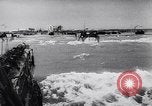
Canadian and U.S. Army troops disembark from landing crafts and move ashore in France during D-Day Invasion
View from Canadian landing craft as Canadian troops of the North Shore Regiment (3rd Canadian Division) land at the Nan sector of Juno beach on D-Day. View on the beach shortly after the landing. Scene shifts to American troops disembarking from a landing craft LST elsewhere at Normandy on D-Day. U.S. Soldiers move ashore in a long line through the water to reach the shore as an explosion occurs in the background. (World War II period).
Italian troops occupy Samos Island in Greece during World War 2
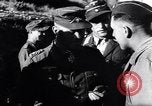
German General Friedrich-Wilhelm Müller visits with Italian troops of the 6th Infantry Division CUNEO, after they occupy the Greek Island of Samos, without any resistance, in May 1941. He and his staff members drink local wine with the Italians. Italian soldiers eating bananas at the port, and picking oranges from a local tree. Remainder of film shows 8 thousand surrended defenders taken as prisoners of war, marching in a long line. Next, they are seen crammed on the deck of a Greek ship and then, later debarking. They march in loose formation.

Sound recording procedure at Symphony Hall in Boston, Massachusetts, for the creation of a phonograph record.
A young woman opens ribbon and unwraps a gift package containing a vinyl RCA long playing record album disc of Romeo and Juliet. View she places the vinyl record on her phonograph turntable and starts playback. A film titled ' The sound and the story' shows the sound recording procedure at the Symphony Hall in Boston, Massachusetts. View of woman studying cover jacket of her new record album. Exterior view of Symphony Hall building in Boston Massachusetts in the mid 1950s. Interior view of the Boston Symphony Orchestra, circa 1956, in rehearsal under the baton of Music Director Charles Munch. The orchestra plays as a sound engineer of RCA (Radio Corporation of America) sits at a control panel. Close up view of meters on the recording console. Music being played is recorded on magnetic tapes. Close up view of reel to reel recording tape running on recording machine. Views of Maestro Munch, and various sections of the orchestra while they play under conductor Munch. Stereophonic or stereo recording equipment configuration is shown. View of two early home stereo speakers. After the recording, Maestro Munch, smoking a cigarette, sits with the recording engineer and listens to the recording. Close up view of a manufactured RCA vinyl record spinning on a phonograph turntable.
CRITICALPAST.COM: About Us | Contact Us | FAQs - How to Order | License Agreement | My Account | My Lightboxes | Shopping Cart | Advanced Search | Featured Collections | Website Terms & Conditions | Privacy Policy ©2026 CriticalPast LLC.
License Agreement |
Terms & Conditions |
Privacy Policy
©2026 CriticalPast LLC.