


 Francais
 Deutsch
 Italiano
Refine Your Search
Long Binh Vietnam 1968 stock footage and images
- Showing 3013 to 3018 of 5712 results more
more Hide
Hide
Japanese delegation meets with members of General MacArthur's staff to plan formal Japanese Surrender ending World War II
Japanese officials arrive to coordinate arrangements for a formal Japanese surrender, at a Conference in Manila, Philippine Islands. Headed by Lt. Gen. Torashiro Kawabe, Vice-Chief of the Army General Staff, the sixteen-member Japanese delegation descends steps from U.S. Army Air Forces C-54 transport Aircraft, tail number 44-9045, at Nichols Field, near Manila. General Kawabe salutes American Colonel Mashbir, coordinator of the Allied translator and interrogator Section. Major General Charles Willoughby, Director of Intelligence, leads them to waiting cars. Meeting in the City Hall in Manila, the Japanese officers surrender their personal swords and present documents delegating them powers Plenipotentiary by the Japanese Government. They file into a conference room, where they and American counterparts take their places across a long, black table. U.S. Army Lieutenant General Richard Kerens Sutherland, General MacArthur's Chief of Staff, presides over the discussions, accompanied by Major General S. J. Chamberlin, General MacArthur's Operations Officer. They are supported by Allied translators and interpreters. The conference is concluded successfully and sets the stage for the final formal surrender of Japan. (Note: Plans for this critical conference were developed by Colonel David Larr, Chief of Planning on General Chamberlin's staff.) The clip concludes with views of many U.S. warships and of cargoes being loaded in readiness for the occupation of Japan.
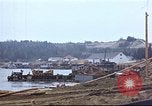
Soldiers roll steel pipes onto a barge and construction vehicles ferried across a river for the Canol Project in Canada.
The Canol construction project in Canada during World War II. Construction vehicles ferried across a river. African American soldiers of the 388th General Services Regiment relax aboard a ferry. Workers roll steel pipes onto a barge along the river. They lift heavy long pipes. Equipment on ferries. The workers roll the pipes on two parallel pipes on the ground. Piles of pipes in the background.
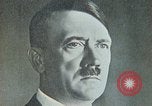
FBI catches Operation Pastorius criminals and hands evidence of their sabotage plots to the United States Military.
A picture of German leader Adolf Hitler. Footage of Pearl Harbor attack by Japan during World War 2. A reenactment shows landing of Operation Pastorius would-be saboteurs in Long Island, New York and presence of the FBI at the site collecting evidence the Germans had buried. Evidence of their plots to bomb various sites in the United States is collected by the FBI and presented to the United States Military. Views of some of their captured equipment and uniforms. Faces of the Operation Pastorius captured criminals (who included George John Dasch, Ernst Peter Burger, Herbert Haupt, Heinrich Heinck, Eddie Kerling, Herman Otto Neubauer, Richard Quirin, Werner Thiel) during their military tribunal hearing in July - August 1942.
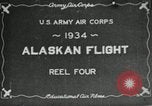
U.S. Army Air Corps airplanes and crews preparing for Alaskan Flight in 1934
Slate lists planned flight legs of U.S. Army Air Corps aircraft as: Washington DC to Edmonton, Alberta; Fairbanks Alaska to Seattle Washington; and Washington DC to San Diego California. Another slate explains that under command of Lieutenant Colonel H.H. Arnold,ten B-12 bombers demonstrate their capabilities in an 18,000 mile flight. Lt. Col Henry H. Arnold, U.S. Army Air Corps, stands in front of a large map on which planned flights are charted. Sign behind him identifies "Engineering Office," at Patterson Field. Arnold uses pointer to show the routings to another officer who has joined him. The next sequence shows Arnold describing the flight plans to more participants, using more charts. Camera pans across ten assembled Army personnel. Lt. Col. Arnold poses with 15 aviators in front of a YB-12 bomber (displaying air intake on port side of engine). Camera pans over eighteen mechanics and ground crewmen posed in front of the bomber. Symbol of eagle superimposed over map of alaska, is painted on side of forward fuselage. Arnold discussing the mission with Army officers and civilian officials, as they walk past a YB-10 (with air intakes atop the cowlings). Camera pans across Patterson field ramp, where officials, automobiles, YB-10 aircraft, and local civilian workers, including several women, are seen. Crew chief seen refueling a YB-10 with long hose from an underground fuel tank installed at edge of the ramp.
The Army Air Corps Alaska Flight support ship, "El Aquario," at Seward; Expedition train goes from Seward to Fairbanks.
View of Midnight Sun from bow of the U.S. Army Air Corps Alaska Flight support ship, El Aquario, underway in Alaskan waters. Mountains are seen as she proceeds through Resurrection Bay, towards Seward, Alaska. Views of the harbor at Seward, where several ships are seen. The El Aquario, seen at the dock in seward. The camera pans the pier, which contains rails for cargo handling. Another ship is docked behind the El Aquario. Slopes in background are covered in evergreen trees. Railroad station and warehouses are seen. View from atop a railroad train, shows rail lines, bridge, buildings, a ship in the harbor, and mountain in background. Captain George Goddard, supply officer for the expedition, stands with another officer and points to chalk writing on an Alaska Railroad caboose car reading: "Capt. Goddard return back on." He and the other officer are then seen on rear platform of that car on a railroad train. Goddard lights a cigarette. View from that caboose platform as the train pulls out of the Seward train station. View from atop the caboose showing the last six cars, containing expedition supplies, preceded by other cars making up a long train. Views of snowy landscapes beside the tracks as the train proceeds. Picture of the Fairbanks railroad station as the train arrives.
The U.S. Army Air Corps processes photo-mapping films covering 21,000 square miles, brought back by the 1934 Alaska Flight
Followup to the U.S. Army Air Corps 1934 Alaska Flight. The U.S. Army Air Corps Photographic department processes and assembles the 60 rolls of film shot by the USAAC 1934 Alaska Flight during its aerial photo-mapping mission over 21 thousand square miles of Alaska territory. Photographic workers mount film onto large rolls and place them into developing solutions. Long strips of film are seen drying on rotating slatted drums.Oblique negatives placed in rectifying printer are transformed into vertical photographs. Workers develop the negatives. Developed single wing photographs. Composite five lens photographs ready for mapping.
CRITICALPAST.COM: About Us | Contact Us | FAQs - How to Order | License Agreement | My Account | My Lightboxes | Shopping Cart | Advanced Search | Featured Collections | Website Terms & Conditions | Privacy Policy ©2026 CriticalPast LLC.
License Agreement |
Terms & Conditions |
Privacy Policy
©2026 CriticalPast LLC.