


 Francais
 Deutsch
 Italiano
Refine Your Search
Long Binh Vietnam 1968 stock footage and images
- Showing 3109 to 3114 of 5713 results more
more Hide
Hide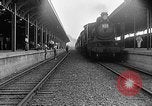
Tainan, Formosa (Taiwan) under Japanese colonial administration.
Views of Tainan, Taiwan under Japanese colonial administration. Steam locomotive pulling train, glides into railroad station in Tainan, Taiwan. People on platform near another track, step down and cross it to board from trackside, as others board from proper platform. Next is shown the front of the train station, in old town square. Palm trees grow in grass area. Pedestrians, a few vehicles, and a man pulling a cart are seen. Scene shifts to wide street with multistory buildings having shops on the ground floor. A woman pushes a baby in a carriage. A man pulls a wagon piled high with some kind of commercial product. Scene shifts to the Japanese Tainan shrine. Next a scenic park and lake are seen with a family dressed as Japanese, walking on the lawn. Another park-like scene shows a couple in Japanese attire, with their child, accompanied by two other similarly dressed women. Closeup of Taiwanese pottery items. A stone sculpture of a horse. View of the the Taiwan Confucius Temple aka the Scholarly Temple. Ruins of old Dutch Fort Zeelandia in Anping, Tainan, with ancient gun barrels layed out on porch floor. A tree is growing through the stone floor. Several sampans are seen being skillfully rowed in the water by boatmen in conical straw hats. Closeups of wooden boat sterns decorated with paintings. Children running along the waterfront past docked sampans. Views of memorial stones in the Anping cemetery. Workers skiming salt from evaporation ponds and placing containers of salt on small open rail cars. Closeup of containers that workers use to transport salt. Closups of rock salt. Views from moving railroad train moving across landscape. View from rear of speeding train, showing long straight track behind.
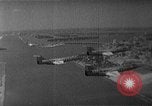
U.S. Air Force Tactical Air Command prepares in the United States during the Cuban Missile Crisis of October 1962.
Events held in the United States during the Cuban Missile Crisis of October, 1962 when the United States and the Soviet Union confronted each other with nuclear destruction. USAF (United States Air Force) F-100 Super Sabre jet fighters in flight. A sign reads 'NAS KEY WEST'. A USAF F-104 Starfighter supersonic interceptor aircraft makes a landing. USAF F-105 Thunderchief supersonic fighter-bombers are armed by airmen at an airfield. Aerial view of a base in Florida showing USAF airplanes in place. Aerial view of air evacuation equipment at a field. Surface to air missiles are readied at a beach. A radar in operation. Barbed wire obstacles are set up along a beach by U.S. troops. A USAF RB-66 Destroyer reconnaissance aircraft takes off from an airstrip. U.S. Marines reach U.S. Navy Guantanamo Bay Naval Base in Cuba. Americans are evacuated from Guantanamo as a precautionary measure. View of a long touchdown run in a college football game between Northwestern and Ohio State teams.
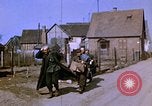
Liberated French prisoners, German prisoners and U.S. tanks in Germany during World War II.
U.S. tanks move up a road in Germany during World War II. Four German prisoners walk. Liberated French prisoners cheer as U.S. troops arrive on tanks. A U.S. tank moves up. A medic attends to a wounded German soldier. Long lines of German prisoners marching along a road and sidewalks. White flags hang from buildings. U.S. tanks move along a narrow street.

Indians take part in canoe race at the Lummi Indian Reservation near Bellingham, Washington.
Native American Indian representatives from the Northwest coastal tribes of Washington and British Columbia gather at the Lummi Indian Reservation near Bellingham, Washington for water canoe races. Indians arrive at the Lummi Indian Reservation to participate in the canoe race. Indians rowing a long canoe holding roughly 12 people (more like a crew racing shell).
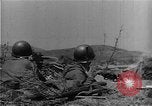
Information about unidentified airplanes is transmitted in the United States.
A public television program by the U.S. Army entitled 'The Big Picture.' U.S. troops are seen hunkered down and looking through binoculars in a defensive position in Korea, during the Korean War. American soldiers riding atop a Sherman tank on a city street in Germany, during World War II. Ski troops moving across snowy hill in Alaska. U.S. Army amphibious assault training on a beach in Puerto Rico. Army Master Sergeant Stuart Queen, narrator, speaks about America's defense against threat of atomic attack in these times of lukewarm peace. View of mountainous region in Alaska. A cluster of Cup'it Eskimo dwellings is seen on Nunivak Island, in the Bering Sea. Several of the local inhabitants are fishing through holes cut in the ice. Vapor trails are seen from Soviet aircraft flying at high altitude. A sign on a tarpaulin displaying logo of the Army Signal Corps, reads,"Alaska Communication System, Long Distance Commercial Telephone-Telegraph." A tracked vehicle carries a soldier to a facility posting a sign reading, "Alaska Communications System Receiver Station." Several tall antennas loom above the site. The soldier, dressed in arctic gear, steps from the tracked vehicle and walks past several snow shoes, standing upright in the snow, to enter a white wooden building. Inside, a man in civilian clothes works at a battery of telecomunications equipment. He transmits a message about the aircraft sighting, to the Alaska Communication System facility in Fairbanks Alaska (briefly shown) by means of a telegraph key. From there it is relayed to a Signal Corps facility, shown, in Washington, DC. A soldier is seen Inside that facility, in a room filled with computers and telecommunications equipment. A Sergeant handles paper tape messages being sent and received by teletype. Another soldier plugs connections into a communications switchboard. Next, the camera pans over the entrance to the Office of the Secretary of Defense, in the Pentagon. More views of soldiers attending banks of teletype machines. Animated map displays paths of orders being transmitted to U.S. Air Defense Centers in San Francisco, Chicago, Seattle, New York, and Atlanta. View from control room, of several U.S. Air Force F-94 Fighter Interceptor aircraft on an airfield ramp. A controller activates a Klaxon horn and pilots on alert, in the Fighter Interceptor Squadron ready room, jump up and scramble to their aircraft. A pair of F-94s taking off. One is number 51-5385. Next, a U.S. Navy F-9 fighter plane is seen taking off from an airfield. It displays tail code AE. It is followed by another F-9 aircraft.
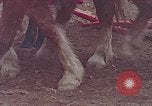
Examples of middle-class United States American lifestyle in early 1970s.
Shows early 1970s era construction activities, economic growth, retail shopping, and American fashions and goods of the 1970s. As a contrast to the modern way of life, a farmer is seen using teams of horses to plow his land. Views of middle-class suburban living in the U.S.A. New, modern houses and cars in the suburbs. Construction workers building new homes. Modern farm machinery being employed. Panels being placed on a new car in a factory production line or assembly line. A long freight train moving goods. U.S. consumer retail stores selling a variety of products, and pedestrians in 1970s fashions shopping on town and city streets for various goods including ice cream, lawn mowers and hardware, custom framing, fast food (McDonalds restaurant shown), an "organic food" cafe or store, barbecue grills, outdoor lounge chairs, and antiques, among others. Shipping containers being loaded on a ship for export abroad. Various construction sites ranging from those for suburban neighborhood homes to those for high rise buildings. Construction of the Dunhill Condominiums in progress in Atlanta Georgia. A 1970 Ford Falcon car in a neighborhood of new homes in the suburbs. Sink and bath tub fixtures in a typical kitchen and bathroom. Families at a high school graduation. African American students on a college campus. White students walking on campus of a college or university. Families shopping for high price goods: View of a hand starting a phonograph record player, a man examining a Ford Pinto car in a new car show room, views of home appliances, washers, dryers, stoves, ovens, televisions for sale in a show room, and window air conditioner units. Private pleasure boats operating near a large ferry boat. More views of carpenters and other construction workers and building tradesmen working at construction sites. People at work compiling statistics in the U.S. Bureau of the Census.
CRITICALPAST.COM: About Us | Contact Us | FAQs - How to Order | License Agreement | My Account | My Lightboxes | Shopping Cart | Advanced Search | Featured Collections | Website Terms & Conditions | Privacy Policy ©2026 CriticalPast LLC.
License Agreement |
Terms & Conditions |
Privacy Policy
©2026 CriticalPast LLC.