


 Francais
 Deutsch
 Italiano
Refine Your Search
Long Binh Vietnam 1968 stock footage and images
- Showing 3169 to 3174 of 5713 results more
more Hide
Hide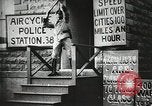
A dramatization depicts: civilians point at the sky and look through binoculars at an aerial contraption in the United States.
Paper print. Early motion picture from turn of 20th century depicting fictional early flight. Humorous Dramatization. Policeman at Aircycle Police station scans sky through spy glass or telescope. Sign reads: "Aircycle Police Station number 38." Another sign reads: "Speed limit over cities 100 miles per hour." Air contraptions being built by two men. Sailors on a ship beat a large fish on deck. Citizens and policemen running and pointing skyward and looking through telescopes. In the air, a man appears riding a bicycle airplane. A man and woman prepare to board a balloon airship. A man flies by flapping large wings like an ornithopter. A man walking on the sidewalk is disturbed by rush of air from the balloon airship. Photographers rush to an observer to photograph the sights.The observer-reporter has a very very long nose.
A horse race gambler searches for his angry wife and asks her forgiveness for his gambling
Paper print. An early motion picture titled 'Sporting Blood' depicts a fight between a wealthy husband and wife because of a race horse in the United States. A man reads sports news from a newspaper. His wife comes and sits with him at a table. A maid serves them tea. A telegram boy comes and hands a telegram to the man. It contains a tip on a horse race. The man tells his wife he must leave on important business. His wife reads the telegraph. The maid opens a door. Wife's friend enters. The women arm themselves with kitchen implements and leave the house. Two men talk on a street. A man with his horse preparing for a harness racing event. Men purchase tickets and place bets at a harness racing bid counter with signs, "Wilson & Shepp." They watch horses and jockeys in a harness race. The man arrives home. The maid complains to the man about his wife. The man leaves his home and arrives at a court. He reports about his lost wife. The wife sits near a street fountain. Other women in long dresses and fancy hats (typical of wealthy of the gilded age) come and they talk to her. The husband asks a shopkeeper and other men about his lost wife. All the gamblers wives join together in protest. Their husbands follow them. The husband asks his wife to forgive him. He takes her to a stable and shows her the horse named Sweet Marie. Other husbands do likewise with their angry spouses. Lubin Manufacturing Co. logo seen at end.
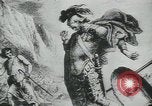
Sketches and pictures depict development of military fire power from slings to breach loading weapons
Development of U.S. Army fire power in the United States. Engraving “David and Goliath” by William Holl the Younger, emphasizing the sling as an extended weapon. Sketches of other examples, such as catapult, where a sling is employed as weapon. Sketch of sword and shield used in combat. A man aims with a crossbow. Another uses an English long bow. Drawings of progression of developments in artillery, from the earliest days. Illustrations of small arms developments. A man loads and fires a gun. Sketches of Continental Army using artillery during Revolutionary war, in America. Sketches of French soldiers using artillery in Napoleon's army. Drawings of weapons being used in the American Civil War. Soldiers load and fire cannons on a battlefield. A breach loading weapon. Photograph of Civil War era Union gun crew with field artillery piece. A mobile field gun with 25 small bore barrels. Colt 1883 Gatling Gun. Sketches of U.S. artillery being used in Spanish-American War.
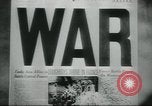
New U.S. infantrymen learn to fire rifles, make trenches and advance on a battlefield, in preparation for going to war in France
Training of U.S. Army infantrymen in the United States. A newspaper headline reads ' infantrymen arrive in France'. The infantrymen are taught to advance on a battlefield. Recruits in New York's Rainbow Division are seen marching in the mud, at Camp Mills, Long Island, They undergo physical training at the camp. They learn to fire rifles and dig trenches. They inhabit a tent city at the camp. Scenes of Rainbow Division soldiers on a chow line at Camp Mills. After basic training, the soldiers board ships and trains for France. Loved ones give them a sendoff. Upon arrival in France, they are given a warm welcome.They resume training in France, until they are ordered to the Front. Scenes of U.S. infantry in trenches wearing gas masks and firing rifles. Tanks advancing across the trenches. View of the 7th Regiment World War I memorial statue in Central Park, New York City.
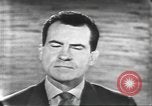
Nixon and Kennedy comment on the Cold War and Communist prestige during a presidential election debate in Washington DC.
The second Kennedy-Nixon Presidential Debate in Washington DC, United States. Edward P. Morgan of ABC News asks Republican candidate U.S. Vice President Richard M. Nixon to comment on whether the United States was doing well in the Cold War. Nixon states that they were not doing as well as they should have in the Cold War because of the presence of the Communists on the international scene. He says that the Communist prestige in the world is lower than the American prestige. He comments on cost cuttings on programs like mutual security and defense by the Democratic Congresses. Democratic candidate Senator John F Kennedy disagrees with Nixon's statement that the Congress has not provided funds for national defense. He also disagrees on the question of U.S. position in the United Nations. He mentions that various reports of Congressional committees indicate that the relative strength of the U.S. compared to that of the Soviet Union and the Chinese Communists together has deteriorated in the past years. Alvin Spivak of United Press International asks Kennedy how the losing prestige can be regained, and programs accomplished without damaging economy. Kennedy talks about the breaking off of the sugar quota with Cuba, passing of an authorization, and the development of the Inter-American Bank. He states that the U.S. has looked at the needs of Latin America. He states that instead of concentrating aid on surplus military equipment in Laos, the aid should have been concentrated in long-term loans. He concludes that Americans should identify themselves not only with the anti-Communist fight but also with the fight against poverty and hunger. Nixon presents his views and states that along with the necessity for economic assistance, the need for technical assistance should also be developed. Americans should not only think in terms of fighting Communism but also in terms of the interests of these countries. He concludes and mentions American ideals of independence, right of freedom and right of progress.
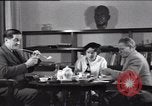
Ernst Hanfstaengl shows a sculpture of German Chancellor Adolf Hitler to a man and woman in Berlin.
Ernst Hanfstaengl (known as "Putzi"; an early friend of Adolf Hitler) sitting in an apartment in Berlin, Germany, smoking a long tobacco pipe as he shares lunch and conversation with Wolf-Heinrich Graf von Helldorf and a woman (possibly Ingeborg von Wedel Helldorf?). He shows them a sculpture of German Chancellor Adolf Hitler by German sculptor Josef Thorak, whom he says the couple will meet later that morning. Close-up view of the bust of Hitler. Hanfstaengl plays the piano for the couple, introducing the song as one he wrote called "The Heart of Song." Behind him, on a book shelf, is a bust of Paul von Hindenburg and a photograph of Adolf Hitler.
CRITICALPAST.COM: About Us | Contact Us | FAQs - How to Order | License Agreement | My Account | My Lightboxes | Shopping Cart | Advanced Search | Featured Collections | Website Terms & Conditions | Privacy Policy ©2026 CriticalPast LLC.
License Agreement |
Terms & Conditions |
Privacy Policy
©2026 CriticalPast LLC.