


 Francais
 Deutsch
 Italiano
Refine Your Search
Long Binh Vietnam 1968 stock footage and images
- Showing 3229 to 3234 of 5713 results more
more Hide
Hide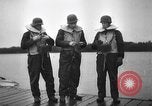
Demonstration of radio controlled German explosive boats. Views of German Hai human torpedo in the water.
Three German soldiers with explosive laden remote controlled motor boats. One man shows radio controls used to guide the boats from one control boat. The boatmen embark, one man aboard the pilot boat and the other two on explosive boats. Boats underway in water. German soldier aims the boat at target and jumps into water. A man works on radio controls as he guides the boat to the target. Scenes of a German "Hai" human torpedo. The 40 foot long Torpedo, with operator in bubble cockpit, is lowered into river by a crane and motors away. (World War II period).
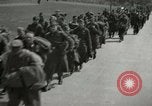
German soldiers in the American-occupied side of the Elbe River, at Tangermunde, Germany, following the surrender of Germany in World War II
A long line of German soldiers happily make their way along a road in Germany on the American-occupied side of the Elbe River, at Tangermunde, Germany after the German surrender in World War 2. A German soldier, wearing only underclothes and dog tags, emerges from swimming across the Elbe River just as an American Field Grade officer is escorting some German officers along the river bank. The American motions for the swimmer to join them. Next, the swimmer is he is seen with another successful swimmer, being escorted by American soldiers.
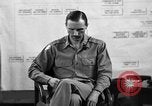
Major Tisdell describes ill treatment of prisoners at Japanese camps during the trial of General Homma in Manila, Phillipines.
U.S. Army Major Achille C. Tisdell testifies before a military tribunal in Manila, Phillipines during the trial of Japanese Army General Masaharu Homma for World War II crimes. Major Tisdell, aide-de-camp to Commanding General of the American forces in Luzon Major General Edward King is asked about how long he was at Camp O'Donnell. He says that he was there from April 13, 1942 to June 1, 1942. He recalls that at the camp the commanding officer of the prison camp addressed them. Major Tisdell being questioned about the Red Cross supplies. He says that once Red Cross food and medical supplies arrived at the camp gates but were not permitted to enter. He also speaks about the number of times he was questioned at the camp and that he was offered an opportunity to move to Manila and work for the Japanese. He says that a number of times the prisoners were beaten for no reason by the Japanese guards.
Phoenixes and pier heads in the English Channel during the Allied invasion of Normandy, France in World War II.
A film titled 'Seabees in Normandy' about the role of U.S. Navy Seabees in construction of artificial harbors in the English Channel during the Allied invasion of Normandy in World War II. Aerial view of several Phoenix units or artificial harbors along the English Channel off the British coast. A pier head in water. Whales joined together to form a 80 feet long bridge. A pier head at the end of a bridge.
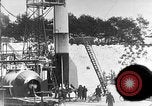
Snow-covered test range, and A4 missile test firing in Peenemunde, Germany.
Snow covers launch pad area at German rocket development center in Peenemunde Germany. Engineers, crew, and guards in long winter coats seen near A4 missile (v-2 rocket). A4 missile lift off emitting a fiery flare. A gauge shows a reading. The missile in flight as it emits fire. A 2nd launch is shown of a different rocket (shown already in mid ascent). Gauge in lower right of image measures rocket progress. (World War II period).
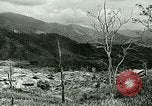
General MacArthur leads U.S. forces to a victory in the Philippines (WW2)
World War II events leading up to the independence of the Philippines. Filipino guerrillas march and line up as they prepare to fight against Japanese soldiers. A Filipino guerrilla of European descent and Chinese Filipino guerrilla are seen. U.S. officers seated in a camp. A newspaper headline reads 'MacArthur invades Philippines'. U.S. Army General Douglas MacArthur and other officers land at Leyte in the Philippines. Filipino guerrillas receive rifles. U.S. and Filipino soldiers fire artillery and tanks roll across a field. A tank named “Luzon Liberator”. U.S. forces march through a city in the Philippines. General MacArthur gets off a car. A sign reads 'Victory Festival'. Filipino civilians cheer for American soldiers. Decorated floats at a parade to mark the end of Japanese occupation. Signs read ‘Mabuhay America & Filipinas’, 'Long live Philippines', ‘Mabuhay President Truman’ and 'Thanks Uncle Sam'.
CRITICALPAST.COM: About Us | Contact Us | FAQs - How to Order | License Agreement | My Account | My Lightboxes | Shopping Cart | Advanced Search | Featured Collections | Website Terms & Conditions | Privacy Policy ©2026 CriticalPast LLC.
License Agreement |
Terms & Conditions |
Privacy Policy
©2026 CriticalPast LLC.