


 Francais
 Deutsch
 Italiano
Refine Your Search
Long Binh Vietnam 1969 stock footage and images
- Showing 757 to 762 of 5707 results more
more Hide
Hide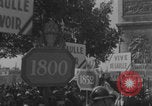
General Charles de Gaulle lay a wreath in front of the Arc de Triomphe (WW2)
General Charles de Gaulle lays a wreath at the Tomb of the Unknown Warrior at the Arc de Triomphe (Paris, France) during World War 2, following the liberation of Paris. Various signs read “1800”, “1793”, “Vive De Gaulle” (“Long live De Gaulle”), “De Gaulle Au Pouvoir” (“De Gaulle in power”), “Vive Les Alliés” (“Long live the Allies”) and “1944” are displayed in front of the Arc de Triomphe (Place Charles de Gaulle, 75008 Paris, France). A man climbs a lamppost to watch a parade. Boy sitting on tree branch watch the man climb a lamppost. Nurses and medics carry with flags of Allied nations (United States, France, United Kingdom). Arrival of General Jacques Philippe Leclerc, holding a walking cane. Leclerc shake hands with an Allied military figure. Charles de Gaulle arrives in Arc de Triomphe with a wreath. General de Gaulle salutes and lays a wreath in front of the Tomb of the Unknown Soldier. Soldiers and journalists surrounding General de Gaulle take photographs using cameras. General de Gaulle walks with Generals Jacques Philippe Leclerc and Marie-Pierre Koenig, and other French officials.
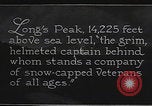
Car driving on the roads of the Rocky Mountain National Park in late 1920s
Park roads in the Rocky Mountain National Park (Rocky Mountain National Park 1000 Highway 36 Estes Park, CO 80517-8397) in Colorado, United States. A car driving on a scenic mountain road to Long’s Peak. Snow-capped Long’s Peak, 14,225 feet above sea level, is seen in the background. Buildings stand near the road. Men riding horses in the backdrop of the Rocky Mountains. National Park Service uses a ditch digger during road construction. Coniferous trees grow in the Rocky Mountains. Rocky mountainside and a lake. View of the Rocky Mountains. Tourists cross a wooden bridge over a small waterfall in the Rocky Mountain National Park.
Chinese parade with flags in Beijing, China; signs urge U.S. to leave Taiwan.
Seal of the Central Intelligence Agency (CIA). Communist People's Republic of China during the "Great Leap Forward." Beijing skyline and its surrounding suburbs. Crowds carrying banners and marching during a rehearsal for the People’s Republic of China’s National Day. Chinese young men carrying banners translate to, "Taiwan must be liberated" and "United States must get out of Taiwan." A young Chinese woman smiles while holding a red banner. Buses, bicycles, horse drawn carts, and cars pass through Tiananmen Square, Beijing’s “Red Square”. The western and eastern walls have giant placards that read "Long Live the People's Republic of China" and "Long Live the Great Unity of the World's Peoples". A man pushes a cart full of bricks. A man slides bricks down a wooden chute at a construction site where a sewer is being built. A construction site building a sewer.
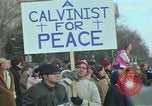
A moratorium march in Washington D.C. to protest against American involvement in the Vietnam War.
A moratorium march in Washington D.C., United States by pacifists and peace demonstrators against the Vietnam War. A banner reads 'A Calvinist for peace'. People march in Washington D.C. as they protest against American involvement in the Vietnam War and demand the end of the war. People outside the White House. People on the top of an ambulance. The Washington Memorial in the background. People in lawns with the Lincoln Memorial in the background. Anti war demonstrators gather to protest against the war. Among famous performers seen are: folk singers Pete Seeger, and Peter, Paul and Mary. Coretta Scott King (widow of Dr. Martin Luther King, Jr.) addresses the gathering. An artist being presented a memento. Activists address the gathering.
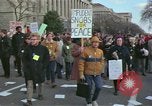
Scenes from moratorium march in Washington D.C., protesting U.S. involvement in the Vietnam War.
A moratorium march in Washington D.C by pacifists and anti-war demonstrators against the Vietnam War. A banner reads 'Impudent snobs for peace'. Demonstrators carrying American flags and wearing badges march at the rally to protest against United States involvement in the Vietnam War. One protestor carries North Vietnamese flag of National Front for the Liberation of the South. One person carries a flag with a dove on it. A banner reads 'Stop the trials'. Some protestors have hippie hair styles and clothing. A banner reads: "Bring all the troops home Now!" Many views of people on Constitution Avenue, between the Washington Monument and the Ellipse.
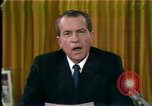
U.S. President Richard Nixon addresses nation about steps to end the war in Vietnam. He asks support of the "silent majority"
Stand of U.S. President Richard Nixon on Vietnam War. President Nixon addresses the nation about the Vietnam War from White House. He details how United States got involved in the war. He talks of protests and demonstrations of anti war activists and wants an everlasting solution to the problem. He reminds of Woodrow Wilson's efforts to end wars and peace. Nixon tells the youth of America about their demonstrations: "I respect your idealism. I share your concern for peace. I want peace as much as you do." He speaks to the "great silent majority" of Americans (contrasted with the youth demonstrators) and asks for their support in fighting "the forces of totalitarianism" and in supporting his plans for fighting and ending the war. He asks that Americans be united for peace and united against defeat. In the final part of this speech segment, President Nixon invokes the term "silent majority."
CRITICALPAST.COM: About Us | Contact Us | FAQs - How to Order | License Agreement | My Account | My Lightboxes | Shopping Cart | Advanced Search | Featured Collections | Website Terms & Conditions | Privacy Policy ©2026 CriticalPast LLC.
License Agreement |
Terms & Conditions |
Privacy Policy
©2026 CriticalPast LLC.