


 Francais
 Deutsch
 Italiano
Refine Your Search
Long Binh Vietnam 1969 stock footage and images
- Showing 2791 to 2796 of 5714 results more
more Hide
Hide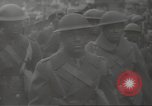
African American soldiers of U.S. Army and WACs (Women's Army Corps) parade in Astoria, New York during World War II.
Segregated African American soldiers of U.S. Army parade along a street in Astoria, New York, and in parade fields of training grounds during World War II. Very large columns of African American troops marching in formation and passing commanding officers in review. Long columns of African American soldiers and WACs (Women's Army Corps) parade.
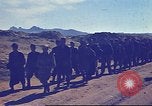
A column of German and Italian prisoners is led by U.S. 1st Division across a sandy terrain in Africa during World War II.
A long line of German prisoners are led by soldiers of U.S. 1st Division across a sandy terrain in Africa during World War II. An air strike on a hilly terrain shows aircraft overhead, bomb explosions and flak bursts. The prisoners march across the open terrain. U.S. soldiers near a half track. German and Italian prisoners are led by U.S. soldiers.
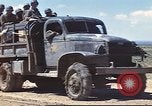
U.S. 1st Division soldiers loaded on jeeps and half tracks pass along a road in Africa during World War II.
U.S. 1st Division soldiers in Africa during the North African Campaign of World War II. U.S. troops aboard a 2 ½ ton truck pulling a 37mm antitank gun along a road. Another truck with water cooled MG (machine gun mounted) and troops move past. A jeep and a T28E1 anti aircraft half track with a trailer follow the truck. Italian prisoners are marched under guard. A long line of prisoners marches across a hilly terrain. U.S. jeeps, 3/4 ton Dodge command cars and a 75mm M3 GMC (Gun Motor Carriage) anti tank half track loaded with troops pass along a road.
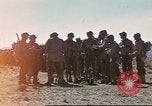
German and Italian prisoners march under the guard of U.S. 1st Division soldiers in Africa during World War II.
U.S. 1st Division soldiers in Africa during the North African Campaign of World War II. German and Italian prisoners are rounded up on a hilly terrain by U.S. troops. One prisoner holds a puppy. A long line of prisoners marches under the guard of U.S. soldiers. Many prisoners wear fezzes.

Assortment of unrelated scenes from post-World War 1 period, containing mostly U.S. Navy officers.
A Rear Admiral steps from a doorway, resplendent in special full dress uniform, complete with cocked hat and special embroidered rank insignia on his sleeve. The uniform appears to be European (not American). The scene is repeated in a second take. A French aviator, in leather jacket, walks in front of an early French bi-wing headless pusher airplane parked in an open hangar. (Unlike a Curtiss headless pusher aircraft, this one does not have tricycle landing gear.) He bends to greet a little girl who walks to meet him with a woman, the girl's mother. The three pose for the camera. Next scene shows U.S. Navy Vice Admiral Richard H. Jackson (Commander Battleship Divisions Battle Fleet, 1925-1926). He steps from a building followed by Naval officers. Jackson converses with a young Navy Captain, as others relax behind them. . Closeup of Admiral Jackson and the Captain. The group moves away. Next, a fairly young U.S. Navy Rear Admiral (unidentified) is seen in front of a long, wide, set of granite steps, shaking hands with a Navy Petty officer. They engage in conversation and then the Petty Officer leaves, followed by the Admiral. Next, is seen the entrance to a building numbered 22, that has U.S. Navy signs in its windows. A U.S. Navy Rear Admiral (unidentified) exits the building, accompanied by a Commander and a Lieutenant Commander. The weather is cold enough to show visible moisture from their breath. The three share entertaining conversation, including smiles and laughs.

Everyday life and diversity of Polynesian people in Hawaii before the attack on Pearl Harbor during World War II.
Various Polynesian people and everyday life in Hawaiian Islands before American involvement in World War 2 and the attack on Pearl Harbor. Women from dominant ethnic backgrounds in Hawaii introduce themselves, including women from Korea, Portugal / Portuguese, China, Phillipines / Filipino, Native Hawaiian, Caucasian / Anglo, Japanese. Narrator describes it as a melting pot. Polynesian children on a long staircase in a village. Group of Hawaiian school children walking to school with some girls wearing Japanese style clog sandals. Diverse crowd of citizens walking on sidewalks of a downtown area of Honolulu near stores and shops. Hawaiian police officer directs traffic. 1930's cars seen on streets. Children in scout uniforms including Girl Scout and Boy Scouts salute. Groups of Hawaiian children playing and relaxing, and seen at desks in school classroom. Graduation ceremony at a high school in Hawaii as graduate young men and women walk by on a stage. Colorful traditions and customs of various cultures in Hawaii are shown. People wearing leis. Women doing various dances including hula and other dancing styles. The Aloha Tower in Honolulu Harbor and scenes of various women from different backgrounds each saying Aloha.
CRITICALPAST.COM: About Us | Contact Us | FAQs - How to Order | License Agreement | My Account | My Lightboxes | Shopping Cart | Advanced Search | Featured Collections | Website Terms & Conditions | Privacy Policy ©2026 CriticalPast LLC.
License Agreement |
Terms & Conditions |
Privacy Policy
©2026 CriticalPast LLC.