


 Francais
 Deutsch
 Italiano
Refine Your Search
Long Binh Vietnam 1969 stock footage and images
- Showing 2851 to 2856 of 5714 results more
more Hide
Hide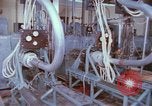
Boeing technicians operate control panels, check graph and install current generator into turbo fan engine of USAF B-52 in the U.S.
Progress report of United States Air Force B-52G and B-52H in the United States. View of long loop cables in a laboratory. Gauges in the background. A Boeing technician turns the switches on panel board and checks a running graph. A Boeing technician installs an alternating current generator into turbo fan engine. Aerial views of the USAF B-52G aircraft in flight.
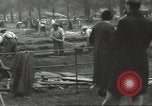
Group of workers dig trenches in Hyde Park, London England while onlookers watch.
Group of workers dig trenches in Hyde Park, London England. Onlookers watch from the fenced area. A woman carries her pet dog while observing the workers. A man distributes supplies to the workers. Men carrying long beams. Civilians walking in Hyde Park (Hyde Park, London W2 2EU, United Kingdom).
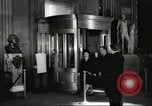
Tourists look at statues in the National Statuary Hall Collection in the United States Capitol building in Washington DC.
Tourists visit the National Statuary Hall Collection in the United States Capitol building in Washington DC. Tourists enter the landmark building. Man collects tickets at the entrance. Statues of Senator Robert M La Follette, Hey Long, W J Bryant. Tourists look at row of statues. Guide educates tourists with a painting on the wall in the background. Sculpted face of Abraham Lincoln.

United States Marines attend Army Airborne School (AKA Jump School) at Fort Benning, Georgia.
United States Marine Corps Recon unit personnel undergoing training at the United States Army Airborne School (AKA Jump School), Fort Benning, Georgia. The course is three weeks long and consists of three phases: "Ground Week", "Tower Week" and "Jump Week". Marines jumping from a low platform, learning how to safely fall, during phase one. Marines climbing a ower, during phase two, and sliding along a cable, while suspended from parachute risers. Next, they are seen in controlled parachute descents from a tall tower. A closeup of one hitting the ground. Marines seated with full parachute gear, in an airplane during the third (Jump week) phase of their training. They stand and move toware the jump door, with their chutes hooked to a static line. View from below, of open parachutes descending. Marine receiving his parachute wings, upon graduation from Jump School.
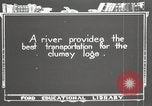
Wooden logs are floated down a river to reach a mill in the United States.
The lumber industry in forest areas of the United States. Transportation of wooden logs is done through rivers. A group of workers in a boat. The logs come down with the force of water. Workers remove blocked logs at various points using long poles. The wooden logs reach a mill where they are sorted. The logs roll into water from flatcars.

Film that takes viewer to "dinner at the Statler" Hotel in Detroit, Michigan.
Film taken at the new Statler Hotel in Detroit, Michigan (opened in 1915). The Statler Hotel main dining room Ala Carte menu is shown. A waiter in tuxedo takes orders from wealthy patrons. Glimpse of clams served on half shells. Closeup of a woman in fur coat eating soup. Waiter presenting a poultry entree. The woman eating a large portion. Side dishes of vegetables seen on the table. A different waiter (in white tie) taking order for the next course. Closeup of the woman eating a parfait with a long spoon. Dessert cookies seen in a dish on the table. The table of four all eating parfait, and one woman taking a cookie. One of the men passes the plate of cookies. Wider view of the dining room with many persons being served dinner by formally dressed waiters. The frame rate increases showing much activity quickly in the dining room.
CRITICALPAST.COM: About Us | Contact Us | FAQs - How to Order | License Agreement | My Account | My Lightboxes | Shopping Cart | Advanced Search | Featured Collections | Website Terms & Conditions | Privacy Policy ©2026 CriticalPast LLC.
License Agreement |
Terms & Conditions |
Privacy Policy
©2026 CriticalPast LLC.