


 Francais
 Deutsch
 Italiano
Refine Your Search
Long Binh Vietnam 1969 stock footage and images
- Showing 2995 to 3000 of 5714 results more
more Hide
Hide
Man exchanges guitar for basket of fruits in the barter system after inauguration of Franklin D Roosevelt in Washington DC.
Great Depression footage after the inauguration of Franklin D Roosevelt as the President of the U.S. in Washington D.C. in 1933. During a bank holiday two day after the inauguration of Franklin D Roosevelt as the President of the US, vehicles move on the streets. Long lines of civilians move on the streets. Man makes a genuine hand made "depression dollar." which is made out of rubber. He demonstrates how it can grow for inflation by stretching. He displays the dollar designed for inflation. Other man stretches the dollar. Man approaches a merchant. He exchanges his guitar for basket of fruits under the barter system which was common in the depression. Footage is from a 1958 newsreel recounting events 25 years earlier.
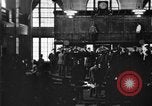
Bidders bid for cotton at the Liverpool Futures Market in New York.
Cotton bidding at Liverpool Futures Market in New York. The interior of the building. Bidders gathered in a large open area. Men behind a long desk along the side. Men on a floor in the building bid for cotton. A man stands on the balcony in the floor above. Rates written on a board in the background.

A man secures stabilizer to ring tail,covers with drag ring,adjusts valve before the release of torpedo in United States.
New techniques in aerial torpedo attack, United States. An aircraft in flight over a sea. The aircraft releases torpedo in water. Torpedo moves. Men haul trolley loaded with the torpedo. The shroud ring or ring tail is in conjunction with the drag ring on nose of the torpedo. Using ring tail and drag ring with wooden stabilizer results in successful test drops. A man secures the stabilizer to ring tail with wooden dowels. The man covers the torpedo with a drag ring which helps to stabilize the torpedo during air travel, and seals the ring. The man adjusts the water trip delay valve which prevents the torpedo from burning up during long travels. Depth setting is done. (World War II period).

A man explains graphical presentation of the proper speed and altitude combination for torpedo release in United States.
New techniques in aerial torpedo attack, United States. A man explains the graphical presentation of the proper speed and altitude combination for torpedo release. An aircraft in flight releases torpedo in water. The torpedo moves in water. The torpedo launching guide. In double entry type graph, the combination of 2 coordinates gives the third coordinate. Dropping speed and dropping altitude data is entered in the chart. It gives the entrance angle. The man explains the concept of point of release to the point of hitting target using the graph. The cross wind effect on torpedo drop is explained. Time column on graph gives time of fall of torpedo. Release of torpedo with proper range is necessary. Radar ranging requires teamwork between the pilot and the radio man. Demerits of long and short range is explained. (World War II period).
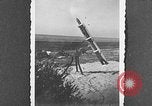
Rocket testing by German rocket pioneer, Reinhold Tilling, at the lake lake Dümmersee in Germany
Still pictures of early German rockets on tripod launchers. A number of small rockets laying on the ground partially covered with a tarpaulin. Several men on a hillside with a rocket launcher pointed horizontally. Fleeting glimpse of the work shop of German rocket pioneer, Reinhold Tilling, followed by views of several men holding a Tilling postal rocket nose down with its wings folded. They are standing in tall marsh grass near lake Dümmersee. Next, Reinhold Tilling is seen with his assistant, Angela Buddenboehmer, and his mechanic Friedrich Kuhr, making adjustments to a rocket, with its wings open. Men carry the rocket with its wings folded and place it on a tall pole. Next, the rocket launches straight into the air. Men maneuver in a sailboat and other boats in the Dümmersee, preparing to retrieve a Tilling rocket. Closeup of the men in the sailboat. Several men in a long boat near marsh grass where a Tilling rocket has landed.
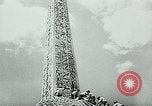
French workers remove sandbags from Luxor Obelisk and remove defenses following German capture of Paris (WW2)
German newsreel shows activities of French workers in Paris, France following capture and occupation of the city by Nazi German forces in World War II. French workers and soldiers lined up on a ladder and removing sandbag defensive protections from the Luxor Obelisk (Pl. de la Concorde, 75008 Paris, France) at the Place de la Concorde. Buildings in the background. Workers pull nails from boards as they disassemble defensive positions and gun emplacements. Long line of saddened workers and French soldiers pass buckets slowly in a bucket brigade. Eiffel Tower in the background.
CRITICALPAST.COM: About Us | Contact Us | FAQs - How to Order | License Agreement | My Account | My Lightboxes | Shopping Cart | Advanced Search | Featured Collections | Website Terms & Conditions | Privacy Policy ©2026 CriticalPast LLC.
License Agreement |
Terms & Conditions |
Privacy Policy
©2026 CriticalPast LLC.