


 Francais
 Deutsch
 Italiano
Refine Your Search
Long Binh Vietnam 1969 stock footage and images
- Showing 3037 to 3042 of 5714 results more
more Hide
Hide
A train moving on the Union Pacific Railroad depicts the First Transcontinental Railroad Line of the U.S. started in 1869.
A train moving on the Union Pacific Railroad in the United States. A herd of cattle advances across the Americn plain. Close up view of Long Horn cattle. A train pulled by a black steam locomotive moving on the Union Pacific Railroad depicts the First Transcontinental Railroad Line of the United States opened for through traffic on May 10, 1869. The locomotive engine of the train as it emits black smoke. Mountain and western United States landscape views. A windmill in operation. Distribution of water and farmlands in the Western United States. A herd of cattle crossing a river.
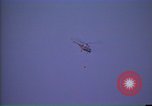
A California firefighting helicopter delivers fire suppression foam on forest fire in 1987.
California State Department of Forestry firefighting helicopter is seen flying overhead and dispersing a long trail of foam from a suspended bucket, over a fire on the ground. View from the air of burned forest with smoke rising and isolated flames.

Firefighters enter final phase of battle against fire in Stanislaus National Forest, California, 1987
A supervisory firefighter briefs teams about people not seeing flames and not feeling threatened, so they may be getting tired of seeing firefighters all the time. He describes this as approaching the "5th stage" of rescue which he defines as "shoot the rescuer." The assembled firefighters chuckle about this. A long line of firefighters walks along a dirt road and enter the Stanislaus National Forest. Smoke blows from the entrance.

Athletes walk about in the gardens of the "Olympic village," during Games of the XX Olympiad, in Munich, Germany
The 1972 Summer Olympic games (XX Olympiad) in Munich, Germany. Men and women athletes, in civilian clothes, stroll about and relax in the garden walkways of the "Olympic village." A woman, with long hair, sits in the garden. An olympic official strolls amongst the athletes.
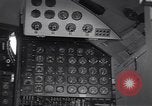
Views of USAF C-74 aircraft. Instrument panel, cockpit, maintenance access, takeoff, landing, flying on only two engines
A U.S. Air Force C-74 Globemaster cargo aircraft at Wright Field in Dayton, Ohio. Flight engineer's Instrument panel in the C-74 aircraft with view of cockpit to the left, with double bubble windows. Loran set screen seen to left of the cockpit, at Navigators station. Exterior view. "Beetle" double cockpit windows clearly visible. Crewmen examine nose wheel. Interior of cockpit, with main flight control wheel and, to its left, at knee position of pilot, the nose wheel steering wheel can be seen. Flight engineer opens hatch in floor of cargo compartment and crawls through superstructure of aircraft to perform maintance. C-74 takes off, retracting landing gear as it climbs out. Several views of C-74 in flight, including one accompanied by another aircraft, and one in which it is operating on only two engines, with engines number 3 and 4 shutdown and feathered. C-74, descending for landing, with landing gear extended. It touches down quite long on the runway and appears to employ reverse thrust on its engines during ground roll.
Mission and operations of the U.S. Army Service Forces during World War II
Film opens with an explosion at Pearl Harbor, Hawaii, December 7, 1941, during the Japanese attack in World War 2. The USS Arizona sinking. Newspaper headline reading "U.S. Declares War." Relief map globe of the world. Narrator speaks about accomplishments of the U.S. Army Service Forces since the Pearl Harbor attack. Glimpse of two M4 DV early Sherman tanks moving on a road. The famous Uncle Sam recruiting poster. Huge number of massed U.S. Army troops marching toward the camera lined 16 abreast. Army supply service personnel inspecting providers of all manner of supplies needed to feed, clothe, and equip the U.S. Army. Brief views of supply operations underway involving food and fuels. An Army truck and a P-38 lightning airplane (under wraps) being loaded aboard a ship. A warehouse stacked from floor to ceiling with military supplies. Forklifts moving in the aisles. Group of officers sitting around a table. Some wear shoulder patch of Army Service Forces on their uniforms. The processing of millions of volunteers and draftees for military service. Men in recruitment office being guided by staff. Lines of new recruits undergoing physical exams and then arriving in civilian clothes, with their baggage, at a training center. Barracks being constructed at a training camp or base in the United States. Camera pans across a large completed military camp. Soldiers forming up in front of barracks. Sign reads "Dispensary, Recruit Reception Center." Recruits lined up and receiving vaccinations against tropical and other diseases according to the regions to which they are being sent. An Army Sergeant assessing recruit qualifications for various military assignments. New recruits eating in a camp dining hall and also in a chow line at an outdoor field mess. Views of industrial workers picking up tools and assembling military equipment in war plants. A coal burning electric generating plant with 8 smoke stacks. A furnace with hot steel visible. An Army agent and an industrialist or business man signing contract documents. Glimpses of women war production workers placing items on a conveyer; guns being assembled by men in an armory; railroad train carrying freight across rugged U.S. territory; ocean-going ships ready for loading; cargo stacked up at ports; numerous 55 gallon drums ready for loading; rope slings of cargo being loaded for shipment; numerous army trucks ready for shipment to Allies, under "Lend Lease;" a nurse checking medical supplies for shipment; Many U.S. Army M3 tanks ready for shipment. Views of British forces engaged in the North African campaign, before the U.S. entry in World War 2. U.S. soldiers marching along a Camp road past a sign reading: "Headquarters, 725th Railway Operating Battalion" (Located in New Orleans). Rapid glimpses of various supplies, equipment, etc. being loaded for shipment abroad. Women war production workers in plants. Men in outdoor yards filling long lines of jerry cans. Close up views of clock hands moving, and gears of clock working. U.S. Army soldiers shooting automatic weapons (including tracer rounds) at a firing range.
CRITICALPAST.COM: About Us | Contact Us | FAQs - How to Order | License Agreement | My Account | My Lightboxes | Shopping Cart | Advanced Search | Featured Collections | Website Terms & Conditions | Privacy Policy ©2026 CriticalPast LLC.
License Agreement |
Terms & Conditions |
Privacy Policy
©2026 CriticalPast LLC.