


 Francais
 Deutsch
 Italiano
Refine Your Search
Long Binh Vietnam 1969 stock footage and images
- Showing 3055 to 3060 of 5714 results more
more Hide
Hide
A WB-50D aircraft of the 59th Weather Reconnaissance Flight takes off from Kindley AFB, Bermuda
A U.S. Air force WB-50D Weather Service aircraft, tail number 50-4040, assigned to the 59th Weather Reconnaissance Flight (Hurricane Hunters) begins a takeoff roll and goes a long distance on the runway, but is never seen actually breaking ground. Navigator steps up into bubble canopy with a sextant. View from behind the copilot in cockpit of a WB-50D, as it takes off from Kindley Air Force Base, Bermuda. View of pilot in the left seat, at the controls. View of the copilot. in the right seat.
USAF WB-50s of the 59th Weather Reconnaissance Flight take off from Kindley AFB, Bermuda
A WB-50D Weather aircraft from the USAF 59th Reconnaissance Flight (Hurricane Hunters) is silhouetted against a gray sky as it takes off from Kindley Air Force Base, Bermuda. at sundown. Another one, tail number 50-4040, takes off. Both aircraft use long takeoff runs and slow rates of climb after breaking ground.

The SPARS complete a five months radio course to be radio operators during their training in Atlantic City, New Jersey.
The United States Coast Guard Women's Reserve (SPARS) working in the Atlantic City, New Jersey. Long lines of women seated in chairs inside a building during radio training. They complete a five months radio course to be radio operators during World War 2, freeing more men for duty on the war front. Women marching outside Coast Guard buildings. A board on a building reads: 'US Coast Guard Training Station'. The women receive radio operator certificates, awarded by Commander Dorothy Stratton during a ceremony. Women SPARS in Coast Guard uniforms smiling after receiving their certificates.
Post World War II reclamation of U.S. Army artillery at factory in the U.S.
U.S. factory workers repair and recondition used artillery left over from World War 2. Several heavy and small guns being repaired. A 90 mm anti aircraft gun, a 155 mm gun (Long Tom) and other guns being repaired.
A U.S. soldier and an Asian man jokingly demonstrate elements of close order drill during World War I
A U.S. soldier of the American Expeditionary Forces jokes around, with an Asian civilian, for the camera. The soldier pretends to teach the other man elements of close order drill. The civilian performs facing movements. The soldier adjusts the man's hat to a jaunty tilt, after which the man salutes and marches toward the camera. Several soldiers and civilians are walking on street in background. A long.wall lines the street. (World War I; World War 1; WWI; WW1)
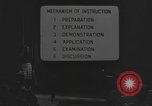
Correct mechanism and methods of instruction are explained to soldiers in the United States.
Training methodology for U.S. soldiers in the United States. An instructor instructs soldiers seated in a class room. He speaks about the correct methodology of teaching. A chart on a board reads 'Mechanism of instruction'. There are six steps in the mechanism of instruction. They are 'Preparation, Explanation, Demonstration, Application, Examination and Discussion'. The methods of instructions are also explained. These things should be considered while instructing 'The Lecture, the Conference, the Demonstration, the Group Performance Method and the Coach and Pupil method'. The lecture should be brief and interesting. Training films, slides, maps, models and other devices should be used. An instructor instructing a class. He takes a long lecture. The soldiers sleep in the class. (World War II period).
CRITICALPAST.COM: About Us | Contact Us | FAQs - How to Order | License Agreement | My Account | My Lightboxes | Shopping Cart | Advanced Search | Featured Collections | Website Terms & Conditions | Privacy Policy ©2026 CriticalPast LLC.
License Agreement |
Terms & Conditions |
Privacy Policy
©2026 CriticalPast LLC.