


 Francais
 Deutsch
 Italiano

Refine Your Search
Long Binh Vietnam 1969 stock footage and images
- Showing 3127 to 3132 of 5714 results more
 Hide
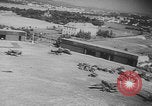
German military use of airport in Bromberg, Poland as a base during World War 2
Long shot aerial view from a low-flying airplane shows airport in Bromberg (Bydgoszcz), Poland. View of many German Air Force planes, as well as various outbuildings. Narrator describes that after the German invasion of Poland during World War II, the Germans took over the airfield to use for their own military aircraft and operations. Bomb craters on ground from German bombing on September 1st, 1939. View from inside a hangar looking outward on destroyed aircraft debris. More shots of debris on the airfield. Several Polish aircraft are shown in various states of ruin. German soldier approaches a Polish biplane with gun damage to the skin of the fuselage.

Prisoners of war in German camps receive supplies and a prisoner reports good treatment
World War II German propaganda clip shows prisoners of war in a German prison camp in German-occupied Poland receiving food and supplies. View from upper story window shows long lines of captive soldiers on the street below who stand waiting to receive provisions. The captives appear to be from the Polish and British militaries. German soldiers hand out the supplies, and the POW troops thank the German men as they receive goods. A well-groomed officer of the British Royal Air Force (RAF) stands in front of a microphone and addresses the camera, reporting that he and his fellow soldiers have received good treatment at the camps. He says that they have "good quarters, adequate food, and no complaints." The airman smiles as he turns to step away from the microphone.

U.S. Army pre-World War II bayonet training film on the parry right move.
Narrator discusses the logistics of the parry right move with the fixed bayonet, over slow motion front view footage of the move without an opponent. Move is then demonstrated and discussed with an opponent soldier. Finally, the full sequence (parry, long thrust, withdrawal, guard position) is shown in slow motion and at full speed.

U.S. Army pre-World War II training film on the main bayonet attack sequence.
Slow motion demonstration of the main bayonet attack sequence. Guard position, long thrust attack, withdrawal, short thrust attack, withdrawal, jab attack, back to guard position. Narrator says the names of each movement of the sequence as the soldier demonstrating reaches them.
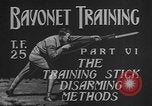
U.S. Army bayonet training film on the use of the training stick in bayonet practice.
Pre World War 2: U.S. Army description and demonstration of the use of the training stick in bayonet practice. The training stick is a long stick with a loop at the base end and padding at the far end. Footage of two soldiers practicing and switching roles by throwing the training stick and bayonet to one another, then practicing again. They practice on a large field, with suspended straw dummies behind them. Further in the distance, more soldiers can be seen walking in a line.
U.S. Army pre-World War II training film on how to disarm an opponent attacking with an underhand knife attack.
1930s U.S. Army training film describes how to disarm an opponent attacking with an underhand knife attack. Closeups of training knife and late 1930s U.S. Army uniforms. Two soldiers practicing the move slowly and at full speed, before practicing both disarming moves at will, switching roles with each disarm. Narrator advises attacking in pairs of two over footage of soldiers practicing a two against one scenario. Large group of soldiers practicing with bayonets by performing long thrusts and withdrawals on suspended straw dummies. Narrator advises that soldiers should practice bayonet skills on straw dummies each day while training.
CRITICALPAST.COM: About Us | Contact Us | FAQs - How to Order | License Agreement | My Account | My Lightboxes | Shopping Cart | Advanced Search | Featured Collections | Website Terms & Conditions | Privacy Policy ©2026 CriticalPast LLC.
License Agreement |
Terms & Conditions |
Privacy Policy
©2026 CriticalPast LLC.