


 Francais
 Deutsch
 Italiano
Refine Your Search
M4-training stock footage and images
- Showing 6685 to 6690 of 8218 results more
more Hide
Hide
United States Army in War practice at Fort Benning in Georgia.
A large number of Pre-World War II tanks moving across field in Fort Benning in Georgia. Several explosions in the field, two soldiers can be seen in foxhole. U.S. Army M2 Light Tanks enter enemy sector during a war practice at Fort Benning, tanks moving across field into and out of a gully, through woods, knocking down several small trees. Soldiers move across pontoon bridge on river to other side of river. A group of soldiers fire 75mm field artillery pieces set up in trees beside the road. Tracer bullets traveling across field and crews operate machine guns during night time.
First flight of the Douglas XB-19, at Clover Field, Santa Monica, California
Huge single 8-foot diameter tire on the XB-19 bomber is seen rolling over airfield ramp at the Douglas aircraft company Clover Field in Santa Monica, California. Douglas engineers walk along beside the B-19 aircraft as it is being towed. U.S. Army Air Forces test pilot, Major Stanley M. Umstead, stands with a Douglas Aircraft Company executive, in front of the XB-19 wheel. A mechanic is seen on an engine nacelle, looking down over the propeller.The XB-19 is towed into position. View of the empennage, with rudder slightly turned. The airfield is crowded with Douglas company employees out to watch the aircraft's first flight. Baggage being loaded on the aircraft. Engines start and the XB-19 taxis and takes off and does not raise its landing gear. The XB-19 in flight,with landing gear still extended, seen from a chase airplane. It departs the coastline. View from beneath the XB-19 as it cruises, at low speed. The XB-19 coming in for a landing at March field, Riverside, California. The pilot rounds out high and porpoises a bit until touching down on main wheels, and slowly lowering the plane onto its nose wheel. The XB-19 rolls out on the runway showing full flaps. A crowd has turned out to watch the aircraft's arrival.Newsmen and photographers gather as the crew stand on the ramp. Major Umstead, with cigar in his mouth, is interviewed.
Decoration ceremony for U.S. Army Air Forces 9th Air Force fighter pilots in France during World War II.
Decoration ceremony conducted by Lieutenant General Brereton, Commander of U.S. Army Air Forces 9th Air Force, at advance airfield, Criqueville (A-2) France, during World War 2. Nine pilots of the 354th Fighter Group are lined up at attention in a field. A photographer clicks pictures. Two officers stand beside a table on which medals are kept. Captain Beerbower marches towards Lt Gen Brereton. The Lt Gen decorates him. Lt Gen Brereton decorates a major, a captain and a lieutenant, shaking hands with them. The company stands at attention. The honored men stand back in a line. General Brereton is seen, later, conversing with Captain Beerbower (wearing Silver Star). Among those decorated in this ceremony were: Capt. Don M. Beerbower (Silver Star); Capt. Wallace N. Emmer, Distinguished Flying Cross (DFC) and Lieutenant Carl Bickel (DFC).
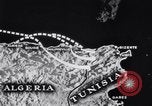
Allied Forces move successfully towards Tunisia but are forced to withdraw by severe German counterattacks during World War II.
Animated map shows Allied forces in three columns heading toward Tunis, from Algeria in World War 2. Another map shows German forces pouring into North Africa, from Italy. German troops disembarking from a troop ship. View of German Marshal Albert Kesselring, the Mediterranean Commander in Chief of the Axis powers, visiting German troops at the front. Skirmishes between Allied and German forces in Tunisia. German troops firing a heavy machine gun from a dug-in position. American soldier firing his rifle. British soldiers advancing across a field, under fire. Germans firing heavy machine gun. British soldier throwing a hand grenade. American M2 light tank advancing. Army truck carrying U.S. troops. British soldiers marching along a roadside. Sign identifying Béja Tunisia. British soldier with field radio. View of French military commander in Tunisia, General Barré, whose troops were holding Medjez-el-Bab) against German forces. Views of the French forces employing only machine guns and rifles to hold the German forces back at Medjez-el-Bab. General Kenneth Anderson, Commander of the British 1st Army is seen observing at the front with binoculars. (Narrator notes, he moved his troops to support the French, and the Germans withdrew.) Allied troops are seen continuing their advance toward Tunis, but suffer attack by German bombers. November 25th battle with Allied and German tanks engaging each other. Views of Allied armor firing and German shells striking. Explosions all over the battlefield. German tank burning. (Narrator says "15 enemy tanks destroyed, and the rest withdrew.") Animated map shows continuing Allied advance toward Tunis and Bizerte. Scenes from what was known as the "Run For Tunis." Milestone showing 64 kilometers to Bizerte. Roadsign showing 14 Km to Tindja, and 27 Km to Bizerte. A patrol of British troops, sheltered in ruins of a hilltop building, looks down over the city (presumably Tunis). Distant view of German Panzer IV tanks crossing open area. German forces begin heavy counterattacks with armor and heavy artillery. A squadron of German Ju 87, stuka dive bombers attacks making their familiar howling sounds. Bombs bursting on the ground. Glimpse of silhouetted German Heinkel He 111 bomber overhead and more attacking German aircraft dropping bombs. Fires raging everywhere among Allied forces locations. British soldiers assisting a wounded comrade. A burning downed British aircraft. Allied forces forced to retreat toward hills.
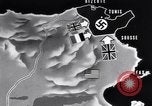
Allied Forces defeat Axis forces in Tunisia during World War II
The final battle of Tunisia, North Africa during World War 2. An animated map shows Allied Forces moving on all sides pressing forward against German forces still remaining in Northern Tunisia. in World War 2. Map outlines battles of Hill 609, Longstop Hill, Goubellat Plain, and Dejebel Mansour, and Takrouna. U.S. forces move 200 miles from the south to confront German forces in the north. Views of U.S. soldiers in trucks and M3 half-tracks, and towing heavy artillery with a tractor. Views of hills where Germans are positioned, west of Tunis and Bizerte. Allied guns firing. French forces sweeping for mines and digging some up with bayonets. French General Alphonse Juin confers with his staff as they review a large map laid out on a jeep. Brief view of French infantry in the field and gunners firing artillery. German Panzer IV tanks moving to counter British attacks. German tanks and artillery firing barrages against the British. Camera pans over destroyed German armor. British 78th Division attacks Longstop Hill. A long line of British infantry moving single file up a hillside. British soldiers firing Vickers machine guns from protected positions and infantry moving uphill, carrying small arms and Bren light machine guns. British troops scaling steep hills, using ropes, as shells burst close to them. One throws a hand grenade that explodes on the hilltop. After reaching the hilltop, the infantry scamper down the other side and continue moving forward, firing their weapons. Several dead German soldiers are seen as the British troops overrun the German positions. British engineers and pioneers working with caterpillar tractors and shovels to build roads. Later, trucks are seen using a new road. In the meantime U.S. troops are seen arriving to commence their assault on Hill 609. It begins with long range artillery firing from camouflaged positions and shells exploding all over on Hill 609. It continues into the night. View of soldiers in artillery headquarters, under a tent illuminated by lanterns. Long sequence of nighttime artillery fire. Medical Corps doctors treating wounded as the nighttime artillery barrages continue. U.S. infantry digging in after taking Hill 609. View of American soldiers walking up Hill 609. View of British Field Marshal Bernard Montgomery consulting with staff officers in the field. British 8th Army commander, Lieutenant General Sir Oliver William Hargreaves Leese, looking through binoculars as he stands with staff members at the front. Scene shifts to U.S. airmen arming machine guns on a parked P-38 fighter plane. Others roughly handling bombs to be placed into U.S. bombers. Bomber with nose art of devil riding a bomb and name "Hell a Poppin." Air crews arrive by jeeps at their B-25 Mitchell bombers and others arrive at their B-17 bombers. View of B-25 number 41-13202 named "Idaho Lassie" of the 321st BG, 445th BS, 12th Air Force. Engines running on bombers and on a British spitfire fighter plane. Formations of Allied aircraft, including B-24 liberator bombers, Martin B-26 Marauder bombers, British spitfire fighters, and B-17 Flying fortress bombers. British and American armor moving forward firing guns. French artillery firing and French infantry advancing. French machine gunners in white hats. U.S. B-24 Liberator aircraft dropping bombs. German fighter planes attacking allied bomber formations. Gunners in the bombers firing at them. Gun camera view of German fighter being shot down. More views of Allied aircraft bombing and strafing. Map shows American forces reaching Bizerte, the British capturing Tunis and German forces split and defeated.
U.S. campaigns against Japanese in Marshal Islands, New Britain, and Rabaul, in the Pacific during World War II
U.S. offensives against Japan in the Pacific Theater during World War 2. A United States Carrier Task Force in the Pacific Ocean. Fighter planes and dive bombers on the deck of the Task Force. Sailors push trolleys containing bombs. A map shows Marshall Islands. Douglas Dauntless dive bombers take off to strike against the enemy. U.S. Navy fighter planes engage defending Japanese aircraft and down many of them, as seen in gun camera footage. The first wave of Douglas Dauntless dive bombers returns to its carrier for refueling, rearming, and debriefing. Sailors on the aircraft carrier man anti-aircraft guns to defend against attacking Japanese aircraft. Black flak fills the sky and a number of Japanese aircraft are destroyed by the anti-aircraft fire. A Japanese bomb explodes near the flight deck of a carrier. (Narrator notes that 85 Japanese aircraft were destroyed in this one operation.)An animated map shows New Britain Island. U.S. Major General William Henry Rupertus, Commander of U.S. Marines on a ship. He looks through a pair of binoculars as a U.S. planes (B-24 Liberators) drop bombs on Rabaul. U.S. warships launch an attack at the enemy positions. Fire and explosions. The Marines load into landing craft and move towards the shore. They land behind an intense naval bombardment. Marines head ashore from beached LCI-1 Class Landing Craft Infantry (Large), number 343. M 16 tanks, equipment, and artillery roll ashore from Landing Ships Tank (LSTs). . The tanks lead the way through the jungle terrain and the marines advance behind them. Marines fire mortars as they advance. They flush out Japanese from trenches and bunkers. A damaged Japanese Mitsubishi fighter plane and wreckage of others. Some dead Japanese soldiers. The Marines wade through deep water as they push on to Rabaul. Others advance through deep mud. More views of them slogging through mud.
CRITICALPAST.COM: About Us | Contact Us | FAQs - How to Order | License Agreement | My Account | My Lightboxes | Shopping Cart | Advanced Search | Featured Collections | Website Terms & Conditions | Privacy Policy ©2026 CriticalPast LLC.
License Agreement |
Terms & Conditions |
Privacy Policy
©2026 CriticalPast LLC.