


 Francais
 Deutsch
 Italiano
Refine Your Search
M4-training stock footage and images
- Showing 697 to 702 of 8248 results more
more Hide
Hide
Army Air Force Republic P47 fighter aircraft strafes lines of communication and attacks an Me-109 during World War II
Gun camera footage from USAAF P-47 of the 378th Fighter Squadron, 362nd Fighter Group, operating from Verdun Airfield, France, during World War 2. The aircraft flown by pilot named Bullock, on March 31, 1945, strafes lines of communication, striking vehicles on roads and trains moving on rail lines. In second sequence, the same pilot, now identified on slate, with the 377th Fighter Squadron, on April 4th, attacks a lone German Me-109 seen flying in thin cloud below him.
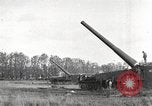
U.S. Naval Railroad guns in France during world War I
Two U.S. 14"/50 caliber Mk 4 naval guns mounted on railroad carriers, are seen in a field in France during World War 1. A glimpse of U.S. Army artillery officer inside the control room of one gun. Armed sentry outside the gun. Navy gunners standing on platform abutting the control room. View from further back along the train, as Navy gunner on the platform cranks a handle raising the gun's elevation. Different view of the gunner on the platform cranking the elevation handle, lowering the barrel to near zero elevation and then back up again. (WWI. WW1)
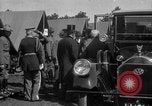
President Woodrow Wilson visits National Guard troops returned from Texas during Mexican Punitive Expedition
President Woodrow Wilson at the National Guard training grounds in Sea Girt New Jersey, to visit with troops returning from duty in Texas during the Mexican Border Campaign (aka Pancho Villa Expedition) of 1916. Brief glimpse of The President stepping from his 1916 Pierce Arrow 38-C Series 4 Brougham Limousine, parked next to a row of army tents. The car displays a unique American Eagle radiator cap ornament (and an AAA emblem on the radiator). He is surrounded by officers, who greet him. The next scene show the President and the unit's commanding Brigadier General, seated in rocking chairs in a tent. Wilson, in dress clothes, including top hat, mounts an army horse, and rides along with officers, to review the Guard troops drawn up in formation. He sits astride the horse, next to the General, and removes his hat in salute as the troops march in review.
Olympic skaters perform at Rockefeller Center ice rink in New York.
The U.S. Olympic Figure Skating Team show their skating skills at Rockefeller Center in Manhattan, New York City. Olympic pair skaters, Yvonne Sherman and Robert Swenning, of the New York Figure Skating Club, demonstrate a pair lift and side-by-side spirals. Spectators watch them performing. Richard Button of the Philadelphia Skating Club and Humane Society performs 2 axels, and a flying camel spin into a back sit spin, changing into a forward scratch spin. (These are shown in slow motion to better show his movements.) New Yorker Eileen Seigh performs 4 split jumps, 3 axels and a forward sit spin into a final scratch spin. (Note: Eileen and Dick trained with Gus Lussi in Lake Placid. The pairs team, Yvonne Sherman and Robert Swenning were pupils of Pierre Brunet, a former French National champion, who , with his wife Andree, were World pair champions ).
Officers receive commissions,being assigned service schools and prepared for final parade at the West Point in New York.
United States Military Academy at West Point in New York, United States.. View of the United States Military Academy (USMA). The cadets receive commissions. They are assigned to service schools. After 4 years of intensive education and military training the cadet is ready for the final parade. They march past on the field holding rifles. Trees in the background.
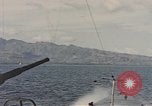
The submarine USS Bowfin engaged in surface gunnery practice off Guam in World War II
Near the end of World War 2, U.S. submarines were being refitted with extra guns and undertook more surface combat operations. Here, the USS Bowfin (SS-287) is seen in surface training activities off Guam, during May,1945. Its armament now includes (in addition to its original 4-inch/50 caliber deck gun) a Bofors 40mm aft of the conning tower and an Oerlikon 20mm cannon forward of it. As the Bowfin heads out, its deck gun is seen. Next, in a view from the conning tower fairwater, looking aft, the Bofors 40mm autocannon can be seen below. Scene shifts forward and then to side, where deck gun barrel is seen at extreme right of image. It fires at distant target boat. More views of targets being fired upon by autocannons and deck gun. Smoke rising from struck target. Sequence ends with the Bowfin firing a few rounds on its way back to Apra Harbor.
CRITICALPAST.COM: About Us | Contact Us | FAQs - How to Order | License Agreement | My Account | My Lightboxes | Shopping Cart | Advanced Search | Featured Collections | Website Terms & Conditions | Privacy Policy ©2026 CriticalPast LLC.
License Agreement |
Terms & Conditions |
Privacy Policy
©2026 CriticalPast LLC.