


 Francais
 Deutsch
 Italiano
Refine Your Search
M4-training stock footage and images
- Showing 7411 to 7416 of 8218 results more
more Hide
Hide
German forces plan and attack at Liege, Belgium in World War 2
Sand table animation shows plan of attack on Liege. Point of application for initial thrusts is Fort Eben Emael on border of Belgium and Netherlands. Map illustrates bombardment fron the air by the Luftwaffe (German Air Force). River Meuse and the Albert canal in the city. Bridge on the river. First line-the Ijssel position, second line-the Grebbe position, third line-the the Meuse position, fourth line- the Peel position. Fifth line-the Willem canal fortification and sixth line-the Albert canal fortification. Soldiers move in trucks on the street. German assault and shock troops use rubber boats with ladders to cross river Meuse under fire. Mechanized German infantry and bicycle contingents cross river Meuse over bridges not destroyed. Houses and buildings alongside the street. Soldiers fire guns in field. Smoke arises due to the firing. Soldiers at a boat in the waterway. Destruction of Werk 4 bunker fortification at Fort Eben-Emael. Wreckage from bombardment. Heavy smoke arises from firing and bombardment. Captured Dutch and Belgian Prisoner of War soldiers walk on the street under guard of German soldiers during German occupation. (World War II period).
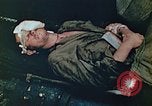
U.S. Marines treat wounded after amphibious assault on Saipan in World War II
U.S. marine with bandaged head wound lying on a stretcher in sand on Saipan after amphibious assault by infantry of 2nd and 4th Marine Divisions in World War 2. Medic administering blood plasma. Marines transferring dead to a landing craft.
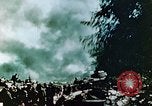
U.S. Marines establishing beachhead during amphibious assault on Saipan in World War II
U.S. Marines of the 2nd and 4th Marine Divisions on the beachhead during amphibious assault on Saipan, during World War 2. The beach is jammed with Marines and equipment. Smoke rising in background from bombardment by U.S. Navy warships.

Highlights of the Allied New Guinea campaign and other Pacific battles against the Japanese in World War II
The Allied campaign across New Guinea and onward to the Philippines during World War 2. U.S. warships firing their guns at night. Flashes illuminate the blackness. Bombs dropping from an aircraft bomb bay. Bombs exploding on stretch of jungle near water. A U.S. Army Air Forces B-26 bomber in flight View rearward from very low flying USAAF bomber as it bombs it drops explode behind. U.S. troops making amphibious assault on New Guinea. Map showing path of Allied attacks from Australia, across New Guinea from Port Moresby to Buna and on to the Admiralty Islands, cutting off Japanese-held Rabaul, New Britain. Map shows Allied forces moving towards Japanese strongholds at Wewak and along the North shore of New Guinea and bypassing Wewak to strike at Hollandia. General Douglas MacArthur is seen aboard a U.S. warship conferring with American and Philippine officers. Annimated map shows Allied assaults on Japanese positions along the coast from Hollandia, to Warde, Biak, and beyond, stepping along towards the Philippines. Views of numerous fallen Japanese soldiers numbering more than 150 thousand dead. Crosses in battlefield cemetery at graves of some of the more than 13 thousand Allied military who lost their lives during the campaign. A soldier paying respects at one of the gravesites. Admiral Chester Nimitz with members of his staff at his headquarters in Hawaii. U.S. Navy F4F aircraft launching from an American aircraft carrier. American aircraft bombing Japanese positions on an atoll. U.S. warships bombarding Japanese positions with their heavy guns. Admiral Nimitz standing with Admiral William Halsey. More Navy gunfire and amphibious assault scenes. Map showing places where Allied forces had to battle the Japanese, including, Tarawa in the Gilbert Islands, Kwajalein, in the Marshals, Saipan, and Guam in the Marianas, and Palau to complete the "bridging" of the Pacific to the doorstep of the Philippines.
U.S. Army Air Forces repair and re-fly a battle-damaged B-17 after an emergency forced landing in World War II
Film opens showing a large formation of U.S. Army Air Forces B-17 bombers flying high overhead as they return to bases in the United Kingdom, during World War 2. Closeup of one plane shows Triangle tail code of the 97th Bombardment Group, and tail number 42-23383. View looking past tail tunner turret towards numerous aircraft in a formation. Scene shifts to view from a B-17 of black flak clouds from German anti-aircraft guns. A B-17 in flight with flak damage to a wing, and another with a destroyed left tail stabilizer and elevator. Closeup of feathered right inboard engine on a B-17 in flight. More views from behind the formation, and looking straight up at passing B -17s overhead. View looking down at a B-17 approaching for landing. Closeup of both right engines feathered on a B-17 in flight. (Narrator states an aircraft named "Stella" had three engines inoperative and was unable to reach the field to land.) Army Air Forces controllers communicating by radio with crews of aircraft. View from ground of the B-17 ("Stella") coming in for a crash landing in an oat field, with landing gear not extended. Closeup from cockpit, of number 3 engine running and number4 feathered. View from inside the aircraft as it crash lands. View of it in the field. It displays tail number 42-5910 and a "G" tail code in a white triangle, identifying it as belonging to the 40th Bombardment Wing, 305th Bomb Group at RAF Grafton Underwood Trucks are seen carrying mechanics and technicians to the crash landing site. Next, the B-17 is seen surrounded by repair crews. It is sitting in a cleared area and its landing gear is intact. Closeup of the aircraft's flak torn fuselage. A severely damaged gun turret on the ground next to the aircraft. Section of cockpit sitting on the ground. Views of mechanics working in their portable shops as they make repairs to the B-17 aircraft. Machinist running a lathe in one of the portable shops.View from ground of the mechanics at work on the aircraft's engines, as engineers employ earth-moving equipment in the background to create a temporary runway to facilitate takeoff. Closeups of the earth-moving equipment at work. More closeups of mechanics working to restore the aircraft. Some work on an engine suspended from an A-Frame. Closeup of two mechanics, one of whom displays images of a Lockheed P-38 lightning fighter aircraft and a B-26 Marauder aircraft on his jacket. More views of eath-moving operations. Closeup of a mechanic being moved by crane as he guides a propeller into place on the B-17. Closeups of mechanics affixing propellers on the plane. View of engineers employing surveying instruments as they ready the emergency strip for the B-17's takeoff. Closeup of the aircraft ("Stella") surrounded by seated mechanics, as she is about ready to fly again. View from behind spectators, including local English people, as the aircraft engines start. The repaired B-17 taxis onto the improvised air strip, and raising lots of dust as she takes off. Glimpse of local people waving as the aircraft becomes airborne.
A man performs a test on a motor to determine the amount of carbon formed by oil in Indiana, United States.
A man determines the carbon forming tendency of oil in Indiana. This is done through actual tests on a motor. A man collects the carbon from the motor and weighs it. Test tubes on table contain different oils to determine which oil forms what amount of carbon. Test tubes of oil number 1, 2, 3 and 4 on the table and the amount of carbon formed by them.
CRITICALPAST.COM: About Us | Contact Us | FAQs - How to Order | License Agreement | My Account | My Lightboxes | Shopping Cart | Advanced Search | Featured Collections | Website Terms & Conditions | Privacy Policy ©2026 CriticalPast LLC.
License Agreement |
Terms & Conditions |
Privacy Policy
©2026 CriticalPast LLC.