


 Francais
 Deutsch
 Italiano
Refine Your Search
M4-training stock footage and images
- Showing 7537 to 7542 of 8218 results more
more Hide
Hide
Meeting of the Eighteen-Nation Disarmament Committee at the U.N Palace of Nations, Geneva Switzerland, in 1967
As film starts, the loud sound of jet airplanes is accompanied by views upward of clocks and the control tower at Geneva, Switzerland airport. The flag of the Canton of Geneva and that of Switzerland are displayed in tall flag poles. A jet passenger plane begins its takeoff roll in the background. An observation deck atop the airport building is filled with visitors. A Swissair Boeing 707 passenger plane is taxiing to the ramp after landing. Snow covered mountains fill the background. Narrator says "tomorrow, the 4 year old, 18 Nation Disarmament Conference, co-chaired by the Soviet Union and the United States, will once again, convene." Photographers ready cameras as a mobile stairway moves to the aircraft doorway. Closeups of spectators on the observation deck, including families with children. The American delegate, William C. Foster, Director, United States arms control and disarmament agency, is seen walking away from the airplane, across the airport ramp, accompanied by persons greeting him. Inside a building, Foster is mobbed by surrounding reporters and photographers. An interviewer asks him what is the most important item on the agenda for the United States. He replies: "The achievement of a Non-proliferation Treaty." Newsmen continue to press him about prospects of success in negotiations with the Russians. Scene shifts to the shore of Lake Geneva and the original League of Nations, Palace of Nations building there. Camera pans over the building to a tablet in its wall, memorializing U.S. President Woodrow Wilson, Founder of the League of Nations. View from a high hill overlooking the lake, shows the second home of the League of Nations built in 1936, adjacent to the original building. (It is now the European Headquarters of the United Nations.) Camera pans across the building and its grounds, where a flag and a large sculptured globe of the world are seen. Scene shifts to a parkway with several cars on it. The camera focuses on the shaded building of the Soviet Mission, just off the parkway. In downtown Geneva, the camera focuses on a large building of glass and aluminum, which houses the United States Mission, where the United States Disarmament delegation is headquartered. William C. Foster is seen at a large conference with the delegation staff. Closeup of him and staff members as they consider the best ways to approach the negotiations. Various closeups of Mr. Foster as he works over texts at his desk. He is heard saying: "The important thing is to get complete control of a possible exchange of nuclear weapons on a grand scale." Brief view of Lake Geneva at night. Next, the camera pans downward from the ceiling to the council chamber floor where delegate seats are arranged around a huge table in readiness for the next days activities. It is the next day, and an American flag flutters on the fender of a car carrying William Foster to the Council chamber for the day's session. Closeup of him in the back of the car. The camera also captures scenes outdoors as the car drives along the scenic lake front drive to the Palace of Nations. A daytime view from overlooking hill of the Palace of Nations and Lake Geneva. In the outer hall of the Palace of Nations building, some 200 reporters mill about discussing world events of the day. William Foster's car arrives at a curb and a white-capped officer greets him as he steps from the car. Other delegates, including a woman, are also seen arriving and entering the building. Inside the building, delegates are seen socializing (with many languages heard). Closeup glimpse of Mr. Foster among the group.
United State helicopter pilot examines a crashed B-25 in Burma during World War II
American pilot, examining a crashed B-25, in Burma, during World War 2. He places instruments, he's removed from the aircraft, on its wing. The aircraft is a B-25J serial 43-3951 "Cornhusker" of the 83rd Bomb Squadron, 12th Bombardment Group. He gets down from the wing carrying the instruments and moves towards his Sikorsky YR-4B helicopter. He gets into the helicopter and starts the engine. The Helicopter lifts off and hovers low over the crashed B-25.
United States Navy fighter Sky Ray undergoes take off and landing tests from carrier Coral Sea in United States
Aboard the carrier Coral Sea, United States Navy fighter Sky Ray undergoes take off and landing tests in United States. Sky Ray also known as Douglas F4D takes off and lands back after a short flight.
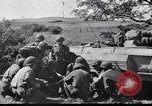
U.S. soldiers investigate Nazi massacre in Village of Martincourt. U.S. units attack in area of Sedan, France, in World War II
September 4, 1944, U.S. troops are being briefed and then set out to patrol and investigate report of Nazi massacre of French civilians at village of Martincourt, in World War 2. An armed Free French woman with armband, stands looking over the remains of the village. A U.S. patrol in a jeep drives through the remains of Martincourt, which had been burned with flamethrowers and its citizens killed and beaten. View inside the burned out church. As1st Army pushes towards Liege and Aachen, other U.S. units seem launching an attack, South of the border, in the area of Sedan, France. U.S. ground troops firing machine guns as USAAF P-47 aircraft dive to bomb and strafe German positions. U.S. troops occupy a town where wrecked German equipment is seen.
The Battle of Iwo Jima in World War II
Scenes filmed by Navy and Marine combat photographers, of the Battle for Iwo Jima, in February and March, 1944, during World War 2. View from a boat offshore, of Mount Suribachi, on the Island of Iwo Jima. Warships of the U.S. 5th Fleet attack with naval gunfire, as landing craft manuever near shore. U.S. Marines aboard Landing Vehicles Tracked (LVTs) head for the beach, with the heavy cruiser, USS Baltimore (CA-68) in the background. U.S. Carrier-based Grumman TBF Avenger aircraft drops bombs on Mount Suribachi. Landing craft arriving at a fairly level area of beach. U.S. marines moving cautiously on the beachhead. The USS Baltimore and a Fletcher class destroyer offshore in background. Marines hunkered down with smoke rising near them, and then moving forward again, through the black sands. Closeup of a marine with flame thrower. Several U.S. Chance Vought F4U Corsair aircraft fly overhead, dropping bombs on the mountain. Marines continue to move forward, under constant fire from Japanese small arms. A heavy landing craft Infantry, LCI(H) moves toward shore in background. A DUKW ("Duck") coming ashore. Marines using a crane to offload a 105mm howitzer from a landing craft. As they raise the gun, the landing craft moves away and marines Hook the howitzer to a DUKW to help move it. Next, marines are seen setting up two 105s on the beachhead and firing them. Marines with more artillery pieces stacked on the beachhead. A gunboat, LCI (G), firing from close to the shore behind them. Marines digging in sand that the narrator calls the floor of an active volcano. Smoking sulphur gases are seen rising behind them. The USS Baltimore firing her guns from close to shore. Machine gun tracer rounds crossing the beachhead, as Naval gunfire resumes from offshore. Marines crawling and then occasionally sprinting forward across the sand dunes. (One carries a stretcher.) Four marines carrying one wounded back to the beachhead, on a stretcher. Two marines carry another between them. Marines scrambling over brush and rough ground. View from hillside of marines climbing up from below, as shell bursts only a few yards away. Scene shifts to later in the battle for Iwo Jima. A catapillar tractor is parked near bodies of Japanese soldiers strewn across the landscape. (Narrator notes that more than 14 thousand such dead had been counted by March 6, 1944.) Finally, the iconic moving images of U.S. marines raising the American flag over Mount Suribachi.
First Allied convoy reaches Kunming, China, over the Ledo Road, during World War II
U.S. military trucks, part of a convoy of 113 vehicles, led by Brigadier General Lewis Andrew Pick, are seen traversing the Ledo Road (aka the Stilwell Road) approaching their final destination of Kunming, China, on February 4, 1945, during World War 2. (They departed Ledo, India, on January 12, 1945, traveling a distance of 1,079 miles.) (Narrator gives distance as 1,044 miles.) View from an overflying airplane shows the long column of trucks on the road below. View from the ground, of the convoy reaching the city gates, where it halts as General Pick and his staff proceed through the gates to a speaker's platform set up in a covered pavilion displaying American and Chinese flags, and pictures of U.S. President Franklin D. Roosevelt and Chinese Generalissimo Chiang Kai-shek. General Pick and staff are introduced by Chinese General J.L. Wong who, speaking in English, celebrates this first convoy over the Ledo Road, and points to a banner containing four Chinese characters that spell out "The Road to Victory." General Pick takes the podium, shakes hands with General Wong, and accepts the banner from him. Camera shows the area completely filled with Chinese troops, witnessing the ceremony, including many sitting atop a nearby roof. General Pick speaks briefly, accepting the banner on behalf of the convoy members. He then leaves accompanied by the Governor of Yunnan Province, China. Officers cut a ceremonial ribbon across the road at the West Gate of the city, and the convoy is led into the city by two Chinese soldiers on motorcycles. Chinese spectators line the way and celebrate with firecrackers and cheers, as General Pick passes, standing in a jeep, displaying the Amercan flag and with the Chinese "Road to Victory" banner in its back seat. views of the convoy trucks proceeding through the city. Closeup of one, with a painting of the road, and snow capped mountains, and "First Convoy over the Ledo Road" and "Pick's Pike Life Line from India to China" painted on its canvas cover. A sign over one of the shops along the road reads in Chinese and English, "Welcome First Stilwell Highway Convoy." Views of troops waving from the trucks and Chinese citizen spectators crowding the sides of the road to watch.
CRITICALPAST.COM: About Us | Contact Us | FAQs - How to Order | License Agreement | My Account | My Lightboxes | Shopping Cart | Advanced Search | Featured Collections | Website Terms & Conditions | Privacy Policy ©2026 CriticalPast LLC.
License Agreement |
Terms & Conditions |
Privacy Policy
©2026 CriticalPast LLC.