


 Francais
 Deutsch
 Italiano
Refine Your Search
M4-training stock footage and images
- Showing 7573 to 7578 of 8218 results more
more Hide
Hide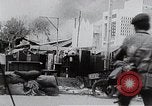
ARVN soldiers battle Vietcong militants in Tet offensive; captured Vietcong prisoners interrogated
Army of the Republic of Vietnam troops in house-to-house combat with Vietcong during first week of Tet Offensive. ARVN soldiers battle with Vietcong on day 4 of offensive. Dead Vietcong soldiers. Wounded are given medical treatment by ARVN teams, and taken on litters to ambulance. Interrogation of captured Vietcong by military correspondents and captured weapons on display. Rubble in combat area. Wrecked buildings and houses. Refugees search through ruins. (Vietnam War period).
New Yorkers, in lower Manhattan, celebrate Armistice ending World War I
Crowds fill streets celebrating Armistice ending World War 1. Street cars move through the crowds. Many people wave American flags. Mounted police maintain order. Crowd filling space in front of S.S. Kresge Company 5&10 cents Store. Large American flags hang from front of the Central Savings Bank, at 14th Street and 4th Avenue (Union Square). People gather around a large monument displaying many figures. A group of people realize they are being photographed and face the camera smiling. One man lifts up a small boy dressed in soldier uniform, holding a flag and saluting. Several men carry a wood slab with effigy of defeated Hun on it. Scene shifts to large open area, where crowd is gathered around a multistory copy of the Statue of Liberty. A group of women in white dresses (possibly nurses) stand in front of a seated Army brass band. Scene shifts back to Union Square, again with crowd around the large monument and American flags draped over windows of the Central Savings Bank. Trick photography creates ethereal image of statue of liberty in the scene. Next, lines of people with banners and flags move near area of trolley cars. Another group gathers near camera, as mounted policeman moves behind them. Trinity Church steeple can be seen in far background. Several men in blackface makeup carry a coffin containing detritus of war. View from building overlooking avenue filled with people. American flags fly from building window sills. A flag displaying "104" (104th Regiment?) and numerous stars, hangs from one window. (World War I; World War 1; WWI; WW1)
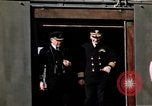
Gun crew fire guns mounted on Queen Elizabeth ship.
Ship's C.O. with a U.S. Navy Captain, come out on the deck. A British Merchant Marine Captain talks with the U.S. Navy Captain (Navy Captain has a sub. insignia over his breast pocket). U.S. Navy officer smokes a pipe on the deck. Two junior U.S. Navy officers on the deck. U.S. Navy Commander on weather deck. Two British crewmen with a U.S. Navy officer, look out over the sea. Rocket-type launcher in a tub, above weather deck. Sign reads 'Stand Well Clear, When Klaxon Sounds'. Rocket launchers on ship. One of the gun mounts fire in the background. Crew on weather deck, near fantail area. Wake of the ship in the background. Crew fires 4'' gun on stern of the ship. Gun crew on gun, breech opened. Crew works around rear of the gun. Gun fires. Small group of weather deck. U.S.A. officer, U.S.N. officer and a ship's officer talk. Weather deck of the ship and crew walk by in foreground. Personnel look at a plane in flight. (World War II period).
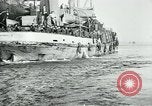
Ships transport U.S. Soldiers returning home from France at the end of World War I.
A French boat named the "Wenette" ferrying American troops, is seen alongside a two funnel ocean liner, in Brest Harbor, France, at the end of World War 1. A Connecticut class American battleship is also seen in the harbor, to transport troops home from the war. Another two-stacker ocean liner anchored in the harbor. American soldiers fill the decks of an armed transport ship, flying the American flag. Several views of French tug boats assisting a transport ship as it leaves the harbor. A large 4-funnnel transport ship surrounded by tugs and other small boats. Closeup of an armed transport ship filled with soldiers, making way slowly out of the harbor.
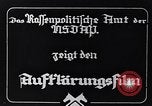
Nazi film shows various men, women, and children in German mental and physical care institutions, contrasted with average Germans
NSDAP (Nazi) German film on hereditary diseases opens by showing German boys and girls playing outside houses and children in the streets of Germany. Some of the children are dirty and poor, and living in meager tenement areas. Prior scene is then contrasted with exteriors of numerous hospitals and clinics with well kept grounds and facilities. Doctors and nurses in white uniforms stroll the grounds. A group of boy patients are shown in an outdoor area. Scene shifts to show a German farmer with a boy working on a farm. The boy watches geese. The farmers build a rock embankment beside water. A fishing boat on water and a German fisherman working with his nets. A German woman wrings out wet laundry. German workers in an office perform clerical work and typing. German laborers working hard and constructing new buildings. Construction scenes. A man planes a long piece of wood. Other workers lay stones, work on overhead wires, and work at a steel molting factory. German farmers harvest wheat and horses pull carts bearing harvest. A windmill turns. Scene shifts to outdoor grounds of an institution housing mentally and physically handicapped German boys, girls, women, and men. Disparaging views of various mentally disabled and physically disabled men, women, boys, and girls are shown. Some are physically deformed patients, others are insane patients, or violent patients in strait jackets. Jewish patients are separately identified, shown, and disparaged (seeds of anti-Jewish sentiment and the holocaust to come). Nurses and doctors seen observing and working with patients. Patients eat, many exhibiting difficulty eating. Some patients are spoon fed. Others are fed by nasal tube. The scenes shown appear designed to show the patients in the most denigrating way. Diagrams depict mental illness transmitting through defective genes (part of theories espoused by Nazi Germany in support of its eugenics programs, sterilization, and euthanasia programs such as Aktion T4, before and during World War 2).
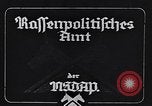
Nazi film shows Mentally disabled men, women, and children in German mental institutions, and presents costs for their care.
A Nazi film released before World War 2 examines hereditary diseases in German citizens, and the costs for caring for such patients. Mentally disabled and deranged adults and children are shown in German medical institutions. Mentally disabled patients are shown in a disparaging way. Close views of epileptic and schizophrenic cases. Various individual and family cases are shown attempting to focus on hereditary causes for the afflictions. Physically deformed patients. Statistics are shown on the cost to German society of supporting the mentally and physically handicapped German citizens. Sterilization and possible euthanasia suggested (later enacted as part of the Nazi program known as Aktion T4). End of clip shows NSDAP ideal scenes of healthy Aryan German young men working in a field, and group of happy young German children smiling.
CRITICALPAST.COM: About Us | Contact Us | FAQs - How to Order | License Agreement | My Account | My Lightboxes | Shopping Cart | Advanced Search | Featured Collections | Website Terms & Conditions | Privacy Policy ©2026 CriticalPast LLC.
License Agreement |
Terms & Conditions |
Privacy Policy
©2026 CriticalPast LLC.