


 Francais
 Deutsch
 Italiano

Refine Your Search
M4-training stock footage and images
- Showing 7903 to 7908 of 8248 results more
 Hide

U.S. Vice President Richard Nixon visits U.S. Kimpo Airbase, Korea. He climbs in cockpit of F-86 and meets USAF and UK flyers
U.S. Vice President Richard Nixon visits a U.S. air base at Kimpo in Korea. Nixon with United States Air Force officers. A sign in the background reads: "4th Fighter Intercepter Group Combat Operations". He climbs into the cockpit of and F-86 aircraft. He shakes hand with some air force officers. Some cameramen with their recording cameras. The officers salute. Nixon meets some flyers from the United Kingdom, as well, standing in front of their Canberra twin jet aircraft. Two squadrons of U.S. Air Force jet fighters fly over in formation.

The U.S. Army uses burning as a method to destroy ammunition in the United States.
Destruction of ammunition by the army in United States. Piles of ammunition. Wooden cartoons of ammunition. A note on a cartoon reads "Issues prohibited". Soldiers unloading the cartoons of ammunition from a truck. An unfilled ammunition condition report. Authorized methods of ammunition destruction include dumping at sea, detonation or burning. Burning: ammunitions lying on a table. Ammunition to be burned includes bulk TNT (Tri Nitro Toluene), composition C-4, dynamite, black powder, solid propellants, primers, detonators, boosters, fuzes, small arms ammunition, pyrotechnics and hand grenades, photo flash bombs, hand grenades high explosive, rocket head and 240 mm projectile. Two soldiers reading a map. A soldier draws a circle using a compass. Burning site is one that is safely away from a public highway, habitation, railroad, and observation point. Two soldier working on a map on a table. One of them rolls down the map.
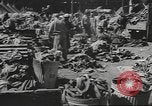
Numerous scenes of U.S. Army Quartermaster salvage operations in Italy during World War II; also brief aircraft crash scene.
U.S. soldiers in the textile repair section of a Quartermaster Salvage Depot, are seen sorting military clothing of all types to be recycled an reissued, or otherwise used as rags for cleaning purposes. Workers from the local populace are hired as paid employees in these salvage operations. A woman removes bundles of used army uniforms from a horse drawn cart and gives them to children who carry them to other women and children who are seen working on various levels of a building, where they mend and otherwise repair and restore the garments. A man works at a sewing machine on the ground floor of the building. But the women and girls seen are all engaged in hand sewing. Scene shifts to a section of the depot yard where tents are being examined, sorted and repaired. Large tents are suspended from a crane to facilitate inspection. The next scene shows interior of a mobile repair shop designed for the Signal Corps, where soldier technicians work on electrical and electronic equipment. A soldier repairs an SCR 536 (better known as handy talky) and an Army Technician fourth grade (T/4) works on an SCR-508 mobile Signal Corps Radio. He tests each tube and connection. A Staff Sergeant removes parts from a BD 72 field switchboard. Outside, several local civilian men employed by the Depot, are physically salvaging useful items, such as brass knuckle joints from metal tubing. Another pulls worn copper wire from an armature. Elswhere in the yard, soldiers and local helpers salvage lead plates from old storage batteries, where they are melted down over a fire and poured into old army helmets, serving as improvised ingot molds. A huge collection of spent artillery shells covers a vast area in the depot. They are loaded aboard barges and brought to ships for transport back to the U.S where they will be repacked and reused. Soldiers collect unserviceable tires for reshipment back to the U.S. Soldiers inspecting a pile of tires. Soldiers inspecting rubber tubes and checking them for leaks. A pile of inflated tire tubes left to sit awhile before being inspected. Outside the infantry too repair shop, soldiers repaint pick mattocks and set them out to dry. Using tools they invented, two soldiers remove wooden handles from shovel blades and from ax handles, in the infantry shovel repair department. Inside the building, soldiers are seen repairing stoves in the stove repair department. One ignites a stove and checks its flame. In a corner of the shop, a worker repairs gasoline lamps. Several are seen illuminated. Soldiers hammer out dents in mess kits and use compressed air and stone molds to take dents out of canteens. One disinfects mess gear by dipping in a lye bath and then in water and repeating that procedure again. He hangs them in the sun to dry. At one spot (where no smoking is written on the wall in Italian) a soldier works repairing 5 gallon (Jerry) gasoline cans using air pressure and water immersion to detect any holes. A jerry can is brazed by a worker using an acetelyn torch and rod. A warplane is seen crashing in flames. Signs advertising salvage as savings, are seen in various places. Salvage trucks and cranes are seen along with glimpses of salvage crews at work. A cartoon sign by a destroyed building shows a GI with ax holding Hitler's head. It reads: "Behead Hitler. Turn in Salvage." Another cartoon sign shows a girl and reads: "You will bet back to me sooner, if you turn in your salvage." A GI whistles in admiration as he passes the sign to pick up two discarded jerry cans. He salutes the sign as he walks away.

U.S. Marines fight against the Japanese and land at a beach in Palau during World War II.
Allied forces in Palau during World War II. An aircraft lands at an airstrip in Palau. Allied forces fire artillery. Smoke rises. U.S. Marines advance across a field. A U.S. Marines Corps F4U Corsair aircraft in flight as it attacks Japanese positions. A column of smoke rises. The Marines load shells in an artillery and fire at Japanese cave positions. Wounded Marines on the ground. The wounded being placed on a litter and rescued amidst heavy shelling. A landing craft with troops loaded on to it heads for a beach. Aircraft in flight as they bombard the coast. Crafts arrive at the coast. Artillery being fired as tanks advance.
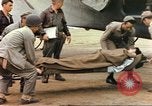
Wounded Marines are air evacuated in Iwo Jima, Japan during World War II.
Allied invasion of Iwo Jima, Japan during World War II. Wounded Marines lying on stretchers are loaded aboard an aircraft. A walking wounded is helped to board an aircraft. A soldier loads shells in an 81 mm mortar. The mortar being fired. U.S. Navy F4F Wildcat and TBM Avenger aircraft strafe Iwo Jima. Litter patients being loaded onto an aircraft for evacuation.

U.S. Marines land and advance near Mount Suribachi amidst enemy fire during the Battle of Iwo Jima in World War II.
'Action on Iwo Jima' depicts the Battle of Iwo Jima or Operation Detachment during World War II. United States Marines Divisions eliminate positions on Mount Suribachi. Mount Siribachi on the island coast. Additional waves of Marines arrive at the island. 3rd Marine Division arrives to enforce the 4th and 5th Divisions. Landing crafts and ships approach the shore amidst enemy fire and explosions. Crouched Marines in a Landing Craft Vehicle Personnel (LCVP). Marines advance inland amidst mortar fire and machine gun fire by the Japanese. They advance across mine fields on the beach. Soldiers unload supplies from landing crafts and ships. They pull a tank across the beach. A view of the battle from inside a tank. Marines battle around Mount Suribachi. Advanced units scale cliffs and take cover against grenades and demolition charges from the Japanese in caves and pill boxes. The Marines use flames to flush Japanese soldiers out of dug in positions. A Japanese soldier takes cover from machine gun fire. Guns fired and explosions on the island.
CRITICALPAST.COM: About Us | Contact Us | FAQs - How to Order | License Agreement | My Account | My Lightboxes | Shopping Cart | Advanced Search | Featured Collections | Website Terms & Conditions | Privacy Policy ©2026 CriticalPast LLC.
License Agreement |
Terms & Conditions |
Privacy Policy
©2026 CriticalPast LLC.