


 Francais
 Deutsch
 Italiano

Refine Your Search
M4-training stock footage and images
- Showing 7981 to 7986 of 8248 results more
 Hide

A four mast ship launched from a harbor in Europe.
A shipbuilding harbor area in Europe during World War I. View of the harbor area and shipbuilding facility as seen from the water. Buildings in the background. A ship being launched from the shipyard. The ship slides down and pivots in the water revealing view of 4 wooden masts.

Crowds attend dedication of the Golden Gate Bridge
Opening slate states: "Golden Rivet Marks Dedication of Huge Golden Gate Span" View of the completed Golden Gate Bridge from the San Francisco side. A crowd of people is assembled for the bridge dedication on May 4, 1937. Joseph Strauss, Chief Engineer of the Golden Gate Bridge holds the "Golden Rivet,"seen in closeup. Closeup of a bridge worker in a metal hard hat. Next he is seen holding up the rivet in a protective glove as he stands next to Mr. Strauss. Glimpse of worker's cage moving along a bridge cable overhead. Closeup of two riveters setting the final rivet as spectators crowd close around them. Long view from San Francisco hills of the bridge.
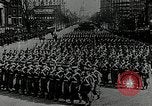
Early 20th century America footage; establishment and early circumstances of the U.S. Department of Labor
Film opens with view from a building overlooking President Woodrow Wilson's Inauguration Day parade along Pennsylvania Avenue, on March 4, 1913. A large contingent of U.S. Army West Point cadets march in forefront of the parade. Spectators line the sidewalks. Several stand atop buildings. Outgoing President, William Howard Taft is seen in his office signing a bill establishing the U.S. Department of Labor. Closeup of the bill and Taft signing it. Scenes of traffic and pedestrians in New York City. Some of the pedestrians appear to be wealthy class. Crowded early 20th century city streets filled with various horse drawn carriages together with bus traffic and early automobiles in chaotic confusion. A double decker bus with open top and sign "Fifth Avenue" and lower sign "To 22nd Street Only" operates in busy traffic on 5th Avenue beside horse drawn carriages and other motorized vehicles. Glimpses of women working in a factory; Men pouring molten metal into molds; Women punching time clocks as they leave a factory. Newly arrived immigrants at Ellis Island, New York City circa 1910 or during first 10 years of the 1900 decade. View of the Statue of Liberty. Women working in a textile factory. Men tapping a furnace in a steel plant. Pushcarts and peddlers at market lining the curb in a Jewish neighborhood of New York City (possibly lower east side). Brief view of pioneer Labor leader Samuel Gompers, founder of the American Federation of Labor. He hold a walking stick and doffs his hat. Sketches illustrating scenes of labor-related violence. Department of Labor sign being affixed to its location. A horse and wagon, representing the first assets of the new Department. A group of persons illustrative of the employees in the Department's Bureau of Labor Statistics.
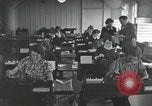
The Great Depression persists as President Franklin D Roosevelt takes the oath of the office in the United States.
Department of Labor women clerical employees seen typing letters and forms. Men in the department meet at a table. Women working inside a textile factory in the United States. Close up of man's face as he works at a factory job. Scene of early trading activity at the New York Stock Exchange. A biplane airplane at an air show event crashes through a wall (seemingly intentionally) while landing, as onlookers watch. The plane is heavily damaged but lands on two wheels. Bread lines and soup lines for the hungry and unemployed men during the Great Depression. Lines at the bank during bank panic or run on a bank during the Great Depression. Vacant lot, stopped idle factory, and stopped railway switch yard during the Great Depression. Busy city street (possibly New York City lower east side) with push carts of street market vendors selling to shoppers and pedestrians. A horse cart is also seen on the street. More scenes of soup kitchens and bread lines for needy. Children jump rope, gathered on a wooden porch. Two men arriving at factory job carrying lunch boxes. Children playing jump rope. Exterior of the Capitol building in Washington, D.C. as Franklin Delano Roosevelt takes his first oath for the President of the United States on March 4, 1933, and excerpt from his inaugural address focusing on jobs and putting people back to work.

The U.S. and Switzerland compete in the first hockey match of the 1948 Winter Olympics
The U.S. and Swiss hockey teams line up and salute each other with their hockey sticks at the start of the first ice hockey game of the 1948 Winter Olympics, in St. Moritz, Switzerland. The game commences and camera catches much of the skating and scoring activity. At one point, the beautiful mountains and Olympic buildings can be seen in the background. (The game was won by Switzerland, 5 to 4.)

A U.S. Navy ship caught in a storm. Later, sailors prepare a deck gun for firing
An American ship being pummeled by wind and wave in a storm at sea. Next, sailors are seen preparing to fire a 4-inch / 50 caliber Mark 9 deck gun mounted near the ship's stern.. The sailors work on the gun, while an Officer holding a log book, of sorts, observes. The sailors raise the gun barrel and rotate it to starboard. They ram a shell into the breech, and rapidly close it. (The breech is equipped with an Ausbury mechanism for rapid opening and closing.) They continue to open and close the breech, loading multiple powder charges. Closeup from a different viewpoint of the gunners loading the gun, as a sailor at the gun maneuvering controls elevates the barrel with a hand crank
CRITICALPAST.COM: About Us | Contact Us | FAQs - How to Order | License Agreement | My Account | My Lightboxes | Shopping Cart | Advanced Search | Featured Collections | Website Terms & Conditions | Privacy Policy ©2026 CriticalPast LLC.
License Agreement |
Terms & Conditions |
Privacy Policy
©2026 CriticalPast LLC.