


 Francais
 Deutsch
 Italiano
Refine Your Search
M4-training stock footage and images
- Showing 8005 to 8010 of 8248 results more
more Hide
Hide
Japanese children being taught English in a class by Japanese and American teachers in Okinawa, Japan (WW2)
American occupying forces allow Japanese children to resume classes in Okinawa, Japan after World War II. Children exercising in Koza Elementary School (4 Chome-16-1 Central, Okinawa, 904-0004, Japan). A teacher inspects students while exercising. A board reads 'Koza Primary School'. A Japanese headmaster reads from a paper. A group of American officers seated under tents watch students exercise. A Japanese teacher writes on a blackboard in English during a class. A student recites. A man plays the piano. Children singing. An American soldier teaches children to sing an English song.
U.S. Navy and Marines conduct Amphibious Assault exercise.
As film begins, U.S. Marine paratroopers are seen jumping from an R4D (Douglas DC-3) transport aircraft. View of the airplane with Marines parachuting from its cargo door. (The aircraft has "QF"and number 17225 stenciled on its tail, and United states Marines on its fuselage.) A marine descending on opened parachute is seen from below. Narrator describes them as "Pathfinders," to establish landing zones. As they hit the ground, the parachuting marines quickly set up homing devices, electronic signals and markers to guide incoming helicopters. The amphibious assault carrier, USS Princeton (LPH-5) is seen underway at sea, with her deck full of marine helicopters. She is accompanied by a transport ship. Closeups of the carrier and helicopters, from low flying helicopter overhead (unseen). Scene shifts to pilots being briefed aboard the ship. Marines in battle dress on the carrier flight deck. They double-time and board their assigned Sikorsky H-34 helicopters. View from inside a helicopter as marines board it. View from helicopter flying above those on flight deck shows those below with their engines running. Deck crew directs launching of the choppers. The H-34s are followed by Sikorsky H-56 helicopters carrying heavy equipment. Several views of them flying near the ship. Formation of helicopters in flight en route to landing areas. Helicopters heading to the beach and landing in formation. Closeup of them landing and marines moving quickly to exit and take up their positions ashore. An artillery piece suspended from a helicopter, being lowered to the ground. A number of views of marines and equipment deploying from helicopters. Scene shifts to landing craft in formation approaching the beach. Explosion occurs on shore.
Animated map show U.S. forces landing on Saipan, Mariana Islands.
Animated map shows Saipan, Marian Islands. Animation shows U.S. forces acquiring the island from the Japanese during World War II. Advancement of Task Force 56. The 77th Infantry Division at Oahu. The 2nd and 4th Marine Division land on the island on the orders of a United States General. Animation shows the 37th Division troops landing on a beachhead from ships.
President Truman and his party at RAF Station Harrowbeer near Plymouth, England during World War II.
United States President Harry S. Truman, and his party, make unplanned stop at RAF Station Harrowbeer during return from the last 4-Power meeting of World War 2, held at Berlin in July, 1945. (Their planned destination, RAF Station St Mawgan, was fogged in. So the President instructed his pilot, Lieutenant Colonel Henry T. Myers, to land at Harrowbeer, when they saw it was clear.) Truman descends steps from the Presidential Airplane (Douglas VC-54C named the "Sacred Cow," used by Presidents Roosevelt, and Truman). Two other C-54 aircraft have also arrived (unseen). One carried Secretary of State, James F. Byrnes, who poses with the President and three members of the British WAAF (Women's Auxiliary Air Force) identified as: Section Officer Eira Buckland Jones, Corporal Clarice Turner, and Leading Aircraft Woman Audley Bartlett. Views from inside car taking members of Presidential party to Plymouth Harbor. Groups of local people wave as the car passes through the English countryside. Larger numbers of spectators line the streets of the city of Plymouth. View of Plymouth Harbor from launch taking members of President's party out to the USS Augusta, anchored in Plymouth Sound (not seen).
A man tries to fit an air force uniform on Richard Mackey at Lackland Air Force Base, San Antonio, Texas.
Richard Mackey enters the U.S. Air Force at 20 years old, measuring only 4 feet 7 inches. Air force recruits in San Antonio, Texas. Man tries to fit a coat on the small man. Airmen stand behind a counter and take their uniform issue at a supply depot. Richard is four feet and seven inches tall and 107 pounds. A man tries to fit an air force uniform on him. The recruits perform a drill and march, with Mackey trying to keep up. Mackey with a cigarette in his mouth, lighting the cigarette of another soldier.
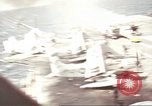
U.S. Navy aircraft land on the flight deck of a U.S. aircraft carrier underway in the Gulf of Tonkin.
Events of the Gulf of Tonkin Incident, 2-5 August 1964, re-enacted at later date. A U.S. aircraft carrier underway in the Gulf of Tonkin. A U.S. Navy A-4E Skyhawk being recovered aboard the ship. The aircraft makes an arrested landing and is being recovered. A U.S. Navy F-8E Crusader aircraft being recovered. A U.S. Navy RF-8A Crusader aircraft touches down for a landing. The F-8E aircraft touches down for an arrested landing.
CRITICALPAST.COM: About Us | Contact Us | FAQs - How to Order | License Agreement | My Account | My Lightboxes | Shopping Cart | Advanced Search | Featured Collections | Website Terms & Conditions | Privacy Policy ©2026 CriticalPast LLC.
License Agreement |
Terms & Conditions |
Privacy Policy
©2026 CriticalPast LLC.