


 Francais
 Deutsch
 Italiano

Refine Your Search
M4-training stock footage and images
- Showing 8035 to 8040 of 8248 results more
 Hide
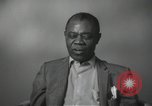
Early life of Jazz musician Louis Armstrong; scenes in New Orleans Louisiana in 1930s-1940s
African American Jazz trumpeter and singer Louis Armstrong in the United States. Armstrong speaking during an interview. He says that he was born in 1900, in "James Alley." (He was actually born in 1901.) A large crowd gathered likely on Canal Street in New Orleans during Mardi Gras circa 1930s. A large float in the parade. Highlights of Louis's life. Louis Armstrong's childhood home, shortly before it was demolished in the mid-1960s. In 1901, Louis Armstrong is born on August 4th, in New Orleans, Louisiana, to Mary (Mayann) and William Armstrong. A photograph of Armstrong with his mother, Mayann, and sister, Mama Lucy (Beatrice), circa 1922. 1940s street views of the French Quarter in New Orleans, with characteristic ironwork and porches. A horse drawn carriage and a 1940s car parked in front of Antoine's Restaurant (713 St. Louis Street, New Orleans). Still photo images of Louis Armstrong's teachers Bunk Johnson, Joe 'King' Oliver and others. Louis Armstrong speaking and saying that he has played with all the best musicians. Still image of Louis Armstrong seated with a trumpet in his hand and other musicians standing beside him.

SP-2H aircraft prepare and taxi at various airfields in Vietnam during the Vietnam War.
U.S. Navy Lockheed SP-2H Neptune aircraft at an airfield in Vietnam during Operation Market Time of the Vietnam War. Two men stand on a work stand as they work on the engine of an SP-2H aircraft. Another man climbs up on a work stand at Da Nang airfield. Two men on a work stand as they work on the cockpit area of a SP-2H aircraft. An armed crewman signals in the foreground. Port engines of the SP-2H aircraft turn over. A man pulls a fire bottle in the foreground. A captain walks towards the under part of the aircraft and climbs aboard. SP-2H aircraft of the VP-4 (Patrol Squadron) at Ton Son Nhut Air Base. A barbed wire fence in the foreground. Vietnamese workers work on a runway using shovels. An SP-2H aircraft turns and taxis on the runway.
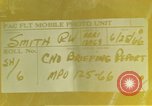
A tractor tows an aircraft at an air base in Vietnam during the Vietnam War.
U.S. Navy aircraft in Vietnam during Operation Market time of the Vietnam War. Nose of an aircraft parked at an air base. A sign on the cockpit of the aircraft reads 'C.P. LTJG E.J. Hopkins'. Another sign reads 'Lt. Swenson' and 'Lt. Hopkins'. Two flight crew men work on a tow bar. They hook the bar to the nose of the aircraft. A tractor backs down and the men hook up the bar to the back of the tractor. The tractor driver works on the controls as he moves the aircraft out of the turn up area. The tow bar being attached to the tractor. The aircraft being slowly moved to the turn up area. The tractor tows the aircraft. A crew member releases the tow bar from the tractor. The tow bar being released from the aircraft. A pilot climbs aboard the aircraft. Two crewmen stand by as the starboard engine is started. The port engine turns up slowly. A U.S. Navy Lockheed P-2H aircraft taxis out from a line. A U.S. Navy Phantom F-4B taxis down the line with a drogue parachute open.

Damaged La Scala Opera House and cathedrals in Milan, Italy during World War II.
The aftermath of Allied bombing in Milan, Italy during World War II. Italians walking around damaged buildings and rubble on the ground after heavy bombing. Damaged La Scala Opera House (Via Filodrammatici, 2, 20121 Milano MI, Italy) after the bombings. Interiors of the opera showing its damaged dome. Damage sustained in the Palazzo Marino (Piazza della Scala, 2, 20121 Milano MI, Italy), near the La Scala Opera House. A statue of Italian poet Alessandro Manzoni (Piazza S. Fedele, 20121 Milano MI, Italy) still stands among the rubble of the surroundings. Behind the statue is the Church of Saint Fidelis (Piazza S. Fedele, 4, 20121 Milano MI, Italy). Damaged glass dome of the famous shopping mall Galleria Vittorio Emanuele II (P.za del Duomo, 20123 Milano MI, Italy). Italian men walking in Galleria Vittorio Emanuele II after bombing. Exteriors of the Ospedale Maggiore (now known as the Policlinico di Milano Via Francesco Sforza, 35, 20122 Milano MI, Italy) after bombings. Corridors of a building with rubble spread all over. Cars and pedestrians on a street and damaged buildings in the background. The neighborhood of San Babila with significant damage. Basilica di San Babila exteriors after bombing. Damaged exterior of the famous Duomo Cathedral (P.za del Duomo, 20122 Milano MI, Italy). Rose windows of the Duomo Cathedral. Damaged body of a naked statue. People close the doors of the Duomo Cathedral.
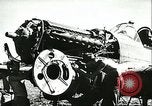
Mechanics repair and refuel Curtiss P-40 aircraft on New Guinea during World War II.
Mechanics servicing P-40 fighter aircraft on what is most likely 4-mile Strip on New Guinea. Date is probably late 1942. "Scatterbrain" was the name painted a P-40 flown by Captain George Manning of the 7th Fighter Squadron, which was based at Rogers Airfield, Port Moresby, New Guinea, during 1942-43, during World War Two.
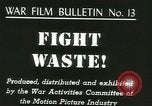
U.S. Government tells citizenry how they can help the war effort by living conservatively and avoiding waste, early in World War II
A public service informational campaign during World War 2 in the United States. A uniformed nurse tends to a U.S. Army Sergeant, Vincent Booth, who lost a leg during the African campaign of World War 2. He is in a wheel chair. The Sergeant speaks about the things that can be done on the home front to ration and help the war effort. As he narrates, a typical American family of three, father, mother, and youth in Boy Scout uniform, are seen sitting down at their dining room table. Missing is their daughter, serving as a WAC overseas (shown briefly in uniform) and their son, in the Navy (also shown briefly, in uniform). Scene shifts to the father at his work place. Narrator says he uses 10 percent of his weekly income to buy war bonds. The mother is seen at home with her Boy Scout son. She is writing letters to her son and daughter in the service. Change of scene shows her in a hospital, volunteering as a Red Cross Nurses aid. Next, the family members are seen in their home, characterized by the narrator as "an arsenal for victory," where they are being careful not to waste resources like electricity, home heating fuel, and cooking oils. They contribute their old metal objects to the war drive collections, and their son in the Boy Scouts participates in the local paper salvage drives. He is seen in Boy Scout uniform tying up a bundle of newspapers (with pictures of Hitler and Tojo on top which he dramatically stands on when tying the papers). They repair and use their old clothes, or contribute them to charities. The propaganda film ends summarizing ways that ordinary civilians can help the war effort, by rationing and avoiding waste at home, with on screen instructions: "Fight Waste! 1. Don't waste anything; 2. Buy only what is necessary; 3. Salvage what you don't need; 4. Share what you have."
CRITICALPAST.COM: About Us | Contact Us | FAQs - How to Order | License Agreement | My Account | My Lightboxes | Shopping Cart | Advanced Search | Featured Collections | Website Terms & Conditions | Privacy Policy ©2026 CriticalPast LLC.
License Agreement |
Terms & Conditions |
Privacy Policy
©2026 CriticalPast LLC.