


 Francais
 Deutsch
 Italiano

Refine Your Search
M4-training stock footage and images
- Showing 8239 to 8244 of 8248 results more
 Hide
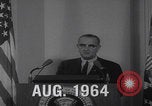
President Johnson addresses the public on United States actions against North Vietnam
During the Vietnam War, President Lyndon B. Johnson addresses the United States public during the “Radio and Television Report to the American People Following Renewed Aggression in the Gulf of Tonkin” from the Fish Room at the White House in August 4, 1964. "Renewed hostile actions against United States ships on the high seas in the Gulf of Tonkin have today required me to order the military forces of the United States to take action in reply,” says President Johnson. The USS Constellation (CV-64) aircraft carrier sailing. Pilots walk away from Douglas EKA-3B Skywarrior fighter jets in the USS Constellation. Aircrafts fire missiles, destroying facilities in North Vietnam. United States Secretary of Defense Robert McNamara addresses the public to explain the direct attack against North Vietnam. “We wish to emphasize we seek no wider war. Our response will depend upon the action of the aggressors, in this case the North Vietnamese. The key to the situation remains the cessation of infiltration from the North into the South,” says Secretary McNamara.
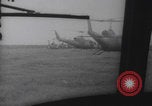
Various scenes depict Vietnamese children, soldiers in the Vietnam War, and President Johnson delivering a speech
Rear view of United States Army Bell UH-1 Iroquois “Huey” helicopters during the Vietnam War. U.S. Army helicopter pilot and soldier crew member in cockpit. South Vietnamese soldiers using a field phone. Republic F-105 Thunderchief fighter bombers in flight. Aerial bombing of Vietcong positions. An officer points to a map. Hand traces marked positions on the map. Vietnamese civilians evacuate from their homes. An injured civilian is taken on a helicopter. A Vietnamese child cries. Vietnamese children wash their hands and dries them with washcloths. A girl combs her hair. A boy lays a tablecloth and glass on the table. A girl holding a bowl of biscuits. A boy is given a biscuit and eats it. “I do not find it easy to send the flower of our youth, our finest young men, into battle,” says United States President Lyndon B. Johnson during a news conference at the White House on July 28, 1965. Photographs of various young American men of different backgrounds, some with their girlfriends or working. A photograph of American teenagers or young adults. Communist Chinese leader Mao Zedong smiling. A portrait of North Vietnamese leader Ho Chi Minh over a flag of North Vietnam. View of a ship’s bow. The United States Navy aircraft carrier USS Wasp (CV-18) or USS Lexington (CV-16). A Douglas A-4 Skyhawk fighter jet takes off from aircraft carrier. A pair of bombers dropping bombs over Vietnam. Bombs falling from bomber. Aerial view of bombs exploding in North Vietnam. A USMC LVTP-5 amphibious armored personnel carrier. United States Marines land on beach head and moving in jungle. “This, then, my fellow Americans, is why we are in Vietnam.” President Johnson ends his speech.
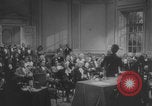
Filipino citizens after United States occupation of Philippines
Dramatization of the Second Continental Congress during the American Revolutionary War. The United States Declaration of Independence. The Thomas Jefferson Memorial (16 E Basin Dr SW, Washington, DC 20242, United States) in Washington DC. Bronze statue of Thomas Jefferson. The statue of United States President Abraham Lincoln at the Lincoln Memorial (2 Lincoln Memorial Cir NW, Washington, DC 20002). President Woodrow Wilson meets European leaders in France after World War I. Artistic depiction of United States soldiers fighting in the Spanish-American War. Map showing the Philippines, one of the two territories acquired by the United States after the Spanish-American War. Filipino students attend a class. They listen to the teacher standing in front of them. Behind the teacher are two blackboards. Two American consultants working with a Filipino man at the Manila City Planning. A scale model of Manila. Men constructing a house in the Philippines. Filipino men carry an entire native Kubo nipa house as a form of “Bayanihan”. A parade in Manila in 1946. The United States grants independence to the Philippines on July 4, 1946. Paul V. McNutt, High Commissioner to the Philippines, reads a proclamation at the ceremony held at the Independence Grandstand in front of the Rizal Monument. Filipino women wearing traditional Filipiniana dresses attend the ceremony. The United States flag is lowered as the Philippine flag is raised.

Several gliders landing (WW2)
A Waco CG-4A glider landing northeast of Zaan district, North Holland, Netherlands during World War II. A glider lands in the airfield, tilts up on its nose and falls back. More gliders landing. Soldiers opening the nose of a glider “Tessie” to unload.

Allied gliders take off from RAF Ramsbury (WW2) for Holland in Operation Market Garden
Waco CG-4 Hadrian military glider taking off from British base RAF Ramsbury in Wiltshire, England during World War II. Many Allied aircraft are parked in the airfield in the background. A Douglas C-47 Skytrain aircraft tows a WACO glider on airfield. A soldier sits on the grass and watch the C-47 tow the glider. A group of aircraft in formation. A United States Army glider gliding over the airfield.
Formation of transport planes fly overhead at RAF Newbury (WW2)
Allied transport aircraft fly overhead at RAF Newbury in Berkshire, England during World War II. The transport planes release gliders. A Waco CG-4 Hadrian military glider bank as it lands on the airfield. Various military planes parked in the background. A formation of transport planes fly overhead. A British Airspeed AS.51 Horsa military transport glider. C-47 Skytrain transport plane tows a glider during takeoff.
CRITICALPAST.COM: About Us | Contact Us | FAQs - How to Order | License Agreement | My Account | My Lightboxes | Shopping Cart | Advanced Search | Featured Collections | Website Terms & Conditions | Privacy Policy ©2026 CriticalPast LLC.
License Agreement |
Terms & Conditions |
Privacy Policy
©2026 CriticalPast LLC.