


 Francais
 Deutsch
 Italiano
Refine Your Search
M4-training stock footage and images
- Showing 1627 to 1632 of 8223 results more
more Hide
Hide
Signal Corps weekly film reports sent to Photographic Center and used in training films for U.S. troops during World War II.
The role and contribution of the U.S. Army Signal Corps in combat and war. Amphibious landings of the first wave of Allied troops including Signal Corps Units in Normandy, France on D Day during World War 2. The Joint Assault Signal Companies (a Signal Corps Unit that accompanies the soldiers on every beach landing) go ashore in Normandy. Soldiers in landing crafts approach the beach. Landing crafts anchored along the shore line. A U.S. flag on the beach. Crafts approach the beach. U.S. Army Signal Corps combat photographers using motion picture cameras to film the battle that ensues on the beach and in the fields. Gun fire and explosions in the battlefield, filmed by combat cameraman. Allied aircraft in flight. Airmen load weekly film reports of the war in all Theaters made by Signal Corps officers from a van into an aircraft. The films are sent to the Photographic Center in New York. A soldier assembles the films. Technicians organize and arrange the films. They place the film reels onto racks. The film content is used to make training and orientation films for the U.S. troops. Troops watch the films in order to cut down the training period, and stay informed about the order of event in other Theaters of Operation. The films include 'Why We Fight' and 'The Fighting Men' series. Clips and recordings from these films.
Civilians bid farewell to Italian soldiers as they march to trains bound for Russia during World War II.
Italian troops mobilize during World War 2. Italian soldiers pack their back packs and prepare to march forward. The troops begin to march to trains bound for Russia. The military band plays as they march. A huge crowd of civilians on the streets. Men, women, and children watch as the troops march towards the trains. People hold miniature Italian flags and cheer the soldiers. Civilians gather on either side of the road as the soldiers move ahead.
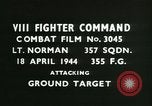
U.S. AAF VIII Fighter Command Lt. Norman strafes German trains, marshaling yards and trucks in Germany during World War II.
U.S. Army Air Forces Eighth Air Force, VIII Fighter Command operations in Germany during World War II. 18 April 1944: Lieutenant Norman of the 355th Fighter Group 355th Squadron attacks ground targets. He strafes a German train, marshaling yards, and a military truck convoy. Smoke from the wrecked train. The bombed marshalling yards and burning trucks.
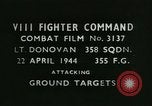
U.S. AAF VIII Fighter Command Lieutenant Donovan strafes a train in Germany during World War II.
U.S. Army Air Forces Eighth Air Force, VIII Fighter Command operations in Germany during World War II. 22 April 1944: Lieutenant Donovan of the 355th Fighter Group 358th Squadron attacks ground targets. He strafes a German train. Black smoke rises from the burning train. The U.S. aircraft in flight.
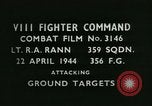
U.S. AAF VIII Fighter Command Lieutenant RA Rann strafes German trains and a factory in Germany during World War II.
U.S. Army Air Forces Eighth Air Force, VIII Fighter Command operations in Germany during World War II. 22 April 1944: Lieutenant RA Rann of the 356th Fighter Group 359th Squadron attacks ground targets. Lt. Rann attacks German trains and a factory. Buildings and sheds at the factory. Smoke rises from the burning passenger train. Trees on either side of the tracks.
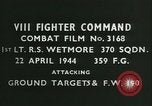
U.S. AAF VIII Fighter Command 1st Lieutenant RS Wetmore strafes a train and an FW 190 in Germany during World War II.
U.S. Army Air Forces Eighth Air Force, VIII Fighter Command operations in Germany during World War II. 22 April 1944: 1st Lieutenant RS Wetmore of the 359th Fighter Group 370th Squadron attacks ground targets. Lt. Wetmore strafes a Germn train. Smoke billows from the burning train. A hit German Luftwaffe Focke-Wulf FW 190 Wurger in a field. Smoke rises from the wrecked aircraft.
CRITICALPAST.COM: About Us | Contact Us | FAQs - How to Order | License Agreement | My Account | My Lightboxes | Shopping Cart | Advanced Search | Featured Collections | Website Terms & Conditions | Privacy Policy ©2026 CriticalPast LLC.
License Agreement |
Terms & Conditions |
Privacy Policy
©2026 CriticalPast LLC.