


 Francais
 Deutsch
 Italiano
Refine Your Search
M4-training stock footage and images
- Showing 1831 to 1836 of 8223 results more
more Hide
Hide
Chemical Warfare Service troops wearing gas masks during World War I training in the United States.
A division commander of Chemical Warfare Service tells assembled World War 1 trainee soldiers that, properly trained, they should be able to perform their duties, in simulated combat, for at least one hour, in full protective gas masks, without loss of efficiency. Soldiers seen training in field wearing gas masks. Officer in charge of gun crew is wearing new diaphragm microphones so that gun crew can hear while wearing their gas masks. He drills gun crew with commands.
Chemical Warfare Service training. U.S. Army division in live fire chemical warfare maneuvers. Encounter windborne gas; gas shell
Chemical Warfare Service training of U.S. Army trains in the United States during World War I. American Army soldiers wearing gas masks attempt to identify chemical agents as they are discharged on a field. The Division is deployed in trucks and on foot. Soldiers move forward in a line around a hil and along a muddy road. Soldiers lying in foxholes as cloud of gas approaches. One soldier swings a gas alarm ringer round and round to alert everyone. Other soldiers immediately don their gas masks. Later wind conditions allow them to rest. But the enemy fires gas shells into their midst anyway. So they must don gas masks again. A patrol goes out and encounters mustard gas. They check wind to avoid contact with it and move upwind.
Ski troops of the 41st Division fire rifles and ski during a training at Mount Rainier in Washington, United States.
Ski troops of the 41st Division train at Mount Rainier in Washington, United States. Soldiers on ski boards climb up a snow covered slope. The soldiers ski down the slope as they train for combat in snow covered areas. They fire rifles and machine guns. A soldier looks through binoculars. (World War II period).
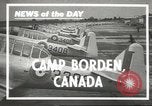
RCAF pilots in NA-64 Yale training aircraft in a mock attack and simulated dogfights in preparation for World War 2 combat
The Royal Canadian Air Force pilots train at Camp Borden in Ontario, Canada. RCAF pilots rush towards and board all-metal fuselage NA-64 Yale training aircraft at Camp Borden. The aircraft engines have already been started by ground crews, to save the time of manual starting. The aircraft take off for a mock attack. The aircraft in formations. They make interception attacks on approaching Avro Ansons. Explosions during the mock bombing raid. Simulated dog fights. the aircraft fly low during the fight. Pilots in the cockpits. The aircraft return to the Camp after the exercise.
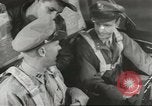
A USAAF officer trains a new B-17 pilot in cockpit check, including seat and controls check in the United States
A U.S. Army Air Forces (USAAF) training film titled 'How to fly the B-17. Part I. Ground Operations.' about inspections and safety precautions by a pilot prior to take off. A USAAF officer trains a new pilot beginning his career as a USAAF B-17 Flying Fortress pilot. The instructing officer, trainee pilot and aircraft engineer inspect a USAAF B-17 Flying Fortress. Cockpit check including seat and controls check: Seat check: seat belts, seat adjustment, rudder pedals. Control check: rudders and elevator controls unlocked, lock down and latched, aileron lock. Trim tab indicators inspection: rudder tab control, elevator tab control, aileron tab control. Check for: fuel transfer valves and switches, inter-coolers, JAIROS, fuel shut off switches, landing gear switch, cowl flaps, turbos, waste gate open, idle cut offs, throttles, RPM, auto pilot, de-ice and anti-ices, wing and propellers, cabin heat controllers, generators. Engine start check: The officer instructs the pilot to check for the fire guard with a fire extinguisher standing by near each engine. The pilot warns the ground crew for propeller clearance. (World War II period).
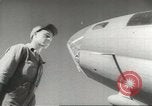
A USAAF officer trains a new B-17 pilot in cockpit inspection and start up procedures in the United States.
A U.S. Army Air Forces (USAAF) training film titled 'How to fly the B-17. Part I. Ground Operations.' about inspections and safety precautions by a pilot prior to take off. A USAAF officer trains a new pilot beginning his career as a USAAF B-17 Flying Fortress pilot. The instructing officer, trainee pilot and aircraft engineer in the cockpit, prepare for take off. The fire guard gives the all clear. The pilot is instructed to check and adjust the: master and ignition switches, batteries and inverter power, volts on the inverter. The pilot reaches out of the cockpit window and gives the hand signal for external power (source of electric power). The ground crew man turns on the portable generator and links the power cable to the aircraft. Further cockpit check includes turning on or inspection of: parking brakes, hydraulics check, booster pumps, pressure carborator filters, fuel quantity in the tanks. the pilot is instructed to give the signal to start engine number 1 and adjust the throttle. Check: the starter switch, hand timer, other start and mesh controls, oil pressure, RPM. The pilot gives the signal to start engine number 2. Adjustment of the vacuum selector switch, flight indicator check. The officer instructs the pilot to repeat all inspection procedures for engine number 2 as conducted for engine number 1. (World War II period).
CRITICALPAST.COM: About Us | Contact Us | FAQs - How to Order | License Agreement | My Account | My Lightboxes | Shopping Cart | Advanced Search | Featured Collections | Website Terms & Conditions | Privacy Policy ©2026 CriticalPast LLC.
License Agreement |
Terms & Conditions |
Privacy Policy
©2026 CriticalPast LLC.