


 Francais
 Deutsch
 Italiano
Refine Your Search
M4-training stock footage and images
- Showing 271 to 276 of 8248 results more
more Hide
Hide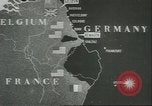
Allied Forces advance from France and Belgium to cross the Rhein River at Remagen during World War II
Film starts showing animated map of American forces driving East from France and British forces.including the 53rd Infantry Division, from Belgium toward the Rhein (Rhine) River in Germany. Allied infantry and armor gathering on a street in France. Closeups of some soldiers in berets mingling with American troops. Left shoulder of a soldier with Engineers patch. Another with white cross in white circle. American troops entering Bad Godesburg, where many white flags are displayed. An M4A3 Sherman tank moves along a street. "Adolf Schmitz" written on building in background U.S. infantry and armor moving through the town cautiously subject to lingering sniper fire. Views of signs identifying shops and commercial establishments in the town. U.S. soldiers silhouetted looking out of an upper story of a building where they are firing a machine gun towards a sniper's nest. German soldier surrendering and being searched briefly. A wounded person being carried on a litter by two civilian men, accompanied by a woman wearing a Red Cross armband. Scene shifts to road in countryside, clogged with long line of German prisoners of war being escorted under armed guard. Closeups of some of the prisoners and guards. Views of the Rhein river with many bridges destroyed by retreating German forces. Closeup of an American tank crew in their M4A3 Sherman tank. The Bridge at Remagen, with a sign on it reading: "Cross the Rhine with dry feet courtesy of the 9th ARMD Div." American soldiers guarding the bridge against air attack man an M33 twin mount 50 caliber antiaircraft machine gun. Another gun crew firing an M45 quad mount 50 caliber antiaircraft machine gun at attacking German aircraft attempting to destroy the Remagen bridge. Another antiaircraft gun defending the bridge. View from some distance of bomb bursting near the bridge, raising a geyser of water. Back at the bridge, itself, American infantry and vehicles continue to pour across it. Closeups of some and of soldiers in the vehicles. An M4A3 Sherman tank completing the crossing and moving on the German side of the river. Infantry walking along the roadside.
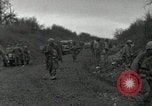
Infantrymen of U.S. 94th Division,301st Regiment destroy a German roadblock in Oberleuken, Germany (WW2)
Infantrymen of U.S. 94th Division, 301st Regiment advance in Oberleuken, Germany during World War 2. Infantrymen advance along a road. A German roadblock destroyed by explosions. Soldiers clear debris after destroying the roadblock. Soldiers use minesweepers over the area. M4 Sherman tanks and infantrymen pass after clearing of road. Soldiers set detonation wire into place. ( Note: The final column of M4 Sherman tanks are worth noting as they are M4A2 dry stowage tanks received from the British as evidenced by the "T" numbers visible on a number of the tanks in the clip and British spare track stowage. The tanks are fitted with U.S. radios, as evidenced by the antenna.)
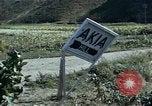
U.S. Marines and M26 tanks advance on a road in mountainous area of Korea.
U.S. Marines pose around a sign pointing toward AKIA Hill, during the Korean War. POV from inside a jeep with angle iron cable cutter on front bumper visible. It is stopped while Marines walk ahead on both sides of the road, ahead of it. View of knocked out North Korean T-34 tank with burned body of tank crewman lying on top. smoke rising from burning T-4 tank. Marines walk past a knocked out camouflaged T-34 tank. Marines standing around a cart loaded with explosives, labeled C-4. Marines walk past bodies of dead North Korean soldiers lying in grass at roadside and in hill at side of road. Marine with mobile radio set stands on bluff overlooking a cluster of buildings below. M26 Pershing tanks with many Marines riding on top, start up and move along a road in highlands. Other Marines are resting at side of the road. Marines taking cover in grasses at side of road. (Korean War)
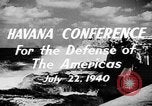
The march to U.S. involvement in World War II, during 1940-1941
Presidential Palace in Havana. U.S. Secretary of State, Cordell Hull speaking at the Havana Conference. Flags of Nations attending. Franklin Roosevelt, on May 16, 1940, telling congress to mobilize for national defense. Airplane and engine factories and manufacturing plants. Navy ships being built. U.S. sailors and marines on parade. U.S. soldiers training with mock weapons. Flour bag "bombs" hitting a U.S. Army tank M2. Army trucks labeled "tanks." U.S. Army tanks M3. Empty "Adelphi" brand beer cans used for training. National Guard units Nationalized. President Roosevelt reading first draft numbers under the Selective Service Act. New recruits getting draft notices and physical exams. New soldiers in boot camp. German Ju 87 and Dornier 17 bombers taking off. Animated map showing German air attacks against Britain. View of radio broadcaster Edward R. Murrow in studio as he is describing the "Blitz" from London. German He 111 bomber aircraft in flight during blitz bombing of London, England, United Kingdom. British antiaircraft guns firing. London citizens in underground bomb shelter. British Fire brigades directing water hoses on burning buildings. British warships at sea. U.S. Destroyers transferred to Britain. British Prime Minister Churchill assigning military base rights to the U.S. Assistant Secretary of State, Berle. Brandenburg Gate and German, Italian, and Japanese flags flying in Berlin on September 27, 1940 Hitler greeting Italian Galleazzo Ciano, and Japanese representative Saburo Kurusu. Signing of Berlin Pact. London civilian citizens resting in underground air raid shelters, while the relentless bombing goes on. American Charles Lindbergh talks to an audience and says Britain is losing the war. Next scene shows Wendell Wilkie saying "England will not only survive, England will win!" British people cleaning up after a German blitz bombing run during the Battle of Britain. Fire fighter moving a mannequin from a store among rubble; a large commuter bus on its side and resting against a building in rubble; a British man with a hard hat clearing rubble finds a small British flag and mounts it in a wall. Polls showing increased American support for Britain based on polling between 1936 and 1941.
America fully mobilized in World War II
Opening slate announces 11 million Americans to bear arms (in World War 2.). U.S. Army Chief of Staff, General George S. Marshall conversing with Chief of Naval Operations, Admiral Ernest King. Next, Admiral King is seen standing with Commanding General of the U.S. Army Air Forces, Lieutenant General Henry H. (Hap) Arnold, and Admiral William D. Leahy, Chief of Staff to the President of the United States. Scene shifts to a graduating class of cadets from the United States Military Academy, at West Point. They are seen receiving their diplomas. West Point cadets are also seen cheering at an athletic event and in several views of them marching in formations on different occasions. Views of cadets from the U.S. Naval Academy, at Annapolis, Maryland, on parade and at a graduation ceremony in Dahlgren Hall, where each receives a diploma and they toss their hats into the air at the end of the ceremony. Next, ordinary citizen soldiers (mostly draftees) are seen marching in formation They participate in calisthenics en masse. Heavyweight boxing champion, Gene Tunney, is seen leading an exercise session. Soldiers run over an obstacle. Next cadets are seen on parade in the U.S. Merchant Marine Academy, at Kings Point, New York. Some cadets are seen practicing escape from a burning vessel at sea. U.S. soldiers engage in field training that includes live weapons fire above their heads as they crawl under barbed wire on a training course. View of soldier firing a Browning M1917 water-cooled machine gun near the trainees. Another is firing a Browning M1919 air-cooled machine gun.
U.S. aircraft on a landing strip, soldiers refill gasoline cans at the IX corps camouflaged headquarters in California.
U.S. Army IX Corps combat operations at desert training centers in California. Landing strip and desert training center area. Four aircraft being parked on the strip. Camouflaged HQ (headquarters) behind the bushes and trees. Aircraft camouflaged with trees and bushes. Soldiers at work on the plane engine under camouflaged netting. Water tank truck leaves a water point. Soldiers refill portable gasoline cans. Crew refuels and starts a U.S. Army Medium Tank M-3 (M3 Lee) tank. A jeep pulls into the camouflaged HQ area. Two African American soldiers at work on a telephone pole. (World War II period).
CRITICALPAST.COM: About Us | Contact Us | FAQs - How to Order | License Agreement | My Account | My Lightboxes | Shopping Cart | Advanced Search | Featured Collections | Website Terms & Conditions | Privacy Policy ©2026 CriticalPast LLC.
License Agreement |
Terms & Conditions |
Privacy Policy
©2026 CriticalPast LLC.