


 Francais
 Deutsch
 Italiano
Refine Your Search
M4-training stock footage and images
- Showing 2899 to 2904 of 8223 results more
more Hide
Hide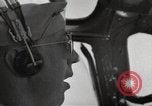
U.S. Navy PB4Y-1 Liberator bombers on mission in Marianas Islands during World War II.
Interior of U.S. Navy PB4Y-1 Liberator bomber in Marianas Islands during World War Two. Pilot at controls in PB4Y-1. His hand on the throttles. Instrument panel visible. Navigator shooting sunlines with sextant in top canopy. Radio operator tuning radios. Copilot in his seat in cockpit. Navigator charting aircraft position and course using weems plotter. View of other PB4Y-1 in flight.
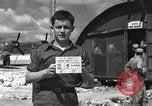
U.S. air crewmen boards U.S. PB4Y Liberator patrol bomber aircraft parked on an airfield in Pacific Theater during World War II.
U.S. Navy PB4Y Liberator patrol bomber aircraft with an aerial camera in the Pacific Theater during World War II. Air crewmen exit quonset hut. Air crewmen walk to PB4Y Liberator aircraft parked in the background on the island. Air crewmen enter PB4Y with aerial camera.
U.S. Waco CG-4 gliders unload airborne engineers to secure Myitkyina airfield after its capture during World War II.
Capture of Myitkyina airfield by Allied Forces during Burma Campaign of World War II. Animated map highlights Myitkyina airfield in North Burma which is captured by Allied ground forces on 17th of May, 1944. USAAF (United States Army Air Forces) Waco CG-4 gliders parked at Shingbwiyang airfield. USAAF officer inspects a map. Airbase engineering equipment are loaded aboard gliders. Tow rope of glider is hooked up with USAAF C-47 Skytrain transport plane. Airborne engineers board the glider. C-47 tows CG-4. CG-4 makes a landing at Myitkyina airfield under Japanese machine gun fire. Another glider makes a crash landing. Airborne engineers exit the gliders on field. A pilot and an engineer of crashed glider are given plasma and first aid. Wounded men are evacuated. Bulldozers level the airfield. Chinese soldiers search for hidden Japanese snipers in area.
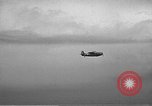
USN Lt. Edward Henry "Butch" O'Hare and LCDR James Thach, pilot F4F aircraft over Hawaii in World War II.
Lieutenant Edward O'Hare, the U.S. Navy's first ace fighter pilot of World War 2, is seen flying his F4F aircraft (number: F-13). Felix-the-Cat logo of the Navy Fighting Squadron Three (VF-3) is seen on his airplane, but only 4 Japanese victory flags are visible below his cockpit. Another F4F (number F-1) appears,flown by Lieutenant Commander John S. Thach, Commander of VF-3. Thach is flying with his canopy open. The VF-3 logo and 3 Japanese victory flags are painted on his airplane. With Thach in the lead, O'Hare maneuvers into the left wing position.
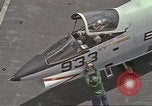
U.S. Navy aircraft RF-8A Crusader and A-4C Skyhawk on aircraft carrier ship USS Constellation (CVA-64) in the Gulf of Tonkin.
U.S. Navy aircraft carrier USS Constellation (CVA-64) in the Gulf of Tonkin. Raised canopy of a U.S. Navy RF-8A Crusader aircraft. A pilot sits in the cockpit. A U.S. Navy A-4C Skyhawk aircraft taxis over the deck. A man holds a nose wheel tow car and guides the aircraft. The canopy of the aircraft is open. The A-4C aircraft taxis towards an elevator. Two A-4C s on the deck edge elevator. (Vietnam War period.)
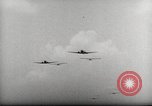
CG-4A gliders being assembled at Ford glider plant near Iron Mountain, Michigan during World War II.
Production of Waco CG-4A gliders at a Ford plant in Michigan, United States during World War 2. C-47 aircraft towing gliders. view of a glider from open door of a C-47. A CG-4A glider landing on a grass field and sliding to a halt just in front of the camera. A pilot seated in the front with a glass panel across the top half of the cabin. Soldiers march to load up in CG-4A gliders. A glider comes in for a landing in sand on a beachhead, followed by another. Exteriors of Ford glider plant near Iron Mountain, Michigan. Workers cover a part of a fuselage and set up wings. They attach wings to the glider.
CRITICALPAST.COM: About Us | Contact Us | FAQs - How to Order | License Agreement | My Account | My Lightboxes | Shopping Cart | Advanced Search | Featured Collections | Website Terms & Conditions | Privacy Policy ©2026 CriticalPast LLC.
License Agreement |
Terms & Conditions |
Privacy Policy
©2026 CriticalPast LLC.