


 Francais
 Deutsch
 Italiano
Refine Your Search
M4-training stock footage and images
- Showing 3709 to 3714 of 8218 results more
more Hide
Hide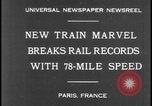
André Chapelon’s first locomotive rebuild for the Paris à Orléans (PO) railway in France on Paris à Orléans (PO) railway.
The Nord Pacific No 3566 locomotive as rebuilt by André Xavier Chapelon departs from a railroad train station in Paris along the Poiters-Angouleme route. Train's engineer, wearing goggles, looks through window as he operates train. View of exhaust as steam whistle is operated. Point of View shot toward back of train as it is underway. POV inside train, towards front of moving train as seen by train engineer. Speedometer indicates that train is running at 125 km/h, a bit higher than the French government speed limit of 75 mph (120 km/hr). Train passes by. Locomotive exhaust and whistle. This locomotive featured Chapelon's first major invention, the Kylchap exhaust, which was created with Finnish engineer Kyösti Kylälä, and produced less back pressure than previous designs. This modified prototype Pacific #3566 was originally 2000 indicated horsepower (IHP) but improved to a 3000 IHP with both fuel and water consumption reduced by 25% as a result of the rebuild process. Footage is from 1931, but first tests of this locomotive took place in November 1929.

Allied officers accept surrender of a German unit in Cordemais France; scenes of relief work for citizens and elderly in France.
Scenes in France near the end of World War 2, a sign "Cordemais" on a damaged building (likely the train station at Cordemais, France). A white flag of German surrender flies in the breeze. American sldiers stand near the building as a German surrender delegation approaches, led by negotiator Hauptmann Reinhold Mueller, to arrange handover of the St Nazaire enclave. A US Army soldier translator is seen speaking to the German officers and taking notes. French negotiator representatives are also seen, including one in black beret with a paratrooper insignia on his uniform. Red Cross representatives are seen taking notes. German and Allied officers (American, British, French) at the surrender conference. French civilians repair railroad tracks damaged during the war. French refugees are assisted by Red Cross workers. Troops board a train and it departs. A sign "Chantenay" (presumably at the train station in Chantenay-Villedieu). Group of people including boy scouts waiting to greet relief train as it pulls in to station. Close up views of the faces of men and women waiting to greet the train with civilians on board. Red Cross nurses walk quickly on railway tracks after train to greet it as it pulls into station. Men and women on train wave. Women, infants, and children first are seen getting off the train at an evacuation center. Scene changes to a snowy woods area and a large dwelling in the woods. A elderly woman collects firewood. An elderly man collects burnable twigs from trash cans and puts them in a bag. Three different older men shown filing a metal item in a vice with a metal file. Man picks up a small frame with a photo depicting a French officer in uniform. Grave site of a French soldier with cross marker and combat helmet hung from the cross top. Ground level view of a line of graves of French soldiers killed in World War 2, each with a helmet hanging on the cross grave marker. An old French woman praying with a rosary. A old woman sitting by a window. Another old woman huddled beside a wood stove rubbing her cold hands and pulling her blanket shawl higher on her shoulders. An old man taking tea in bed. A man rings a doorbell (hanging from a cord) in front of a hospice. Elderly man smokes a pipe and another lights his cigarette from it, women knit. Close up views of faces of elderly French people. Elderly dine at long tables in large hall. French people standing in a line outside a shop. Dix Francs currency of France shown. Views of young women typing and sewing. A diagram of human figures shown. Scenes from a house: An old woman knits, an old man reads, a young woman greets them with kisses.
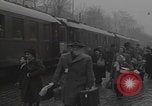
A family escaping the 1956 Hungarian Revolution leaves Vienna.
Refugee family carrying their luggage and belongings at train station platform in Vienna, Austria. The family boards the train before departure, some carrying “United States Escapee Program” bags. A man and his daughter (holding a doll) looking out from the train car window. A smiling woman refugee with her two daughters, both holding dolls, looks out from a railroad car window. Train underway, a woman refugee, identification tag still on her clothes, grabs a snack from a white paper bag and hands it her daughter. Girl eating a chocolate inside railroad train car. A man and his granddaughter eating snacks together on train, girl holding doll. Elderly Hungarian refugee woman with identification tag on clothes takes a nap next to train window. Man sleeps during train ride.
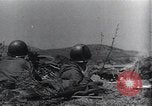
United States Army 187th Airborne Regimental Combat Team returns to Japan from Korea and is welcomed by City of Beppu, Oita
Clip opens with rapid changing scenes: American troops in trench in Korea during the Korean War. American tank on street in Germany. American Ski troops in Alaska. Amphibian assault training in Puerto Rico. Rotating Globe shows: U.S. Army on alert to defend against aggression. Sergeant Stuart introduces episdoe and states that U.S. Army has come to Japan to know their culture and make friends after war and occupation. U.S. Army troops of the 187th Airborne Regimental Combat Team, are seen arriving by railroad train at a train stateion near their base near Beppu,Oita on the island of Kyushu, Japan. U.S. Army soldiers, including white and African American soldiers, exit train cars. They receive a warm welcome from Japanese population. Banner reads:" Welcome Pala Troop comin back from Korea, City of Beppu."[sic] Women holding flowers and families with small children waving American and Japanese flags, welcome them on the train station. A sign over the train station platform reads: "Welcome 187 Para Troop Coming Back From Korea, City of Beppu." The troops stand in formation on the platform while the unit's officers receive the flowers from the women. Japanese men in fraternal uniforms and the general population all join in the welcoming ceremonies. The troops march off the train station under another sign reading: Welcome Home 187 RCT." and march down the main street of Beppu under a swirl of paper confetti. Next scenes are from autumn of 1945, as U.S. soldiers march through streets of Japan during occupation following the end of World War 2. U.S. troops seen marching behind Japanese police to occupy Japan, in 1945, amidst the aftermath of suffering and destruction of the war. The local population standing at road sides and watching with worry and concern. Scenes of postwar destruction in Japan. Rubble of bombed buildings. Scene of simple wooden dwelling shacks and wreckage nearby. A Japanese boy with his baby brother on his back. The baby is crying. Next scene moves again to circa 1950 in streets of a Japanese city, possibly Tokyo, rebuilt and with busy scenes of traffic on streets and commerce. Large outdoor rally with a Communist speaker addressing large crowd of Japanese people who sit and listen. Scenes from a what the narrator describes as a Communist rally in Japan, against America, which turns violent. Protestors running in streets during demonstration, with signboards and police and fire fighters extinguish flames at scene of an overturned, burning car. Flashback again to 1945 or 1946 as U.S. Army soldiers use tractors and heavy equipment to clear and level an area of war rubble and debris during rebuilding efforts after World War 2. Japanese citizens look on, watching the machines at work.
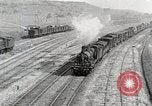
American Expeditionary Forces (AEF) moving by railroads in France during World War I
American forces moving by railroad in France during World war 1. A steam locomotive pulls a long train over tracks in a rail marshalling yard. The train includes troop passenger cars followed by flat cars carrying war materiel, such as wagons and artillery pieces, along with accompanying troops in the open. These are followed by more closed troop carrying cars. Next, U.S. soldiers and some sailors are seen walking on an outdoor rail platform as a train filled with sailors pull slowly into the station. Passengers and those on the ground wave to one another. View from front of a steam locomotive pulling a train headed toward the camera. A French woman moves a wheeled mobile gate beside a train track in France. French civilian men stand between nearby train tracks as a train carrying American soldiers passes them. Soldiers sit with their feet dangling out of the cars. An American flag is displayed on the last car.
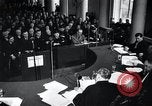
Jews loaded into railroad cars during World War 2; Trial of Nazi war criminal Hanns Albin Rauter in the Netherlands
Footage from 1948 and from circa 1943. War crime trial of Hans Albin Rauter in the Hague, Netherlands in 1948. Judges in tribunal give the floor to the public prosecutor ("procureur-fiscaal"). The prosecutor reads a statement in which he explains why the prosecution of Rauter is one of the two most important Dutch Nazi trials (along with the prosecution of Anton Mussert), and why Rauter deserves the death penalty. Flashback scenes from World War 2 of Jewish Dutch citizens being rounded up and loaded into railroad car for deportation slave labor camps and concentration camps while under guard by Nazi Germans. Jews loading into train cars. Some Jews are wearing Jewish star of David symbol on their clothing. Jewish people climbing into train cars, loading various goods in the train, German Nazi guards standing outside the train cars as men can be seen closing the doors and locking Jews inside railroad cars. Chalk writing on railroad cars filled with Jewish people includes one that says "74 pers." (indicating 74 persons in that train car). Steam comes out from the train locomotive. View of railroad train as it moves away on the tracks. Prosecutor completes his readings and sits down.
CRITICALPAST.COM: About Us | Contact Us | FAQs - How to Order | License Agreement | My Account | My Lightboxes | Shopping Cart | Advanced Search | Featured Collections | Website Terms & Conditions | Privacy Policy ©2026 CriticalPast LLC.
License Agreement |
Terms & Conditions |
Privacy Policy
©2026 CriticalPast LLC.