


 Francais
 Deutsch
 Italiano
Refine Your Search
M4-training stock footage and images
- Showing 3859 to 3864 of 8218 results more
more Hide
Hide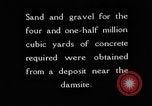
Transportation of raw materials and screening of gravels and sand during the construction of Boulder Dam in the United States.
The preparation and transportation of raw materials for the construction of Boulder Dam on the Colorado River in the United States. A crane and a train near the dam site. Sand and gravel picked from a pit by the crane and loaded in to rail cars. Trains arrive at a screening plant. A man near a train. The sand and gravel dumped into hoppers. Conveyor belts carry the material to the plant. A man near a conveyor belt. A man watches equipment screening over sized pebbles. A man near the screening plant. The screening plant with four towers for separating gravel of different size. Conveyor belts carry the screened gravel. Three different piles of gravel formed. Sand combined in a mixer. The towers of the plant in view. A man in a tower. Conveyor belts load the material into rail cars for transportation.
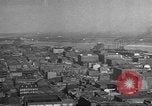
Men work in a factory and iron ore is transported to industries in the Midwestern United States.
Industries in the Midwestern United States. Aerial view of industrial and manufacturing buildings. Men punch in to a time clock using punch cards in a time clock. Men operate machines in a factory that makes machine parts. Coal transported in rail cars. A giant crane shovel loads iron ore in hopper cars in northern Minnesota. Hopper cars transport ore to shipping area at Lake Superior. Barges at docks on Lake Superior. Aerial view of barge underway on Lake Superior, still near land port. Side view of locomotive engine of Illinois Steel Company South Works, with conductor leaning out window, as it pulls away carrying iron ore. View inside plant as iron ore is converted to iron and then to steel for use in industries. Ships underway in inland waters. Close up view of black locomotive train engine in marshaling yard as it moves slowly. A rail worker is climbing on a side ladder of the moving train. View from behind train of hopper cars as it departs the marshaling yard. Trucks at a loading dock area. A United Air Lines DC-3 aircraft parked at an airfield. Passengers ascend ladder into the DC-3. The DC-3 United Airlines aircraft taxis, and number NC 25613 is seen under its left wing. Animated map show rail network, concrete highways and air network in the Midwestern United States.
The 201st Armored Division moves from one place to another using railroad transportation facilitate in the United States (WW2)
Short World War II propaganda film 'Troop Train' about the role of railroad transportation of military divisions in the United States. Men, tanks, troops, Jeeps and guns are moved to the battlefronts. A man talks over a phone. A sign: 'Clear the Tracks'. Transportation system in Washington. Men work in an office. A sign on a door : 'Transportation Corps'. Men talk over a phone. A sign on a door: 'Chief of Staff, Army Ground Forces'. Officers sitting around a conference table. A man speaks about the movement of 201st Armored Division by train. Army vehicles driven on a road. A train arrives.
U.S. Army soldiers with packs and barracks bags move to entrain at the New York port of embarkation in New York City
U.S. troops prepare to entrain at the New York port of embarkation, heading for service in the European Theater during World War II. U.S. soldiers with full packs and barrack bags move. A railroad train in the background. The soldiers move on a train platform. They stand beside railroad train cars.
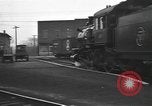
Some views of passenger and freight operations of the Detroit, Toledo and Ironton Railroad
A steam locomotive pulling a passenger train of the Detroit, Toledo and Ironton Railroad (acquired by Ford Motor Company in 1920) arrives at a station and passengers alight. Train leaves the station. Buildings at the station. A group of men on the station platform. Large water tank for servicing steam locomotives with logo of DT&I railroad on it. A porter wheeling a dolly passes on way to some buildings. Passengers standing on platform of train station. Railroad man switches several gondola rail cars to siding. A steam locomotive backing up pulls several Ford Motor Company gondola rail cars from a loading facility and then returns again. A local worker and his family are seen as he pushes two children in a swing. The family poses in front of a modest dwelling, and then go inside. One small house is a log cabin with chinking. The other is a simple wooden house or shack.
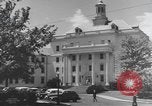
Setting up of hospitals to treat veterans suffering from neuropsychiatric disorders in the United States.
Medical facilities related to neuropsychiatric disorders being provided by the Veterans Administration in the United States. Exteriors of a V.A. hospital building. Animation shows the increase in number of neuropsychiatric patients from 1942 to 1950 and forecasts growing through the 1980s. Narrator describes high prevalence of such problems among veterans. (Also known as "shell shock" or, more recently, Post Traumatic Stress Disorder, or PTSD.) Exteriors of hospitals and training schools where neuropsychiatric specialists train. A doctor talks to a patient in a bed. Neuropsychiatric research being conducted in a laboratory. A technician works on an instrument. A neuropsychiatric specialist being trained. A technician works on an instrument. Psychiatrists discuss. They give various therapies to patients like the shock therapy, the socializing therapy in which a patient plays golf.
CRITICALPAST.COM: About Us | Contact Us | FAQs - How to Order | License Agreement | My Account | My Lightboxes | Shopping Cart | Advanced Search | Featured Collections | Website Terms & Conditions | Privacy Policy ©2026 CriticalPast LLC.
License Agreement |
Terms & Conditions |
Privacy Policy
©2026 CriticalPast LLC.