


 Francais
 Deutsch
 Italiano
Refine Your Search
M4-training stock footage and images
- Showing 403 to 408 of 8248 results more
more Hide
Hide
Allied troops fighting toward and entering Rome, Italy during World War 2
British and troop patrols converge on the road to Rome, in the beginning of this film. Soldiers of the 1st Canadian Infantry Division and 5th Canadian Armored Division are seen next, mopping up after breaching the Hitler Line, on 24 May 1944. They are seen leaving the area to advance further. Brief view of soldiers tending to a tank and marching past an abandoned anti-aircraft gun. Captured German prisoners march rearward along a road as a camouflaged (with foliage) Canadian M4 Sherman tank advances along a road. It carries many infantrymen riding along atop it. (Narrator states they are en route to Pontecarvo.) Allied artillery pounds the ruined streets of the city. Canadian troops are seen next,entering the destroyed town of Aquino. British Hawker fighter planes flying over water in trail formation, behind the camera plane. Allied patrol from the Anzio front engages a German strong point, using bazookas and small arms. Glimpse of burning German armored vehicle. Polish troops are seen entering the village of Piedimonte. They pull a German from his hideout in a trench. German prisoners marching under guard. Stretcher bearers carry wounded to an open field where they are being tended. Polish forces hold a ceremonial parade where British General Sir Harold Alexander decorates a Polish soldier. Brief closeup of General Alexander. June 4, 1944, American troops enter Rome. German Sturmpanzer (panzer) IV "Grizzly Bear" tank abandoned on the street. U.S. troops walking about in the city and in area of Piazza Venezia. Altar of the Fatherland in background. Local inhabitants cheering the Americans. Italians mob the local fascist controlled radio studio and force occupants to leave the building, abusing some as they depart. Views of happy crowds. Some showing newspapers announcing the arrival of the Allies.
Battle for Okinawa in World War II
U.S. infantry and M4 Sherman tanks move against heavily fortified Japanese positions on Okinawa during World War 2. American soldiers use flame throwers to dislodge Japanese defenders. Two soldiers run as an explosion occurs behind them. U.S. artillery firing from under camouflage netting. Glimpse of soldier walking past a burning building. Okinawan women and children seek refuge behind the U.S.Tenth Army lines. A soldier carries a naked baby to safety. View of Okinawan refugees (Ryukyuan people), mostly women and children and some old people, seated together where they are to be cared for by the Army's Civil Affairs Command. Wounded American soldiers being placed aboard a U.S. Air Transport Command C-47 aircraft number 42-72383. Change of scene to the battlefield where a U.S. Army soldiers throw a hand grenades that explode on a Japanese caves. A Japanese soldier is shot as he stumbles out of his cave. Another Japanese soldier is take prisoner. U.S. soldier fires his rifle and a Japanese soldier falls to the ground. Scenes shift to the sea off of Okinawa, where a Benson-Livermore class destroyer is seen under a sky full of black flak clouds. Closeup of the destroyer. A Japanese aircraft is shot down as it flies toward a U.S. New Orleans class heavy cruiser. It crashes into the sea near another U.S. capital ship. An attacking Japanese plane is shot down by anti-aircraft fire and crashes into the sea. More flak filled skies and bombs exploding along with machine gun fire raking the waters. Anti-aircraft tracer bullets firing from ships. A Japanese plane hit, is burning, and then explodes in the air. A Douglas dauntless aircraft lands on an aircraft carrier. Another aircraft doesn't make it to the carrier, and ditches in the water nearby. The pilot is seen standing on the plane's right wing, awaiting pick up. A Navy F4U Corsair plane approaches its carrier to land but loses control and crashes into the carrier's island. Firefighters direct streams of water on it's burning wreckage.
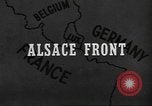
U.S. troops of the 79th Infantry Division engage German forces in the Alsace Front during World War II
Opening shows animated map of Alsace front at junction of Belgium, Germany, and France, in World War 2. Allied forces are schematically shown sweeping toward Wissembourg, Haguenau, and Strasbourg. Next, several U.S. Army M4A3(75) medium tanks are seen driving toward the camera on a rural road, during a pull back by the 7th Army in the first week of January, 1944, from advanced positions at the front. Some are filled with infantry riding atop them. The last of them is seen crossing a bridge 13 miles Northeast of Haguenau. The engineers of the 79th Division place demolition charges to destroy the bridge. Closeup of them placing and then remotely igniting the charge. A huge explosion ensues that completely destroys the bridge. Scene shifts to several U.S. soldiers of an engineer combat battalion preparing 100 pound of TNT in a captured blockhouse at Lauterbach, Alsace. Closeup of engineer carrying the explosives into the blockhouse and preparing the remote detonation device. The engineers string wire in the snow and setup their remote detonation device. One depresses a plunger to ignite the charge and blow up the blockhouse, which explodes in a huge cloud of black smoke. Next, elements of the 79th Infantry Division supported by tanks, are seen moving forward to counter German gains Southeast of Haguenau. (On January 5th the German forces had established a bridgehead across the Rhein (Rhine) river near Gansheim, Germany.) Scene shifts to Drusenheim, Germany where U.S. forces are engaging a Battalion of occupying German forces. Machine gun fire is heard constantly, as American infantry battle the hidden German defenders and tanks drive them from defensive positions near a bridge at the far end of town. Infantry move from behind tanks toward the bridge and are seen crossing it. An M4A3(75) medium tank risks crossing the narrow bridge and is immediately followed by many 79th Infantry troops. The battle continues on the other side of the bridge.
United States Marine Corps of the 6th Marine Division fire rifles in Okinawa, Japan during World War II.
6th Marine Division of the United States Marine Corps at Naha, Okinawa in Japan during World War II. A United States M4A3 Sherman tank moves along a road. A Marine walks beside the tank. Marines fire from behind a stone wall. M4A3 Sherman tank fires at the enemy. Damaged Okinawan houses in the village. The Marines advance on hilly terrain and fields. One of the Marines throws satchel charge outside a Japanese cave entrance. Smoke and explosion at the cave. 6th Marine Division Corps fire rifles.
A chemical is sprayed with the help of army aircraft to kill malaria mosquitoes and cotton boll weevil in the United States.
Aircraft dust cotton fields and swamps to kill boll weevil and mosquitoes in the United States. A hangar. A pilot and crew members stand in front of the hangar which has three compartments. Officers and civilian pilots of aircraft check a map of the area to be dusted. U.S. Army aircraft De Havilland DH-4M2 in the background. Crew members prepare two De Havilland DH-4M2 for the take off. The aircraft dust the cotton fields. Swamps are sprayed to destroy malaria mosquitoes. The aircraft hedge-hop over swamp lowlands and tree covered terrain dusting the spray. A haze over the area.
14th Armored Division in Gemunden, Germany, during World War II.
German prisoners taken by U.S. Army in burning town of Gemunden, Germany, during World War 2. German prisoners cross bridge passing M-4 tanks. Burning town in the background. Brigadier General Albert C Smith, CG, 14th Armored Division, XV Corps, Seventh U.S. Army. General stands at end of bridge and watches German prisoners of war with hands over their heads, being escorted under guard. . He converses with member of his staff. M-4 tanks, U.S. half tracks and ambulances speed through streets. Houses in the background are in flames.
CRITICALPAST.COM: About Us | Contact Us | FAQs - How to Order | License Agreement | My Account | My Lightboxes | Shopping Cart | Advanced Search | Featured Collections | Website Terms & Conditions | Privacy Policy ©2026 CriticalPast LLC.
License Agreement |
Terms & Conditions |
Privacy Policy
©2026 CriticalPast LLC.