


 Francais
 Deutsch
 Italiano
Refine Your Search
M4-training stock footage and images
- Showing 4165 to 4170 of 8218 results more
more Hide
Hide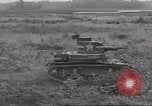
U.S. soldiers demonstrate decontamination of a combat tank at Aberdeen Proving Grounds in Maryland.
U.S. Army soldiers demonstrate decontamination of chemical agents such as mustard gas from a combat tank at Aberdeen Proving Grounds in Maryland, during World War 2. A tank moving on a training ground. Two soldiers decontaminate the vehicle using a spray (second echelon decontamination using Decon 3 devices, which are 3 gallon sprayers). One soldier stands on the tank and decontaminates it. Under carriages heavily encrusted with mud. Two soldiers spreading lime on the ground. A tanker passes through the lime mud slurry to coat the track and wheels. Two soldiers spraying a tank with high pressure water to remove mud from the under carriages. Now they spray the tanks with lime. A water tanker arrives. An aircraft passes over at a low height. A heavy smoke screen in the background. Soldiers wearing cellophane protective covers. Narrator states that the training procedures shown were conducted with real mustard gas.
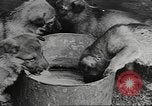
U.S. Army Quartermaster Corps War Dog and grave registration activities during World War II in the Pacific.
Opening scene shows German shephard puppies and their mother in World War 2. Several dogs and their handlers are seen. A dog being aggressively trained by a heavily padded trainer inciting the dog to attack him. Scene shifts to a sign reading "40th QM War Dogs" (40th Quartermaster War Dog Battalion).It is on a rustic compound fence in a jungle area of the Pacific. Dogs here are not aggressive, but are trained to be alert reliable companions to their respective handlers. Next, several soldiers and their companion dogs are seen walking along a jungle trail. Scene shifts abruptly to a completely different aspect of Quartermaster activity: Graves registration. Army pallbearers carry a fallen soldier on a stretcher, covered with an American flag, into an established military cemetery in the Pacific. Soldiers commence burial procedures. Views of the cemetery from a structure therein, showing numerous white crosses, and an extremely tall flag pole displaying the American flag. Scene shifts, to Quartermaster troops assembled in a chow line, as a bugler blows. Two GIs eating by a large tree.
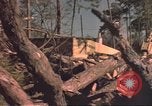
Demonstration of construction and allotment of the house under the HUD Forest Heights Project in Mississippi, United States.
Construction and allotment of houses under the Forest Heights Project of the Department of Housing and Urban Development (HUD), in Mississippi, United States. The earth movers clear the land for the houses to be constructed. The officials discussing the Site Development Phase. Two workers working. A surveyor at work with a leveling instrument. Carpenters and workers construct a house. A tractor clearing land. A man and a woman enters Thiokol Chemical Corporation premises. Thiokol designs and constructs home management and maintenance training program for participating families. The officials are receiving and verifying the qualification of the home buyers. An official passes on the list to the program director who certifies whether an applicant is eligible or not. The list is then passed to the Community Participation Committee made of members of the National Council of African American Women and the Civic Action Committee. Members of Community Participation Committee have meeting. The recommendations are now forwarded to the Local Housing Authority for the final approval. The approved families are being given pre-occupancy training. The instructor distributes some pamphlets to the candidates. African American woman demonstrates the operation and use of a home appliance. A woman addresses the candidates. A house in the background.

Men work on a railway exhibit for the upcoming Worlds Fair in New York.
A railway exhibit prepared for the Worlds Fair in New York, United States. The model includes bridges and roads. Men make adjustments in the model. The model built to a tiny but accurate scale. A train passes by on the tracks. Construction machinery at work. A man controls the model using a switchboard. 'Eastern' written on a railway carriage. A goods train on the tracks. The New York City skyline.
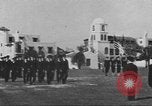
Candidates supervise cargo loading and make engine room repairs aboard a ship in Pass Christian, Mississippi.
Merchant Marine Academy officer candidates learn seamanship at at a basic school in Pass Christian, Mississippi. The candidates march and stand at attention as their training is over. After the training two candidates meet a Cadet Corps officer. They board a ship and meet another officer. The Merchant Marine Academy candidates change their uniform. They supervise a cargo. A candidate operates an equipment aboard the ship. They make engine room repairs. A convoy at sea.
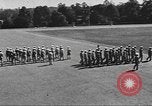
Candidates practice drill and learn naval science and operate anti-aircraft guns at the USMMA in Kings Point, New York.
Merchant Marine Officer candidates learn seamanship at the United States Merchant Marine Academy ( USMMA ) at Kings Point in New York, United States, during World War 2. The candidates practice drills during training. The book of United States Navy Regulations. The cadets learn naval science in their advance training. They learn tactics and maneuvers by operating artillery and antiaircraft guns. They learn to recognize ships and aircraft. The candidates learn to operate anti aircraft guns and machine guns.
CRITICALPAST.COM: About Us | Contact Us | FAQs - How to Order | License Agreement | My Account | My Lightboxes | Shopping Cart | Advanced Search | Featured Collections | Website Terms & Conditions | Privacy Policy ©2026 CriticalPast LLC.
License Agreement |
Terms & Conditions |
Privacy Policy
©2026 CriticalPast LLC.