


 Francais
 Deutsch
 Italiano
Refine Your Search
M4-training stock footage and images
- Showing 4321 to 4326 of 8218 results more
more Hide
Hide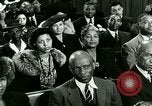
Film illustrating participation of African Americans in U.S. history from Colonial times to after the Civil War
Opening scene shows African American congregation in church, during World War 2, listening to their preacher speak about liberty. Closeup of the Minister speaking. As he refers to the seed of Liberty taking root in Boston, a plaque on the gate of the Granary Burial Ground of 1660 is shown reading: "Within this ground are buried the victims of the Boston Massacre, March 5, 1770." The gate swings open revealing the cemetery. Next, an illustration of British Redcoats shooting into a crowd on that occasion is shown. Closeup of the illustration shows an African American, named Crispus Attucks, falling as the first victim of the gunfire. A monument to him on Boston Common, is then shown. Closeup of the monument. Excerpt from a film about the Revolutionary War shows reenactment of the battle off Concord. The 221-foot granite obelisk at Bunker Hill, Boston, is seen, marking the site of the first major battle of the American Revolutionary War. A musket is seen with a sign attached reading: "Gun belonged to Peter Salem, a colored man who carried it at Lexington, Concord, and Bunker Hill, and with it shot Maj. Pitcairn." (Refers to Major John Pitcairn, a Scottish Marine officer, killed at the battle of Bunker Hill.) Illustration and painting of Peter Salem with his musket in the company of other patriots, is shown, as well as a glimpse of a mass reenactment of the battle of Bunker Hill. Next is seen the famous 1851 oil-on-canvas painting of Washington Crossing the Delaware, by the German American artist Emanuel Gottlieb Leutze. Closeup of one oarsman, identified as African American, Prince Whipple. Film Reenactment of the ragtag American army at Valley Forge in the snow, shows their suffering. Among them is an actor in the role of African American, Salem Poor, who had purchased his freedom from slavery and fought with Washington's army. A bell ringing and the American flag of 13 stars signifying the 1776 Victory. Film reenactments of pioneers including whites and African Americans working together, felling trees and building forts and barns, and the like. Scene shifts to a man of war ship under sail firing a salvo from its cannons. This is followed by illustrations of Commodore Perry in the battle of Lake Erie, during the War of 1812. In a dory with Perry is a black man named Tyler Thompson. War ships exchange gunfire. Narrator cites Perry's famous words of victory: "We have met the enemy and they are ours." Scene shifts to a painting of American general Andrew Jackson and his troops, at the Battle of New Orleans, in 1815. A battle reenactment shows a black American soldier participating. Postwar view of American ship building activity. View of a large sailing vessel. Cannon fire ushers in the Civil War in 1861 as Confederates fire on Fort Sumter. Images of combat are overlaid by the statue of Abraham Lincoln in his memorial at Washington, DC. Next, settlers are seen heading West in a wagon train. Camera focuses on a black couple who are part of the wagon train. White and African American men work side-by-side building a railroad. An early steam locomotive races along the tracks. .
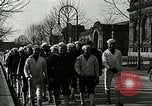
American sailors work unloading lumber and coal cars in the United States.
American sailors at work in the United States near grounds of U.S. Naval Training Station, Great Lakes training facility (Naval Station Great Lakes) in World War I. A group of sailors walks along a street. Buildings along street sides. The sailors carry boxes and lumber boards. They unload coal cars with shovels from raiload cars labeled C&E (Chicago and Eastern Illinois Railroad). The sailors aboard a small vessel 'SP-1011' underway in water. The vessel is tied up at a dock. A sailor mends his cap. A propaganda slate urges American citizens to support the country and the President.
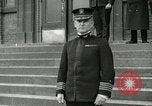
Captain William Adger Moffett and enlisted men pose on the steps of building in Great Lakes, Illinois.
The U.S. Naval Training Center in Great Lakes, Illinois (Naval Station Great Lakes) during World War I. United States Navy Captain William Adger Moffett, commanding the training station, poses on the steps of the building. Other officers join him. The group including enlisted men poses.
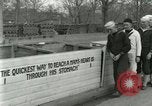
U.S. sailors stand in a chow line and take food from trays and platters at Naval Station Great Lakes
Food for U.S. Navy sailors in training in the United States during World War I. At the Naval Station Great Lakes training facility, sailors seen near a large bin. A sign on the bin reads: 'The quickest way to reach a man's heart is through his stomach'. The sailors get plates from the bin and stand in a chow line. They choose food from trays and platters. Workers behind counters place food on plates as the sailors pass. Officers in a hall. Pictures on a wall. Men walk past. Officers, one with a notepad and a pencil in hand, watch a kitchen worker working out on a punching bag. A seaman poses on steps with a cut-out of the Statue of Liberty.
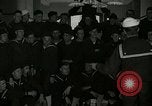
U.S. sailors engage in recreational activities as a sailor pretends to hypnotize two men and other sailors enjoy in the U.S.
During World War I, at Great Lakes Naval Training Station, U.S. Navy sailors in training engage in recreational activities. A sailor pretends to hypnotize two men. Other sailors watch them. They laugh watching the hypnotist and his subjects.
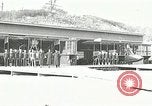
Sailors pull a seaplane out of a hangar and move it down a wooden ramp towards water at Naval Station Great Lakes
During World War I, U.S. Navy sailors in training at the Great Lakes Naval Training Station in the United States. The sailors are seen near Curtiss F-Boat aircraft hangars near the water. Airplanes half out of the hangar doors. The sailors pull a seaplane out of a hangar. They move it down a wooden ramp towards Lake Michigan.
CRITICALPAST.COM: About Us | Contact Us | FAQs - How to Order | License Agreement | My Account | My Lightboxes | Shopping Cart | Advanced Search | Featured Collections | Website Terms & Conditions | Privacy Policy ©2026 CriticalPast LLC.
License Agreement |
Terms & Conditions |
Privacy Policy
©2026 CriticalPast LLC.