


 Francais
 Deutsch
 Italiano
Refine Your Search
M4-training stock footage and images
- Showing 4435 to 4440 of 8218 results more
more Hide
Hide
League of Nations delegates after meeting: Scialjoa of Italy, Villegas of Chile, De Bethancourt of Cuba, Dandura of Canada
Delegates of the 7th Assembly of the League of Nations at the Council Meeting in Geneva, Switzerland. The meeting is over and the Council members leave the hall. Shows several delegates such as M. Scialjoa of Italy, M. Villegas of Chile, De Bethancourt of Cuba, Raoul Dandurand of Canada. Empty meeting hall. Women work on typewriters.
League of Nations Assembly to discuss the Italian and Ethiopian problem in Geneva, Switzerland.
View of League of Nations Assembly in session to discuss the Italian and Ethiopian problem in Geneva, Switzerland. Baron Aloisi of Italy makes speech in French. M. Laval of France makes statement. Anthony Eden of Britain makes statement regarding maintenance of peace. M Tecle taklu Hawariate of Ethiopia makes his speech. Shows graphic detailing of the Cost of last war, Cost of world armaments and the Cost of League of Nations in comparison.
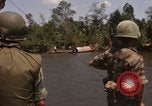
Vietnamese Navy and Marines combined assault in Kein Hung, Vietnam.
Vietnamese soldier armed with M-16 rifle looks at shoreline at Kien Hung in Vietnam. Armored troops carrier (ATC) fires flamethrowers on the riverbank. Republic of Vietnam (RVN) marines disembark camera boat. Boats underway. Vietnamese soldiers in prone position fire M-16s. Marine officer on radio. RVN marines with American advisor. RVN marine sitting on log rests. Vietnamese junk and ATC's underway in river. Machine gun fired. Insignia shows Lion with Mermaid's tail. Assault boats underway in river. Troops disembark. Unites States Marine Corps (USMC) captain at the riverbank. MM canon on boat fired. (Vietnam War period).
Army helicopters at Phu Tho Racetrack during Vietnam War in Saigon.
U.S. soldiers posted in Saigon Vietnam during the Vietnam War. Opening slate reads: "8 Feb 68, After Action (Saigon/Cholon)." UH-1D helicopters off loading U.S. Army soldiers of 199th Light Infantry Brigade. OH-23 helicopter takes off from Phu Tho Racetrack, (It has been suggested that the Commander, 2nd Bn 40th Arty might be aboard.) Soldiers walk across field along with sentry dogs. A formation of UH-1D Huey helicopters lands in the race track center, raising dust. Next, soldiers are seen walking across the field, carrying their weapons and gear. Closeup of one carrying an M67 recoilless rifle. They step over the racetrack railing and walk to the grandstand building. Change of scene shows U.S. soldiers, stripped to the waist, setting up an m29-81mm-mortar.They pause and look up as another formation of UH-1D Hueys lands in the field. One of the mortar crew turns upright, a wooden box and frame, containing a toilet seat. It sits next to another just like it. Troops stream across the field, as they leave their helicopters.
Brigadier Kinder with officers at a dock area and Charles A. Halleck and his wife leave a patrol boat in Wiesbaden, Germany.
U.S. Congressmen and high ranking officers arrive at the United States Air Forces in Europe in Wiesbaden, Germany. Late model automobiles leave the Lindsey Air Force Base gate. A sign reads 'Lindsey Air Base'. A man stands outside a door. A man standing in front of the gate of a building salutes. Brigadier Herbert M. Kinder, Judge Advocate,USAFE and other naval and air force officers in the dock area of Schierstein naval port. Representative Charles A. Halleck and his wife leave a U.S. Navy Rhine River Patrol boat. Accompanying them in civilian clothes is General C. J. Hauck,Jr. Chief of Legislative Liasion in the office of the Secretary of the Army and wave commander, Elma Ellis. Representative Halleck is greeted on the dock by General Herbert M. Kinder.
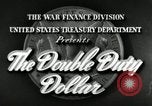
World War 2 film promoting public investment in War Bonds and stamps to aid the war effort and temper inflation
World War 2 era film that also includes some World War 1 scenes. Show girls or chorus girls in follies-like show, costumed as U.S. silver dollars and marching to tune and lyrics alluding to dramatic increase of currency in circulation, over the years. Animation with stacks of coins shows increase in national income from $46 billion,in 1933, to $71 billion, in 1939, and $142 billion in 1943. Back to the "follies dollars," a boy asks why, and then scenes of the Japanese attack on Pearl Harbor,are shown, with U.S. battleships being sunk. Wartime arms plants are shown. An M2A3 Light Tank rolls off a production line. Ships being constructed in a shipyard. B-24 Liberator bombers being built in a factory. Artillery shells being produced. Defense workers receiving their pay. The "follies dollars" group themselves to illustrate the fractions of income devoted to taxes and savings. But other spending is curtailed by wartime shortages. A woman talking with clerk in a drug store. U.S. Army troops crossing a pontoon bridge in open trucks, towing 75mm M1A1 howitzers. Infantry on the march. Animation showing industrial production devoted to war materiel and lots of dollars chasing few civilian goods. A grocery clerk offers to sell a woman customer butter for more than the established price, and she agrees. The "follies" performers then introduce the idea of an "inflationary dollar," and some history of past U.S. inflations. Animated examples of price inflation are shown. Glimpses of World War I scenes are seen, circa 1917 -1918, including: a 12-inch railway gun firing; a huge explosion from shell bursting near the camera; various scenes of United States infantry soldiers and French soldiers in battle action, running to bomb craters for cover and emerging from trenches to go up "over the top" into no-mans land during combat. Meanwhile, singing narration refers to the home front inflation due to competition for limited civilian goods. Map shows Europe and singing narration cites rising prices for food in occupied France and other countries suffering ravages of World War II. Montage of scenes showing needy civilians obtaining food in those countries. Animation shows increases, by 1944, in cost of U.S. civilian goods since the Pearl Harbor attack. "Follies" character called "Double-duty dollar," appears explaining he serves the war and curtails inflation on the home front by being saved through investments in War Bonds and stamps.
CRITICALPAST.COM: About Us | Contact Us | FAQs - How to Order | License Agreement | My Account | My Lightboxes | Shopping Cart | Advanced Search | Featured Collections | Website Terms & Conditions | Privacy Policy ©2026 CriticalPast LLC.
License Agreement |
Terms & Conditions |
Privacy Policy
©2026 CriticalPast LLC.