


 Francais
 Deutsch
 Italiano
Refine Your Search
M4-training stock footage and images
- Showing 4549 to 4554 of 8218 results more
more Hide
Hide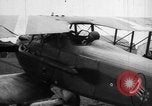
Three ground crewmen work on a SPAD S. XIII and a group of officers of 94th Aero Squadron in Toul, France.
United States Army Air Service (USAAS) 94th Fighter Squadron in Toul, France during World War I. Captain J. A. Meissner climbs out of the cockpit of Eddie Rickenbacker's SPAD S. XIII fighter aircraft and walks away. "Hat in Ring" insignia on side of the aircraft. Three ground crewmen work on a SPAD XIII. 1st Lieutenant Allan Rankin who is an Engineering Officer reads a notice. They pound each other on the back and jump around. Commanding Officer 1st Pursuit Squadron Major Hartney and Operations Officer 94th Aero Squadron Lieutenant Cunningham stand in front of a Fokker V-8 shot down by Lieutenant Rickenbacker. In Toul, France on 18th April, 1918: A group of officers of 94th Aero Squadron including Major J. W. F. M. Huffer, Major Raoul Lufbery, Captain J. N. Hall, Captain Kenneth Marr, Captain D. McK. Peterson, Lieutenant J. B. H. Smith, Lieutenant C. A. Rankin, Lieutenant Reed Chambers, Lieutenant Douglas Campbell, Lieutenant W. L. Loomis, Lieutenant James N. Neissner, Lieutenant M. E. Green, Lieutenant A. L. Cunningham, Lieutenant A. F. Winslow, Lieutenant C. W. Chapman and Lieutenant P. H. Walter, Surgeon, standing in front of a USAAS Nieuport 28 C-l.
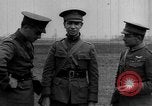
Officers of the 94th Aero Squadron standing beside different airplanes during World War I
United States Army Air Service (USAAS) 94th Aero Squadron in Toul, France during World War I. April 1918 - Commanding Officer 94th Aero Pursuit Squadron Major John W.F.M. Huffer and French-American pilot Major Raoul Lufbery talk with AEF weekly newspaper "Stars and Stripes" editor Major S. P Adams. Captain David M. Peterson stands beside a Nieuport 28c.1 fighter aircraft,with its "Hat in Ring" insignia on the side. 1Lt. Alan F. Winslow stands beside Lt Rickenbacker's Nieuport #12 and starts walking. Jump to November, 1918 - the remaining officers of the 94th Aero Squadron reunite, including Captain James A. Meissner (C.O.147th Aero), 1st Lt Joseph Eastman, Captains Eddie Rickenbacker (now C.O. 94th Aero) and Reed Chambers, and 1st Lt Thorne Taylor (all 94th) standing beside Rickenbacker's SPAD S.XIII #1 parked in front of a hangar at Foucaucourt Aerodrome, France, November 1918. (WWI,WW1, World War One, First World War)
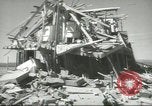
Soldiers assess damage from atomic explosive test shot,"Apple Two," during U.S. Army exercise Desert Rock 6.
Views of various structures and objects after being exposed to atomic explosive test shot "Apple 2" during U.S. Army Exercise Desert Rock VI. A wooden frame house splintered by the blast. A low concrete structure, relatively intact. An overturned Army vehicle. An unsheltered low-wing monoplane, number NG 489851, with skin stripped from its horizontal stabilizer and wing tips. A P-47 aircraft appearing relatively intact. A badly damaged two-wheel trailer. A relatively unscathed auxiliary power unit on a stabilized trailer. Vehicles reduced to rubble. Radar unit and accompanying truck and power unit, seemingly OK, but dish antenna may be damaged. Three soldiers stand around an M2HB heavy machine gun knocked from its stand. A B-29 bomber sits on a ramp with a sign in front of it warning of radiation. A ground crewman sprays the bomber down with a pressure hose to decontaminate it by washing off radioactive particles. A soldier rides a jeep out to check radiation readings on a vehicle that had been exposed. Troops walk back from ground zero and undergo personal cleaning with brooms and checks by geiger counters. A soldier being checked, including his boots. Soldiers sweeping dust from M48 tanks used in the exercise. A soldier being "interviewed" by another, about means of coping with atomic weapons on the battlefield. A formation of soldiers marching, led by one carrying a Corps of Engineers Guidon with the number 14 on it. [Note: According to the U.S. Department of State, Office of the Historian, from February 18 to May 15, 1955, the United States conducted Operation Teapot, a nuclear test series at Yucca Flat and Frenchman Flat on the Nevada Test Site in the continental United States. During the test period 14 nuclear shots and 1 non-nuclear shot were detonated. Several thousand scientific, military (army, air force, navy, marines), and civilian contract personnel participated in the organization, planning, and execution of the test series. Military exercises undertaken during and following the shots took place under the name Desert Rock 6.]
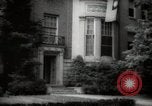
Chinese officers of military mission talk together at a house in Washington D.C. during World War II.
Chinese Military Mission at a house in Washington DC during World War II. Exteriors of a house used by Chinese Military Mission. Chinese flag flies from the building. Interiors show Chinese officers at desk, Lieutenant General Hsiung Shih Fei and Captain M. H. Robert Lee seated. Group at tea table includes Colonel Wen-Tehih Tesi, Lieutenant General Hsiung Shih Fei, Major Tuh-Foo Chiang, and Captain M. H. Robert Lee.
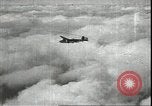
Japanese twin-engine bombers drop bombs over British ships underway off the coast of British Malaya during World War II.
Simulated warfare showing Japanese bombers attack British ships off the coast of British Malaya during World War II. A twin-engine Japanese Mitsubishi G3M bomber in flight over sea. Interior views of of the Mitsubishi G3M aircraft show Japanese pilots and crew looking from window using binoculars. The Japanese pilots talk into radio. Formation of Japanese bombers. The bombers pass through thin clouds. The interior of the aircraft shows a pilot wearing headphones. Others have towel bands around their heads and look down at the sea. Aerial view of three British ships underway. The ships change direction. Guns aboard the ships being fired. Japanese bombers attack and causes an explosion on a ship. More bombs are dropped. The ships exploded by bombs. Clouds of black smoke curl upward into the sky.
A patrol of U.S. Long Range Patrol 51st Infantry soldiers on an alert in a jungle in Vietnam during the Vietnam War.
A patrol of U.S. LRP (Long Range Patrol) 51st Infantry soldiers on a jungle path in Vietnam during the Vietnam War. The last soldier walks backwards as he looks around. A soldier with an M18A1 Claymore mine moves out. Soldiers on an alert in brush with M-60 machine guns. A soldier sets the Claymore mine.
CRITICALPAST.COM: About Us | Contact Us | FAQs - How to Order | License Agreement | My Account | My Lightboxes | Shopping Cart | Advanced Search | Featured Collections | Website Terms & Conditions | Privacy Policy ©2026 CriticalPast LLC.
License Agreement |
Terms & Conditions |
Privacy Policy
©2026 CriticalPast LLC.