


 Francais
 Deutsch
 Italiano
Refine Your Search
M4-training stock footage and images
- Showing 4651 to 4656 of 8218 results more
more Hide
Hide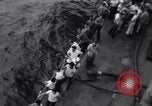
Naval damage control parties fight fire on USS Oriskany (CVA-34) aircraft carrier in South China Sea, off South Vietnam.
Accidental fire aboard the USS Oriskany (CVA-34) from burning flare, while she was operation off the coast of Vietnam. Men from damage control party don breathing apparatus. A-4E type aircraft parked on flight deck. Men gather around a scorched A-4E aircraft. Control party holds fire hoses all over the deck area. Medics move several injured crew members on rolling stretchers.
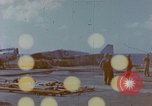
Views of destroyed aircraft and damage to deck of USS Enterprise (CVAN-65) following fire
Fire crews work to extinguish smoldering remains of multiple aircraft destroyed by fire on the deck and fantail area of the USS Enterprise in Pearl Harbor, Hawaii. Fire fighters hold fire hose and spray water over burnt aircraft. Two men climb up the aircraft and inspect. Some of the destroyed aircraft are A-7A and F-4J. Men walk and run all over the deck area. Several A-4FSkyhawk aircraft parked in background. Sailors observe several gaping holes on the bulkhead and deck from bombs that exploded during the fire. Fire hoses and water spread allover the flight deck while ship is moving slowly in the water with light visible wake. Portions of the deck sides are destroyed and crumbling. A forklift works to push aircraft debris off of the fantail and overboard.
USAF aircraft attacking targets during NATO live fire exercise in Europe
A NATO military exercise in Europe. U.S. Air Force F-4s and F-105 aircraft are seen dropping a variety of ordnance, including demolition bombs, antipersonnel bombs, and mixtures of both. F-4s seen dropping napalm. Air to Air and Ground to Air views of the aircraft attacking targets. Also seen are air-to-ground guided missiles being launched from airplanes. Two U.S. Air Force Captains in flight gear, approach and pose by a ladder in front of an F-111 aircraft parked on the ramp (possibly at RAF Upper Heyford).

Mrs. T.D. Robinson christens the 5th USS Lexington, at Fore River Shipyard, Quincy, Massachusetts
Launch of the aircraft carrier USS Lexington (CV-16) in World War 2 at Fore River Shipyard, Quincy,Massachusetts, United States. The decorated aircraft carrier stands in the dock. A sign reads 'The navy wants this ship to replace the Lexington. Let's go. Fore River!' Several sailors who served on the 4th USS Lexington, are present for the launching. Mrs. T.D. Robinson, who also christened the 4th USS Lexington, does the honors for the newest one, and the aircraft carrier glides down the ways into Boston Harbor.

Montage of Wright brothers and their airplanes in France and at Ft. Myer, Arlington, Virginia.
As a contrast to the early pioneering airplanes, passengers are seen seated inside cabin of a "modern" airplane (Douglas DC-4E). View of the DC-4E in flight. A view of Orville Wright. Wilbur Wright gesturing as he talks with officials in France about an aerial course to be flown. Wilbur Wright placing wheels under a Wright Flyer before it is moved across a muddy field in France. A team of men pull a rope raising a catapult weight in a tower. The weight falls, catapulting the Wright Flyer airplane into the air. Soldiers remove a Wright Flyer airplane from a storage building onto the parade grounds at Ft. Myer, Virginia. The airplane is seen in flight with Orville Wright alone, at the controls, On July 30, 1909, soldiers are seen moving a Wright Flyer from its shed for its final acceptance test. President William Howard Taft, U.S. Army Major George Owen Squier, U.S. Army Major Charles E. Saltzman and Wilbur Wright are among those standing with the President, as the Wright Flyer is moved toward the parade ground. Views of the monorail and weight and catapult used for launching an airplane. Men turn the two propellers on a Wright Flyer, as Wilbur Wright stands at the rear of the aircraft engine and makes an adjustment. . On September 9, 1908. U.S. Army Lt. Frank P. Lanham, seen in uniform, seated on a Wright Flyer, is joined by Orville Wright. Wilbur. They take off and set a new airborne endurance record, and Lt. Lanham becomes the first Military officer to fly in an airplane. On July 30th, as part of the final acceptance test, Orville Wright takes Army Lt. Benjamin D. Foulois on a cross country flight to Alexandria, Virginia, and back again. They are seen aboard the Wright Flyer, and then high in the air on their way to Alexandria.
Various "firsts" in U.S. aviation history from 1918 through 1924; early history of flight and vintage flight scenes
Shows several aviation "firsts" accomplished by U.S. Army Air Service aviators in the period from 1918 through 1924. A close formation of biplanes in flight. President and Mrs. Woodrow Wilson chat with Major Fleet, Officer in charge, on the occasion of the first air mail flight, inaugurated on May 15,1918 between Washington DC and New York.The mail is loaded into the Curtis JN-4 aircraft. Pilot in the cockpit. The aircraft takes off and in flight. Air Service. Mention of aviators helping spot forest fires. Smoke rising from forest fires and mountain ranges. In 1920, U.S. Army Captain St. Clair Streett is seen with some of his Squadron who flew four De Havilland DH-4 aircraft 9,000 miles, from New York City to Nome, Alaska. Two of the men play with pet dogs. Their itinerary is painted on the side of one of the aircraft, along with the names of pilot and mechanic (C.E. Crumline and J.E. Long). In 1923 the first non stop coast-to-coast flight was made in the Fokker T-2 aircraft. . A sign on the aircraft reads 'Army Air Service non stop coast to coast'.First Lieutenants Oakley O.Kelly and John A. Macready board the aircraft, at Roosevelt Field, Long Island, New York, on May 2, 1923. Their Fokker T-2 in flight. Their arrival at Rockwell Field, on Coronado Island (San Diego) California. In 1924, Lt. Russell Maughan is seen boarding his P-1 Hawk airplane at Mitchel Field, on Long Island, New York, and taking off , bound for Crissy Field at the Presidio, San Francisco, California. His goal is the first dawn-to-dusk, coast-to-coast flight. Views of his P-1 Hawk airplane flying over Manhattan, New York City.
CRITICALPAST.COM: About Us | Contact Us | FAQs - How to Order | License Agreement | My Account | My Lightboxes | Shopping Cart | Advanced Search | Featured Collections | Website Terms & Conditions | Privacy Policy ©2026 CriticalPast LLC.
License Agreement |
Terms & Conditions |
Privacy Policy
©2026 CriticalPast LLC.