


 Francais
 Deutsch
 Italiano
Refine Your Search
M4-training stock footage and images
- Showing 4687 to 4692 of 8218 results more
more Hide
Hide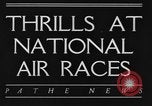
Various aircraft perform at an air show and parachutists descend at the National Air Races in Cleveland, Ohio.
Thrills at the National Air Races in Cleveland, Ohio. A V-formation of P-l2s in flight. Crowd-filled stands at the Cleveland Air Races. A formation of U.S. Navy F4B-4s in sets of three in flight Clarence MacArthur flies a 1910 Curtiss pusher-type aircraft. Waco Taperwing aircraft trails smoke in a dive, levels off and climbs. Milo Burcham flies in a P-12 aircraft. Mary Pickford looks up at the sky and points. Two policemen, a civilian and an army officer stand in the background. A crowd-filled grandstand. Milo Burcham in the aircraft rolls over and flies upside down. He flies low over the ground and goes into a vertical climb. People stand behind a fence. A Kinner Bird minus a wheel in flight. Its engine stops. It touches the ground down and skids. Parachutists jump from two Ford Trimotor C-3As. A number of parachutists descend and two of the parachutists land.

U.S. Destroyers, including some being readied for transfer to Britain, under the Destroyers for Bases Agreement of 1940.
A line of U. S. Destroyers tied up in a port. In the line of ships are seen DD-121 ( USS Montgomery), and DD-122 (USS Breese), both Wickes Class Destroyers that saw action with the U.S. Navy in World War II. Workers, including welders and such, are seen repairing and otherwise preparing 4-stacker destroyers for transfer to Britain in the so-called "Destroyers for Bases Agreement" of September 2, 1940.The USS Hale (DD-133) a 4-stacker Town Class Destroyer, later commissioned as HMS Caldwell (I-20), is seen underway in a channel. Lines of ships underway are seen in an aerial view.
U.S. 1st Marine Aircraft Wing attacks to support the ground troops to move forward in enemy range in South Vietnam.
U.S. 1st Marine Aircraft Wing in action in South Vietnam. Ground troops about 20 meters away from the enemy. 1st Marine Aircraft Wing Headquarter is contacted. Personnel at air base takes the information about location. Pilots are briefed by a briefing officer. He says three runs on target and last man calls off target. Pilots and crew run towards aircraft. They sit in F-4 Phantom and A-4 Sky Hawks. Crafts taxi out of revetments and take off. Ground troops fire. Aerial views as bombers and fighter jets drop bombs and fire rockets on enemy targets. Fire and explosions on ground. Point of view (POV) shots from forward underbelly of aircraft showing rocket launchers as rockets are fired at targets. Dramatic explosions on ground. Marine Forward Air Controller informs the base about accurate bombing. Ground troops move forward. Viet civilians walk on road. (Vietnam War period).

Pilot Lowell Bayles dies in crash of the GEE BEE race plane during an attempt on the world landplane speed record.
Crash of Gee Bee Z Super Sportster airplane at the Wayne County airport in Detroit, Michigan, on Dec. 5th 1931, during attempt to break the world landplane speed record. Ground crew and one of the Granville brothers, who built the airplane, roll the Gee Bee out of a hangar. The aircraft displays tail number NR 77Y and has large numeral 4 painted on fuselage. City of Springfield is painted on front of the airplane. Pilot, Lowell Bayles, climbs into the cockpit and starts the engine. Crew chief places canopy over the pilot's cockpit. The aircraft takes off with modest rate of climb and makes slow banking turn to the left. Camera next shows the Gee Bee descending rapidly as Bayles dives the race plane at high speed into the officially timed sea level course. Camera captures view of wing breaking off and aircraft rolling and crashing in flames. Witnesses rush to the crash site and emergency equipment responds. Views of smoldering wreckage. (According to some sources, the accident began when the gas cap loosened in the slipstream and blew through the pilots canopy hitting pilot Bayles in the face, either stunning or killing him.) His reaction on the controls pitches the plane up sharply causing a catastrophic structural failure of the right wing. The plane then snap rolled into the ground and explodes into a blaze alongside railroad tracks bordering the airport. Bayles' body was thrown 300 ft. as the huge radial engine broke loose and was hurled hundreds more feet. (Recent experiments with a reproduction of the aircraft also indicate that wing flutter would develop at speeds above 240 mph on the Gee Bee Z Super Sportster.) Part of the building shown at 1:52 still exists today in the far northeast corner of the airport near all the rental car companies. The railroad tracks still exist as well. The plane appears to start to break apart over what is now the intersection of Middlebelt & Wick Roads (1/4 mile south of I-94) in Romulus, MI.
Detonation of liquid thermonuclear device MIKE, the first hydrogen bomb, at Enewetak Atoll, Marshall Islands.
Full-scale thermonuclear test of ultracold liquid deuterium, codenamed Ivy MIKE at Enewetak Atoll in the Pacific Proving Ground in the Marshall Islands (sometimes spelled Eniwetok or Eniewetok). (Left to right) Chief engineering and firing commander, Stan Burris -- later the leader of the Strategic Ballistic Missile development, including Polaris and later editions; retired as CEO of Rockwell Aerospace -- military firing and security commander, Colonel Richard Lunger, and ultracold refrigeration engineering commander for thermonuclear liquid fuel state monitoring, Robert Gibney. The intense nuclear radiation ignited the atmosphere around the device, creating a fireball 4.2 miles across. A remote firing control was created, using a televison tower beam signal to safely trigger the detonation from the USS Estes, approximately 35 miles south/southeast of the detonation. White hot device remnant specks are visible throughout the surface of the fireball. Shockwave from Operation Ivy Mike explosion is seen spreading across the water, then a white mushroom cloud spreading above. View of crew on ship deck observing blast. Device yield: 10.4 megatons.
U.S. Army Air Forces P-47 aircraft operating in Belgium during World War II
USAAF P-47 Thunderbolt fighter planes operating at Florennes/Juzaine Airfield (A-78), Belgium, during World War 2. Identifiable units include the 411th Fighter Squadron (U9); the 373rd Fighter Group; the 387th Fighter Squadron (B4) and 388th Fighter Squadron (C4) of the 365th Fighter Group. A number of P-47s, (mostly bubble canopy D models) seen taxiing. (The second one's tail number looks like 42-26571, but that aircraft was downed in October 1944. So it is probably 26579.) Crew chiefs ride the wings of most P-47s to guide the pilots during low speed taxi when they would otherwise have to zig-zag to see ahead. Destroyed building silhouetted against the sky.Two flights of four P-38s circle overhead and peel off for landing.View through breached wall of a jeep towing a bomb cart past a parked P-47. Airmen walking across the field. Clear view of 388th Fighter Squadron P-47 taxiing. Another P-47 taxiing past a small damaged building
CRITICALPAST.COM: About Us | Contact Us | FAQs - How to Order | License Agreement | My Account | My Lightboxes | Shopping Cart | Advanced Search | Featured Collections | Website Terms & Conditions | Privacy Policy ©2026 CriticalPast LLC.
License Agreement |
Terms & Conditions |
Privacy Policy
©2026 CriticalPast LLC.