


 Francais
 Deutsch
 Italiano
Refine Your Search
M4-training stock footage and images
- Showing 469 to 474 of 8248 results more
more Hide
Hide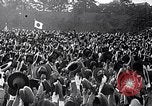
U.S. war effort is concentrated against Japan after the fall of Nazi Germany in World War II
Overlaid on scenes of fervently patriotic Japanese people waving flags and cheering, is slate reading: "Japan is firmly determined to fight a hundred years war to crush the United States." A huge explosion. Glimpse of U.S. Marine Flame Thrower Tank M67 directing flame on a Japanese bunker. U.S. marines charging in an amphibious assault on a Japanese held Pacific Island during World War 2. U.S. troops wading through surf from their landing craft, during amphibious assault. Marines fighting Japanese in Pacific Island jungle. Landing craft at beach in background. American flag being raised on a palm tree. Soldier saluting the American flag. General Douglas MacArthur wading ashore in the Philippines followed by staff officers and soldiers, including Filipinos. U.S. aircraft bombing Japanese held Corregidor in the Philippines. U.S. Navy ships bombarding the Philippine coast. American paratroopers of the 503rd Parachute Infantry Regiment, jumping at low altitude, from C-47 aircraft onto a critical hill known as "Topside" on Corregidor. Views from ground of paratroopers descending. and landing at the hilltop. U.S. troops in an amphibious assault, under fire. The American flag being formally raised as General MacArthur and other officers salute the flag. Marines in amphibious assault on Iwo Jima. A U.S. battleship firing at the coast. Explosions along the coast from Naval bombardment. Marines charging across the black sands of Iwo Jima. Marines firing a 75mm Pack Howitzer M1. Shells exploding at the base of Mount Suribachi. The famous flag raising by Marines on Iwo Jima. American forces attacking the Japanese Island of Okinawa. A Landing Ship Medium (R) firing rockets at Okinawa. Numerous explosions ashore. The USS LSM(R)-198 firing rockets. U.S. troops using a flame thrower to attack Japanese troops in a bunker. A Japanese defender is shot and tumbles down a hill from a fortification. American flag raising on Okinawa. Army officers salute the colors. A U.S. Navy destroyer firing its stern 8-inch guns. A Japanese warship struck by a bomb or shell, with flash of fire and explosion. More views of U.S. Navy warships bombarding Okinawa. A torpedo seen below the water as it is launched A Japanese ship exploding with fireball and huge cloud of smoke. Glimpse of helmsmen inside U.S. submarine. A formation of Douglas SBD Dauntless Dive Bomber aircraft peels off, and dives. A Japanese ship being strafed and bombed. It explodes. U.S. Army Air Forces B-29 bomber aircraft taking off from captured islands to attack Japan. A formation of B-29s in flight. B-29s flying over Japan. Mount Fuji is visible. B-29 raining bombs on Japan. View from aircraft as bombs strike, exploding on ground. Closeup of falling bomb. Huge clouds of smoke rising from struck targets. More views of B-29 aircraft in flight. Some leaving contrails at high altitude. View from bridge of U.S. battleship bow plunging into heavy seas that cover deck. (Ship's forward triple gun turrets are visible.) Aerial view of landing craft speeding toward a beach, leaving white wake in water. Glimpse of U.S. battleship, in camouflage paint, bombarding a shore. Closeup of twin 40mm Bofors anti aircraft guns being fired from U.S. Navy ship. A Japanese Kamikaze airplane on fire, falling through flak clouds. A Japanese Mitsubishi G4M bomber aircraft flying low past a U.S. Aircraft Carrier. U.S. Navy sailors on a ship's deck firing a twin 40mm bofors gun. A Japanese Kamikaze airplane hit and in flames as it falls. A squadron of U.S. aircraft in formation. Gun camera film of Japanese airplane bursting into flames while being shot at by U.S. aircraft. Flaming aircraft falling straight down towards the water and splashing on contact. U.S. troops wade through surf as they leave Landing Ship Infantry Large USS LCI(L)-337. Troops rush past a beached Landing Vehicle Tracked (LVT) on sand beach. Troops in tracked landing vehicles approaching the shore from a cove. White smoke in the area. A banner erected at shore reading: "CIC." Explosions nearby. Soldiers using a flame thrower. Scene shifts to U.S. Secretary of War, Henry Lewis Stimson, speaking from his office in Washington, DC. He speaks of destroying Japan's armed forces and war fighting capability. A soldier shouting with a beached LVT behind him. American soldiers firing small arms from sheltered positions. An artillery soldier closing the breech of a heavy gun after loading it. Montage of scenes similar to all seen already. A liberty bell and "V" for victory is shown.
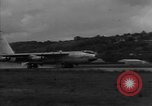
Combined operations of: U.S. Army, Air Force, and Navy, during Inchon Landing, in the Korean War
A B-52 strategic bomber aircraft takes off. A flight of B-52s in formation. Higgins boat landing craft motoring toward shore in the amphibious assault and landing at Inchon, during the Korean War (also spelled Incheon). A U.S. Landing Craft Tank (Rocket), LCT(R), firing rockets at shore during the assault. Wider view of the assault with rockets being fired and smoke obscuring much of scene. General of the Army Douglas MacArthur, Commander-in-Chief, Far East Command, is seen seated aboard the USS Mount McKinley (AGC-7) during the Inchon Korea landings, September 15,1950. Behind him is Rear Admiral James H. Doyle, U.S. Navy, Commander of Task Force 90 and Major General Edward M. Almond, U.S. Army, Commander, Tenth Corps (looking through binoculars). More scenes of the amphibious landing including view of Landing vehicle Tracked (LVT) in the surf. Infantrymen clambering ashore. An M4 Sherman tank in action. Smoke and fire. North Korean soldiers surrendering with white flags and taken captive as prisoners of war. American tanks passing through captured North Korean town.
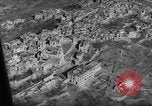
Scenes from the Battle of Monte Cassino, Italy, during World War II.
The Battle of Monte Cassino, Italy. Aerial view of San Vittore to the west. U.S. troops walk along a mountain road, as an Italian woman, holding a small child, watches from the roadside. Views of the town and Abbey of Monte Cassino, from mountainside outlook. Aerial view of Abbey on mountaintop. M7 Priest SP firing 105mm howitzer from camouflaged position. U.S. troops escorting Italian prisoners of war (POWs). American soldier carries several artillery shells up a hill. Several Sherman tanks of the 756th Tank Battalion are parked in a quarry below him. (The quarry is on the Cassino - Caira Rd north of Cassino.} Group of Italian civilians walk past a line of Sherman tanks parked along the empty riverbed of the Rapido River. U.S. soldier observes the Abbey of Monte Cassino through binoculars. Two American soldiers climb aboard an M4 Sherman tank mired down in the mud.(It has been identified as tank number C-14 belonging to the 3rd Platoon of C Company, 756th Tank Battalion.) Their Jeep is parked beside it. U.S. soldiers dug in along a roadside. One soldier plays solitaire with cards. Two soldiers place several propaganda leaflets into artillery shells.
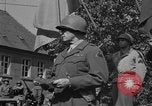
U.S. 9th Armored Division ceremony in Weiden, Bavaria, marking the end of World War II in Europe
Scene opens with closeup of Major General John W. Leonard, Commanding General of the U.S. 9th Armored Division, addressing his troops at the Schlörplatz in Weiden, Bavaria. He has assembled them to hear the news of Germany's surrender, ending World War 2, in Europe. A color Guard stands behind him. Upon hearing the news, the troops raise their arms and cheer, and partially break formation to converse with each other. They resume their formation and listen, as General Leonard continues to speak. Closeup of him reading from some notes. Scene shifts slightly, showing Leonard and the color guard in front of the Gustav von Schlör monument with famous old oak trees behind it. Next, the troops are viewed from the front, as they stand at Parade Rest with buildings near the square behind them. General Leonard walks down from the makeshift podium and passes in front of the assembled soldiers, and shakes hands with his Chief of Staff, Colonel Walter Burnside. Closeups of them shaking hands and conversing. Scene shifts to a unit Chaplain, giving a prayer of thanks for the end of hostilities. General Leonard and Colonel Burnside walk away from the gathering, as the color guard furls the colors. Suddenly an officer walks up on the grass and retrieves something from the base of the Schlör monument and quickly walks back into the square. A Captain has the color guard unfurl the colors again, which include the stars and stripes flanked by the Division colors and the General's two star flag. Next the entire assemblage poses as they are photographed from a high point some yards away. The view shows the color guard standing on grass in front of the Schlör monument with the massive oaks behind, surrounded by assembled troops, including some in a tank. Scene shifts to rear of the assembly, showing troops in armored vehicles at the back of troops in formation. Some armor is moving along a road behind the assembly. Another long shot of the assembled troops is followed by a closeup of them being called to attention. General Leonard walks into the center of the assembly, followed by several officers. They salute the colors and General Leonard converses with the Division Chaplain, who then steps into the grass in front of the color guard, where he removes his helmet, raises his arm, and gives a benediction as all bow their heads. (Note: Armored vehicles seen in this film include M4 Sherman and M36 Tank Destroyer.)
Evacuation of U.S. forces from Hungnam Harbor, North Korea, during Korean War
U.S. Marines and equipment being evacuated from Hungnam Harbor, North Korea,in December, 1950, during the Korean War. Opening scene shows wounded Marines on stretchers, being settled on the deck of a landing craft infantry. Two of the wounded marines are lifted over the gunwale and placed in an ambulance. View of wounded lying on deck of a Landing Craft Mechanized (LCM). An M4 Sherman tank, loaded with supplies, backs toward the shore, under direction of another tank driver. Scene shifts to an M-26 Pershing tank being backed into a Landing Ship Tank (LST). It is followed by another, equipped with a sand shield.
Beach and wreckage three days after the D-Day Allied invasion of Normandy, France during World War II.
Opening scene behind introductory writing, shows U.S. troops climbing down from a landing craft and walking towards a beach during Normandy invasion of World war 2. Date is D-Day +3 (June 9, 1944) and allies are setting up logistic resupply operations. Views across beach at extreme low tide. A cluster of DUKW amphibious vehicles sitting on the sand, below some cliffs. Some buildings of the French village of Arromanches-les-Bainsin background. Closeup of a demolished French dwelling at base of cliff. Two U.S. soldiers walk along a road at the waterfront, where steel barriers that have been removed from the beach, are piled up. Closeup of the steel barriers. An M4 Sherman tank, equipped with deep wading gear is seen mired in the sand. A closeup of U.S. Landing Craft Tank (LCT-25) on the beach with an M3A1 Half-Track destroyed on its offramp. It had been hit by shell fire on D-day, setting other half-tracks and the landing craft afire. Closeup of the destroyed halftrack.
CRITICALPAST.COM: About Us | Contact Us | FAQs - How to Order | License Agreement | My Account | My Lightboxes | Shopping Cart | Advanced Search | Featured Collections | Website Terms & Conditions | Privacy Policy ©2026 CriticalPast LLC.
License Agreement |
Terms & Conditions |
Privacy Policy
©2026 CriticalPast LLC.