


 Francais
 Deutsch
 Italiano
Refine Your Search
M4-training stock footage and images
- Showing 5461 to 5466 of 8218 results more
more Hide
Hide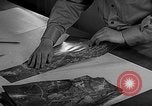
The film mosaic of T-3A camera is assembled together and interpreted in United States.
A U.S. Army training film about interpreting a camera film with aerial views. A print of T-3A camera film is developed. The mosaic prints are mounted by adhesive or staples. Completed mosaic is matched for contrast control networking. It is contrasted with U.S. geographical survey sheets and road maps. These are used to mark known places. Then these prints are pasted together. These pictures are send to an interpreter officer who translates the desired information. He uses stereoscope to find new enemy gun position, camouflage or other informations. (World War II period).
Parts of a K-12 camera described in United States.
A U.S. Army training film about parts of the K-12 camera. Title of the film 'Aerial Photography', Part 2, 'The K-12 Camera'. A man shows a K-12 camera used for night photography. A diagram of the camera. A pointer shows parts of the camera like photo electric cell and amplifier. A solenoid is attached to the shutter. Lenses and 12 volt battery. The aligned system of camera must be 13 and a half inches. Portals attached to a battery current. Before assembling the camera it is cleaned by air blower. Lenses are wiped. Amplifier is attached and locked over camera. Electric nodes are fastened. horizontal and lateral leveling of camera is measured. Number of exposures are calculated. Shutter speed is provided at three levels. Shutter and amplifier are set at on position. Cut film holder is loaded in a dark room and roll film magazine is loaded. The man shows the parts of camera mount.
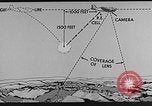
The process of taking pictures from a K-12 camera is described in United States.
A U.S. Army training film about the functioning of K-12 camera. Animation shows the process of aerial photography. A plane flies at 4000 feet above the ground. Lenses of camera are beyond the coverage of bomb. A photographer adjusts the mounting ring. As the pilot signals he sets the amplifier on and releases the bomb. At the sound of explosion he switches the amplifier off. A dark slide is replaced from holder. Exposed film is removed. The electrical connections are checked time to time. Film magazine is placed and locked. Suction tube is checked on cheek. The process is repeated again. One time filming covers one quarter square mile. Overlapping of the field must be done at 35% as it facilitates careful matching. (World War II period).

High school students express their views about the navy and a boy interested in navy is interviewed in the United States.
A U.S. Navy recruitment film about high school students' interest in joining the United States Navy. The film is titled "The Navy?" An interviewer asks high school students what they think about the navy. The students are wearing typical mid 1970s fashions. Some of them have long hair and a "hippie" look. Some of the teenage kids say it is important to have a Navy and some say it is a waste of money and is destructive. A long hair teenager says that we don't need ships anymore. Several teenage girls express support for Navy careers. An African American boy standing in front of a school bus talks positively about a Navy career and how he doesn't want to be hanging around on the corner anymore. About the importance of the Navy and desire to join it students give varying answers. Interviewer discusses the Navy with a group of students. A boy interested in joining the Navy is seen playing basketball and watching television. His mother says that joining navy would be the best thing for him. He discusses about his life and why he wants to join the navy. The boy, who has long hippie style hair, is seen working on a car with a friend. He is seen jumping across the tops of railroad cars of a parked train. He throws a stone from a bridge, and is seen walking along deserted railroad tracks.
Production and supply of equipment to armed forces at Naval Supply Center in Oakland, California in the United States.
A training film of the U.S. Navy in the United States. The film is titled 'Navy Port Terminal Management and Operation'. Mill and agriculture equipment production. Delivery of these products by rail road, trucks and ships. These products are delivered to armed forces. Cargoes in sea. An aerial view of Navy Port Terminal, a Naval Supply Center in Oakland, California.
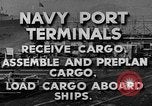
Facilities available at Naval Supply Center in Oakland, California.
A training film of the U.S. Navy in the United States. Facilities available at Navy Port Terminals like internal rail system, wide roads, huge warehouses, open storage spaces, motorized mobile cranes and gantry cranes. Rail cars go in a hangar. Mail packed and freight placed.
CRITICALPAST.COM: About Us | Contact Us | FAQs - How to Order | License Agreement | My Account | My Lightboxes | Shopping Cart | Advanced Search | Featured Collections | Website Terms & Conditions | Privacy Policy ©2026 CriticalPast LLC.
License Agreement |
Terms & Conditions |
Privacy Policy
©2026 CriticalPast LLC.