


 Francais
 Deutsch
 Italiano
Refine Your Search
M4-training stock footage and images
- Showing 5563 to 5568 of 8221 results more
more Hide
Hide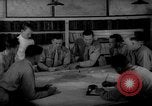
U.S. Colonel Harrison and other officers discuss a map around a table in Marine Chart Room at marine academy in Guam.
Training of U.S. marines at a naval academy in Guam. Interior of Marine Chart Room. Colonel Harrison, other officers discuss a map around a table. Marines march during a drill in front of barracks. Exteriors of the barracks.
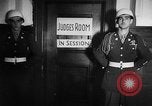
Nazi criminals are brought to justice as the Nuremberg Trials give final verdicts; scenes of World War 2 Nazi activities
Events related to the Nuremberg Trials held at the Palace of Justice in Nuremberg, Germany. Shows two guards standing outside the 'Judges Room'. Judges from Allied nations seated around a table. On 1st October 1946, judges give their final verdict. Scenes from the court room. Lord Justice Geoffrey Lawrence, President of the tribunal states the final verdict. Majority of the accused Nazi criminals are given death sentence, some of them given imprisonment and only a few are found not guilty. Multiple Nazi leaders are shown in the courtroom and in flashback scenes from the World War 2 years, including Hermann Göring, Rudolf Hess, Joachim von Ribbentrop and Wilhelm Keitel (both also shown at unidentified signing ceremonies), Ernst Kaltenbrunner, Alfred Rosenberg, Hans Frank, Wilhelm Frick, Julius Streicher, Walther Funk, Karl Dönitz, Erich Raeder, Baldur von Schirach, Fritz Sauckel, Alfred Jodl, Franz von Papen, Albert Speer, Konstantin von Neurath, Arthur Seyss-Inquart. Many flashback scenes show scenes of Nazi activities, Nazi atrocities, and the holocaust during World War 2 including: Boycott of Jewish shops and stores in 1930s, beating, dragging, and expulsion of resident Jews from ghettos, Nazi rallies with crowds giving Nazi salutes, book burning, massed overcrowded prisoner encampments, emaciated Concentration camp victims, nurses and doctors aiding starving and liberated concentration victims, gestapo dragging a man across a street, bin of gold teeth of murdered concentration camp victims being poured out for display, a German ship being launched, Erich Raeder meeting with Japanese military leaders or political leaders from Imperial Japan, and talking to Adolf Hitler; Hitler youth in training; Nazi slave labor workers at terraced hillside mines digging and doing mining operations; interior of a Nazi German submarine; German industrial worker at a steel furnace in a munitions war production factory. View of prison cells at Nuremberg Prison just north of Palace of Justice in Nuremberg, where some Nazi criminals were kept during the trials. View of exterior prison cell door of Hermann Goering. A guard patrols the roof of the Nuremberg Prison.
Production of petroleum at oil refineries and its transportation in United States, before and during World War II
Documentary titled, ' Oil Is Blood ' on production and transportation of petroleum and its by products in United States. Crude oil in a pit. Man takes samples from the pit. View of derricks at an oil drilling site. Derricks at sea. Exteriors of a building near the derricks. Service station attendants, pumping gas and cleaning the windshield, on a 1942 Lincoln Continental convertible, at a "Tydol Flying A" gas station. Scenes of busy highways and plenty of fuel give way to empty roads, closed gas stations, and restricted hours for obtaining fuel, as it is rationed during World War 2. Views of persons obtaining ration stamps and books. Various gasoline ration books including the "A" books (allowing the smallest amounts) and "B", "C", and other books allowing larger rations to more essential users. Oil rig "roughnecks" inserting new sections of pipe and proceeding to drill. Closeup of a "gusher" before it is capped. Men filling railroad tank cars with petroleum products. A long train of tank cars pulled by a steam locomotive. Animated map illustrates the ocean shipping lanes that formally served as means to transport fuel and oil, before the German U-Boat threat made them too dangerous for general use. Drums of fuel and oil being loaded aboard a ship to supply the Allies during the war. A convoy of ships heading to the war zone of North Africa.
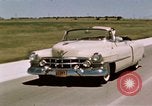
Use of petroleum and byproducts in transportation, agriculture, defense and industries in United States.
Various uses of petroleum and its byproducts in United States. Man drives a cream colored 1952 Cadillac Convertible car along the road. Close ups of various car parts in the 1952 Cadillac Convertible that are manufactured from petroleum byproducts, including seating, parts of dash, and window seals. Other vehicular traffic on road, including an antique automobile. An American Airlines DC-6 aircraft taking off. A streamlined locomotive: Burlington Route E-5A Diesel-Electric Silver Pilot locomotive approaching on a railroad train track. Tractor driven plow. A field being plowed. Petroleum byproduct being sprayed on fruit trees as a pesticide. Use of oil for American ground, air and naval forces. Petroleum byproducts and uses in oil industry. View of an oil refinery. Tourists visit an early oil derrick in Pennsylvania. An oil rig at work.
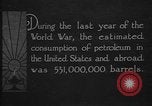
Water flows over the Niagara Falls and a globe with nine circular parallel lines along the equator rotates in the U.S.
The total consumption of petroleum of the U.S. and the world outside of the United States for the year 1918 is compared. Animation is used for this. Per capita consumption is also compared. Water flows over the Niagara Falls. A globe with nine circular parallel lines along the equator rotates. The 9 circular lines denote that if the per capita consumption of petroleum had increased as rapidly abroad as in the U.S. the world's petroleum requirement in 1922 would have been 10 times the actual requirement and if this volume had been loaded into tank cars of the capacity of 10,000 gallons each it would have made a solid train extending around the world at the equator 9 times.
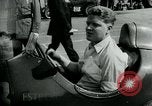
Japanese and French confer in Hanoi; war materiel supplies to China cutoff at Yunnan and Canton; British forces departing Shanhai
Clip opens with unrelated brief two second view of Frank Griswold, winner of 1940 New York World's Fair road race, waving from behind the wheel of his 1934 Alfa Romeo Tipo B after the race. Scene changes to views through the fertile countryside of French Indochina on a trip to Hanoi early in World War II. Narrator notes Hanoi is a principal supply hub for war materiel destined for General Chiang Kai-shek; supplies which the French have now interrupted at the request of Japanese authorities. A train arrives at station in Hanoi. People at the station. Views of downtown buildings of Hanoi and a market place. Street vendors selling foods and goods. A woman carrying a basket on her head. Rickshaw pullers at work behind several people seated at a street-side outdoor cafe. Narrator notes views are proceeding toward the central park where the residence of the head of the new government is located. Views of a couple in formal suit and dress strolling in the park. Major General Nishihara, head of the Japanese mission, is seen exiting a building following talks with the French Governor-General. Scene changes to Lao-Kai (or Lai Cai), a border station between French Indochina and China, where narrator says supply inspectors from Japan have traveled to examine the situation. View of the Yunnan railway with railroad tracks cut off by the French authorities, and guarded by local indigenous soldiers with conical hats (nón lá). Scene changes to the harbor at Canton China. Large ships anchored in harbor. Barrels or drums on the ground near docks, as narrator notes that large quantities of war supplies no lie idle and unusable on the port docks. Scene changes to Shanghai. A procession of forces from Great Britain on parade at a racecourse or stadium, and in the streets of the city, including uniformed bagpipers. Narrator notes it marks the end of British supremacy in China, with the first contingent of British troops departing Shanghai.
CRITICALPAST.COM: About Us | Contact Us | FAQs - How to Order | License Agreement | My Account | My Lightboxes | Shopping Cart | Advanced Search | Featured Collections | Website Terms & Conditions | Privacy Policy ©2026 CriticalPast LLC.
License Agreement |
Terms & Conditions |
Privacy Policy
©2026 CriticalPast LLC.