


 Francais
 Deutsch
 Italiano
Refine Your Search
M4-training stock footage and images
- Showing 5689 to 5694 of 8218 results more
more Hide
Hide
American Army troops entering area of Dachau Concentration Camp, Dachau, Germany, near end of World War II
U.S. troops of the 45th Division, 157th Infantry Regiment, 3rd Battalion, I Company, entering the area of Dachau concentration camp, in the final days of World War 2. They are seen escorting German prisoners of war, with their hands raised, along a railroad siding. U.S. troops in front of a railroad train of boxcars. A dead German soldier, face down on the ground. The U.S. troops follow the railroad track into area of buildings, and run to take cover due to incoming fire. One fires a browning automatic rifle from an elevated walkway. Other American soldiers hunker down behind the walkway wall. U.S. Army soldier fires rifle while standing on a roadway. Surrendering German soldier, carrying a white flag, is attacked by a concentration camp inmate, as several other liberated inmates and U.S. Army soldiers stand nearby, watching. (Note: Opening cameraman slate states date as 04-27-1945, but historical records indicate this took place on 04-29-1945.)
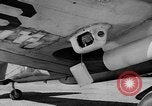
Aromere loads and mounts the A-N Gun Camera in U.S. Curtiss P-40 and U.S. Lockheed P-38 Lightning aircrafts in the United States.
Operation and installation of an Army-Navy aircraft Gun Camera in U.S. Curtiss P-40 and U.S. Lockheed P-38 Lightning aircraft in the United States.Aromere loads and mounts the gun camera under the wing of U.S. Curtiss P-40 aircraft and in the nose of U.S. Lockheed P-38 Lightning aircraft. Aircrafts in flight.During gunnery practice pilot pulls the trigger.they use film magazine in their training.
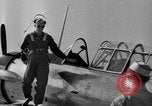
Processing, evaluation, and scoring of U.S. Army gun camera footage during World War 2
Operation and Installation of the Army-Navy aircraft Gun Camera in U.S. Curtiss P-40 and U.S. Lockheed P-38 Lightning aircraft in the United States. Aircraft returns. Aromere takes off the magazine containing film. Film is processed in the laboratory. It is developed and edited. The film is loaded in a 16mm projector and viewed by personnel trained to judge and record the hits and accuracy of pilots and gunners. Aircraft in flight during gunnery practice. Views of pilot in cockpit and gunner firing guns. View of gunner hand firing guns and view as seen from gun camera.
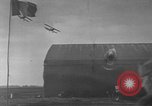
French Air Force in World War I. Formations of airplanes from successive eras.
Opening scene shows French Nieuport airplanes returning to their base from a mission, during World War 1, circa 1918. They fly over their hangar. The French tricolor flag flies from a flagpole nearby. A crashed airplane sits, nose to the ground and tail in the air, near the hangar. An airplane taxis close to the hangar, as mechanics work on airplanes in various stages of damage and repair. Next shown are a succession of formations containing aircraft from different periods of time. A loose formation of biwing aircraft fly overhead, toward the camera. They are followed by a loose formation of twin engine biplanes. Next is seen a large loose formation of American Army training biplanes from the period between the World Wars. Finally, a formation of U.S. 1950 era B-36 bombers is seen in formation.
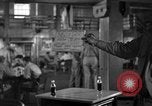
Women Army Corps dance with the American soldiers in a hall in the United States during World War II.
American soldiers and Women Army Corps (WACs) dance in a hall in the United States during World War II. WACs and soldiers dance. Others sit and talk. Few have drinks. A training for the soldiers. A screen in the background.

The Moritzburg Castle, the Opera House and the Zwinger Museum in Dresden, Germany.
Famous tourist destinations and architecture in Saxony, Germany, before World War 2. Views of the Moritzburg Castle (Schloss Moritzburg, Schloßallee, 01468 Moritzburg, Germany) and the Semperoper Opera House building (Semperoper Dresden Schinkelwache Theaterplatz 2 01067 Dresden) in Dresden, Germany. View of the world-famous Zwinger Museum (Zwinger Theaterplatz 1 01067 Dresden). Trains passes by on a track. Buildings in the background.
CRITICALPAST.COM: About Us | Contact Us | FAQs - How to Order | License Agreement | My Account | My Lightboxes | Shopping Cart | Advanced Search | Featured Collections | Website Terms & Conditions | Privacy Policy ©2026 CriticalPast LLC.
License Agreement |
Terms & Conditions |
Privacy Policy
©2026 CriticalPast LLC.