


 Francais
 Deutsch
 Italiano
Refine Your Search
M4-training stock footage and images
- Showing 5851 to 5856 of 8218 results more
more Hide
Hide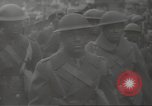
African American soldiers of U.S. Army and WACs (Women's Army Corps) parade in Astoria, New York during World War II.
Segregated African American soldiers of U.S. Army parade along a street in Astoria, New York, and in parade fields of training grounds during World War II. Very large columns of African American troops marching in formation and passing commanding officers in review. Long columns of African American soldiers and WACs (Women's Army Corps) parade.
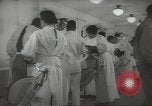
U.S. WACs (Women's Army Corps) during a close order drill and drive jeeps in Astoria during World War II.
African American Women's Army Corps of U.S. Army undergo military training in Astoria, New York during World War II. Interiors of building show African American dentists at work on patients. African American women of U.S. WACs (Women's Army Corps) perform a close order drill and drive jeeps.
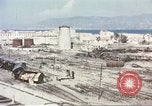
Destruction in city of Messina from U.S. Army Air Forces bombing in World War II
Destroyed trains in railroad marshaling yard at Messina, Sicily, resulting from U.S. Army Air Forces bombing during World War 2. Cracked, broken and destroyed buildings in the city of Messina. Shattered trees and debris-filled areas. Two armed provisional Italian police, wearing white armbands, walk past partially destroyed commercial buildings. They turn and walk toward the camera. Closeups of each, and of armband identifying them as Civil Police, written in English and Italian.
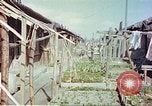
A housing plan employed for workers by Japanese mining companies in Japan after World War II.
Homes constructed for Japanese workers in Japanese cities after World War II. Homes of barracks variety which are given to those workers who are employed at the Higashi Misome Coal Mine. A Japanese woman washes small pieces of clothes in a wooden bucket in front of her home. A housing plan that is employed by the Higahu-Misome Mining Company. It further illustrates the conditions in which those homes are kept. A view from a train as it passes through various towns and cities while en route to Kyoto. The type of buildings found in most cities of Japan which were untouched in the strategic air attack against Japan
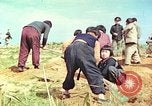
Japanese school girls do various exercises such as running, jumping and the ceremonial dismissal by their teacher in Japan.
A group of young primary school children tend a garden and dig up the ground for further planting. A physical training class being conducted on a school playground. Girls do various exercises such as running, jumping and play basketball. The ceremonial dismissal by their teacher. They are uniformly dressed in white middies and navy blue bloomers.
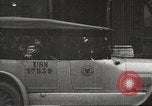
Rear Admiral William Moffett, Chief of U.S. Navy Bureau of Aeronautics. Admiral William Sims, commander of U.S. naval forces in Europe.
Brief glimpse of a U.S. Navy staff car parked in front of a Federal Government building entrance, where several naval officers and at least one army officer prepare to board the car. Attending the car are two sailors wearing dark watch caps. Next, Rear Admiral William A. Moffett, Chief of the U.S. Navy Bureau of Aeronautics, is seen leaving the building on crutches. His right foot is heavily bandaged. A sign in the window of the building reads: "U.S. Navy Aviation." A cadre of naval officers follows the Admiral to the sidewalk, where he cheerfully engages in conversation with several. To his left is a Captain. The other officers are of lessor rank. They appear to be awaiting a car to pick up the admiral. Following a break, two of the naval officers are seen conversing alone at the building entrance. The admiral has left. Change of scene shows a man in military uniform seated at a desk in what appears to be a law office. He is making notes on a pad. The room is filled with shelves full of books. Abrupt change of time and place shows Vice Admiral William S.Sims, Commander of all U.S. Naval forces in Europe, at a railroad train station in London, England, at the end of World War 1. People around him show him some papers and converse with him. A British Bobbie stands nearby. Sims shakes hands with a British official. School boys in the background watch the goings on with interest.
CRITICALPAST.COM: About Us | Contact Us | FAQs - How to Order | License Agreement | My Account | My Lightboxes | Shopping Cart | Advanced Search | Featured Collections | Website Terms & Conditions | Privacy Policy ©2026 CriticalPast LLC.
License Agreement |
Terms & Conditions |
Privacy Policy
©2026 CriticalPast LLC.