


 Francais
 Deutsch
 Italiano
Refine Your Search
Mazamet France 1950 stock footage and images
- Showing 2995 to 3000 of 6211 results more
more Hide
Hide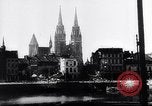
Britain attempts to recover its defensive capabilities following equipment losses in the evacuation at Dunkirk, France, in World War II
Opening scene shows a cathedral and houses near the English Channel coast in World War 2. German troops, part of a force of 100 Divisions, are seen advancing through French towns toward the coast. A German army band leads some. Others march through the countryside. Close-up of some ot the marchers, along with a Sd.Kfz.9 Half-Track pulling an artillery field piece. A column of German army trucks raising dust on a French country road and many waiting in line to cross a canal. A covered German halftrack pulling a covered trailer across a partially collapsed bridge. View from a moving railroad train with German troops and one manning an MG-08 machine gun on an open flat car. German soldiers in a "bucket brigade" passing cargo, including jerry cans, being off-loaded from a German Junkers Ju-52 transport plane at a grass airfield in France. A German Krupp K5 railway gun being run up an elevated rail. Imaginative animated map showing Nazi-dominated Europe in contrast to the British Isles. British troops marching. Change of scene to the beachhead at Dunkirk, France, during the mass evacuation of British forces ahead of approaching German armies. View from a British Destroyer of troops wading out through the water towards it. Close-up of two British soldiers being pulled from the water onto a boat, by two men in fowl weather gear. In skies above, British and German aircraft are engaged in aerial dogfights. A British Destroyer filled with soldiers evacuated from Dunkirk. Vickers/Maxim Octuple QF 2-pounder Mark VIII guns being fired by a British warship. British soldiers, some covered with oil, on the deck of a destroyer. Scene shifts to armor and weapons abandoned by the retreating British forces, including trucks, tanks, anti-aircraft guns and armored cars. Scene shifts to England where rescued soldiers begin ascending a gangway from the crowded deck of a warship to a pier above. Smiling British soldiers relaxing as they arrive on a pier. Many rescued soldiers getting organized on land. Narrator mentions that the losses of war materiel leave Britain short of its needs. Soldiers standing around a British Infantry Tank Mk.III Valentine. Soldiers manning a coastal defense machine gun position. Views of the British English Channel coastline. A British battleship (or Battle Cruiser) showing two forward triple gun turrets, is seen underway, ahead of an aircraft carrier. Silhouetted distance views of several British destroyers, and closer view on one escorting a supply shiip. (Narrator notes the British navy was absorbed in protecting supply lines all over the globe.) Animated map illustrates the overwhelming superiority of German Air Forces directed against Britain. view of British airfield displaying flag with Union Jack and RAF roundel. Several RAF personnel stand around an Avro Anson twin engine airplane, parked on the ramp. Several Supermarine Spitfire aircraft are seen parked on an airfield. Close-up of two flying in formation. View of St. Paul's Cathedral in the heart of London, England. British people are seen in a city and at home engaged in ordinary activities, scrubbing floors, chatting over drinks at a Pub, and waiting on a customer in a lady's shop. A farmer tends sheep in a field next to a church, where he converses with the Vicar. A baby crawls across pavement to his mother who reaches out from a doorway. New recruits in uniform mingle with people on a sidewalk. Mature women in uniform walk along with British Army officers in uniform. British sailor and an officer walk past the camera. A boy and older men at work in a field. Four businessmen dressed in civilian clothes are next seen in military uniforms, shouldering rifles. Home Guard civilians carrying rifles are trained in close order drills on a lawn. A home guard man points to a drawing of a tank as he asks a question during an outdoor training session. Recruits watch demonstrations with Browning M1917 water-cooled machine gun, and hand grenade launcher on Enfield rifle. A recruit takes his turn firing a single round (to save ammunition) from a Thompson M1921 submachine gun. He hands the weapon back to the instructor and returns to his place.

German invasion of France,sinking of RMS Lusitania and resignation of William Jennings Bryan
Events during World War I. Sketches : workers in a German arms factory. German soldiers advance towards France. Animation of a map shows the German invasion of France through Belgium. Kaiser Wilhelm II, the German Emperor. Buildings damaged by invading Germans. U.S. president Thomas Woodrow Wilson advises Americans to stay calm. American people read papers. Cartoon depicts the President about his domestic reforms. The German atrocities in Belgium. Man holds a dead person. Sketch depicts Germany crushing everything on its way. The apprehensive people of America. Sketches of American man against a German leader. Trucks and taxi cabs on the Orne river. A gun barrel. Bombs being dropped on the German ships. Worker at a factory in America. Sketch of a man standing beside a flag having the dollar sign shows the prosperous America. Sketch shows the various resources required by the American industries. An American ship carrying war materiel. Sailors in German submarines. German submarines target allied ships. Sketches of U.S. president Wilson warning Germany. On 1st May 1915 RMS Lusitania a British luxury ship at sea as it starts from New York. Paper shows a warning by the German government. A German sailor on board a submarine as it targets a ship. The RMS Lusitania ship sinks killing many, including Americans. The U.S. secretary of State William Jennings Bryan and Thomas Woodrow Wilson with other officials. The former U.S. president Theodore Roosevelt addresses people opposing President Wilson's policy. The President prepares a note for Germany. Sketch of U.S. Democratic Presidential candidate William Jennings Bryan during his resignation. Sketch of Kaiser Wilhelm II.

Montage of Wright brothers and their airplanes in France and at Ft. Myer, Arlington, Virginia.
As a contrast to the early pioneering airplanes, passengers are seen seated inside cabin of a "modern" airplane (Douglas DC-4E). View of the DC-4E in flight. A view of Orville Wright. Wilbur Wright gesturing as he talks with officials in France about an aerial course to be flown. Wilbur Wright placing wheels under a Wright Flyer before it is moved across a muddy field in France. A team of men pull a rope raising a catapult weight in a tower. The weight falls, catapulting the Wright Flyer airplane into the air. Soldiers remove a Wright Flyer airplane from a storage building onto the parade grounds at Ft. Myer, Virginia. The airplane is seen in flight with Orville Wright alone, at the controls, On July 30, 1909, soldiers are seen moving a Wright Flyer from its shed for its final acceptance test. President William Howard Taft, U.S. Army Major George Owen Squier, U.S. Army Major Charles E. Saltzman and Wilbur Wright are among those standing with the President, as the Wright Flyer is moved toward the parade ground. Views of the monorail and weight and catapult used for launching an airplane. Men turn the two propellers on a Wright Flyer, as Wilbur Wright stands at the rear of the aircraft engine and makes an adjustment. . On September 9, 1908. U.S. Army Lt. Frank P. Lanham, seen in uniform, seated on a Wright Flyer, is joined by Orville Wright. Wilbur. They take off and set a new airborne endurance record, and Lt. Lanham becomes the first Military officer to fly in an airplane. On July 30th, as part of the final acceptance test, Orville Wright takes Army Lt. Benjamin D. Foulois on a cross country flight to Alexandria, Virginia, and back again. They are seen aboard the Wright Flyer, and then high in the air on their way to Alexandria.
Tehran Conference and successive preparations for D-Day attack on Nazi regions in France by Allied forces (WW2)
World War II Documentary entitled "D-Day Convoy." Leaders and military Generals of the Allied nations at the Tehran Conference. U.S. President Roosevelt, British Prime Minister Churchill, Soviet General Stalin, General George Marshall of U.S. Army, General Eisenhower. Map showing the targets of raid in France under German occupation. Immense military ammunition, artillery, tanks, weapons and infantry troops amassed in England and readied for military raids. American infantry troops being trained to raid the Peninsula of Normandy. Troops advance between bomb blasts and gun fire during training. Allied air force bombers bombing their targets in France. Formation of Martin B-26 bomber aircraft flying overhead. Point of view shot from inside aircraft, seen through rain spotted plexiglass gun canopy, flying very low over a French village, on the way to bombing target. Aerial view of U.S. Army Air Force B-17 Flying Fortress bomber dropping bombs over enemy target in Europe. View of bombs falling away from aircraft toward targets during a day time bombing raid. Explosions and smoke on the ground as targets are hit. Aerial fights between German and Allied air forces. Gun camera footage scenes as seen from Allied aircraft as they shoot at German airplanes. Several scenes of German aircraft exploding in flight. Airplane blasts in sky. U.S. army troops with ammunition moving toward camps in southern England. At the marshaling area soldiers receiving and trying on gas masks. They also receive inflatable life belts, food rations, cigarettes, candy including Hershey's chocolate, and French money as invasion currency. Briefing of the troops by the commanders.

Britain, France, and Israel attack Egypt following nationalization of the Suez Canal.
Egyptian nationalization of the Suez Canal leads to war as Israel attacks Egypt, and France and Britain embark troops for transport to a joint staging area at the island of Cyprus. View of commercial ships in the Suez canal. Egyptian President Gamal Abdel Nasser. in discussion with officials. French troops embarking a transport ship in the port of Marseille, France. Brief glimpse of their destination port at Cyprus. British troops boarding airliners to take them to Cyprus where they will reinforce the existing British garrison. British and French carriers and warships assembling in the Eastern Mediterranean sea. A flight of four British Hawker Hunter jet fighter-bombers are seen flying in formation. Closeup of one inflight, with rockets mounted beneath its wings. Closeup of a rocket under its right wing. Scene shifts to another Hawker Hunter armed differently. It displays four outer wing rocket rails on each wing, carrying three rockets each. Auxiliary fuel tanks are installed on pylons under each wing. View of the White House in Washington DC. Inside, United States President Dwight D. Eisenhower and Secretary of State, John Foster Dulles discuss the Suez situation. Next, speaking at a press conference, President Eisenhower states , "the United States was not consulted in any way about any phase of these actions, nor were we informed about them in advance." He asserts America's intent not to become involved and to bring the matter before the UN General Assembly where their is no threat of a veto. He states his intent to "keep in contact with Congressional leaders of both parties," and expresses hope that the United Nations can bring an end to this "tormenting problem." View of the United Nations General Assembly building in New York City. Inside U.S. Secretary of State, Dulles, is seen seated next to America's UN ambassador Henry Cabot Lodge, Jr. Glimpse of the General assembly with all delegates seated.
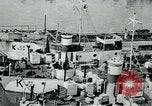
Warships loaded with ammunition and amphibious vehicles at British harbors, ready for invasion of France, during World War II.
The preparations for the D-Day invasion of France by Allied Forces, during World War II. Ships and war boats at British harbors and ports carrying ammunition and warfare materials are readied for invasion. Landing Craft Vehicles (LCV) and DUKW ready at the harbor for invading France.