


 Francais
 Deutsch
 Italiano
Refine Your Search
Mazamet France 1950 stock footage and images
- Showing 4327 to 4332 of 6211 results more
more Hide
Hide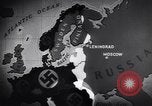
German Operation Barbarossa on the Eastern front in World War II
Animated map shows extent of German controlled areas in Europe following their conquest of the Balkans in World War 2. Norway is under their control and German forces threaten Leningrad and Moscow. A soviet defense line is shown on the map. The German attack is shown to come from 5 directions on June 22, 1941, with the launch of German Operation Barbarossa. A sky filled with German Heinkel He 111 bombers is shown. German Panzer III tanks with 75 mm guns. Army trucks carry German troops into battle. German soldiers on motor cycles and infantry advance under fire. Animated map shows principal German targets as Leningrad, Moscow, and Kiev. It then shows beginning a drive from the North to encircle Leningrad. Arrows show where German Marshal Fedor von Bock's forces drove 480 miles into Soviet territory. Slates identify cities being overrun by German invaders, including: Pskov, Novgorod, Brest-litovsk, Minsk,Mogilev, and Vitebsk. On July 17, 1941, a German tank is seen entering Smolensk, past the Dnieper River threatening Moscow, itself. To the south, German forces, under Marshal Gerd von Rundstedt, cut deep into the Ukraine. Newspapers world-wide consider the Soviet forces close to defeat. Slate shows communique from the German High Command stating: "The issue in the East is already settled. Smolensk is the last halt on the road to Moscow." German infantry marching. Scene shifts to heavy artillery being fired by Soviet forces in a snowy scene clearly later in the year. Animated map shows German forces very close to Moscow on October 15, 1941, forcing the Soviet Government and all foreign missions to move to Kuibyshev, 700 miles to the east. Adolf Hitler, in a speech on October 3, 1941, states that the enemy is broken and will never rise again. Animated map shows 500 thousand square miles of Soviet territory occupied by German forces. Views of fires burning in Russia. Damaged and abandoned Soviet industrial plants. A German guard atop a hill looks down on thousands of Soviet people in the occupied areas of Russia. Damaged and abandoned Soviet T-26 tanks. Glimpse of damaged Soviet aircraft and field artillery. Headline in New York World Telegram newspaper reads: "Berlin Admits Russ War May Last Winter." Another headline reads: "Red Army Holds Push On Moscow." Weary German soldiers traveling in horse-drawn wagons, pulling field artillery. Soviet and German war planners are seen at work. Slate quotes Adolf Hitler saying: "A single blow must destroy the enemy, without regard for losses... A gigantic all-destroying blow." German armor moving along a road. Animated map shows this technique in the German invasions of Poland, France, the Balkans, and Yugoslavia. In contrast, the Soviet planners are seen, as map illustrates how they intend to take advantage of the vast area of their land by holding lines of defense an falling back as necessary to keep engaging the invaders across interior of the Soviet Union. Soviet infantry are seen marching along a road. German troops riding atop their tanks. Soviet troops forcing German invaders into close combat in her cities. Soviet soldiers running in a city and firing heavy machine guns. Bomb damage and rubble inhibit German armor mobility in cities. Cities where this kind of Soviet resistance prevailed were: Rostov, Kharkov, Kiev, Kursk, Smolensk. German troops leaving a city with heavy black smoke rising in the background. More views of cities where Soviet troops are engaged German forces in House-to-house battles, including: Odessa, where the Old Opera Theater building is shown sandbagged and relatively undamaged. The Odessa NI tank, created from an STZ-3 agricultural tractor.
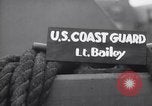
U.S. Coast Guard Lieutenant briefs Coast Guardsmen and soldiers on deck of LCI before Normandy invasion in World War II
The day before D-Day invasion of Normandy by Allies during World War 2. A Coast Guard Lieutenant briefs Coast Guard crewmen and several officers and soldiers, on deck of a Landing Craft Infantry that will be taking part in the cross-channel invasion of France.
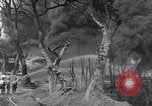
British soldiers fight fire at a bombed oil supply depot near their base in England, during World War II.
United States soldiers at a base camp in England, prior to D-Day invasion in Normandy, France during World War II. Immense smoke rises off a bombed oil supply depot. British soldiers use chemical foam apparatus to fight fire at the oil depot. Flames come out of a building on fire.
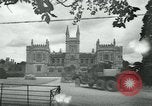
Military vehicles and supplies from the United States arrive in United Kingdom warehouses and bases (WW2)
Trucks arrive at Toddington Manor (Toddington, Cheltenham GL54 5DN, United Kingdom) in Gloucestershire, England. British children playing jump rope as vehicles transport tanks on the road. Rows of aircraft are transported by vehicles into town. The preparations for the D-Day invasion of France by Allied Forces, during World War II. A crane moves boxes. Boxes move in conveyer belts. Sacks, boxes, and crates stored at a distribution point. A man drives a forklift transporting boxes inside a warehouse. Military supplies arriving in Britain from the United States. Piles of tires, barbed wires, concrete tubes stored in docks and warehouses. Cranes move oil barrels into a pile. Military locomotives and freight cars bound for continental Europe at a railway yard. Soldiers open a crate containing a United States Army truck. A crane lowers a tank. A man inspects a row of military trucks. Rows of M3 half-track armored personnel carriers and M4 Tractors in England. A man helps a tank back up. Rows of tanks, artillery, and guns from the United States. Men stocking shells inside an underground storage. Piles of shells outdoors. A truck transports shell. Rows of fighters at an airfield. A man moves a search light at night. Anti-aircraft guns fire at German night bombers attempting to attack bases in the United Kingdom. Barrage balloons fly above warships. A sailor drops an anti-ship mine in the sea. Minesweepers seek and destroy such mines from the sea. Consolidated PBY-5A attacks a German ship.
British and American aircraft and paratroopers attacking German positions in later years of World War II.
US Army Air Force and British Royal Air Force bombers attacking German cities and German production centers in France during World War 2. Allied bomber aircraft take off for mission on German strategic positions. B-17 bombers and P-38 Lightning aircraft taking off and aerial views of them flying in formation. Gunner in plane firing at German Luftwaffe fighter aircraft attacking the formation. A B-17 bomber explodes in air during combat. Bombers drop bombs on oil refineries, munition factories and strategic positions. Ground view of Allied Infantry soldiers marching in Europe. Allied paratroopers dropped from planes. Many views of paratroopers jumping and landing. Mustangs fighter planes flown by Poles with their insignia, bombers with Free French symbol flown by French pilots, and B-25 Mitchell and B-26 Marauder bomber aircraft in action during World War 2. Avro Lancaster bomber aircraft also seen. Gun camera footage from low level bombing flights against enemy German positions in World War 2. Dogfights with German fighter airplanes and Allied guided bombs dropped on munition factories, military and air bases of Germany.
Soviet Union backs out of 4-power administration of Berlin and blockades the City. U.S. Army Air Forces supply the city by airlift.
Teacher and school children playing amid rubble in Berlin, in the aftermath of World War II. Children receiving food outdoors. Children in a school classroom being given cups of soup by their teacher. In March, 1948, a Soviet soldier is seen lowering their flag from one of four flag poles displaying it, along with flags of the British, American, and French flags. (They no longer wished to share occupation of Berlin with the other Allied powers.) View of Western representatives preparing to issue a new stable currency. Next, the Soviets block all access to West Berlin (the "Berlin Blockade.") Open rail cars filled with coal are brought to a halt in their tracks. Trucks servicing West Berlin are stopped from moving over a highway. West Berlin citizens stand at a fence watching a U.S. Army Air Forces C-47 transport plane flying supplies to them. View from below of a C-54 transport plane descending to land, with supplies, at Templehof airfield in West Berlin. A C-54 taking off to make another supply run. A pallet of coal being offloaded from a C-54. A tram running on restricted schedule. A Berliner planting food in a deserted lot near a demolished building. People assembled in front of the severely damaged Bundestag and in other places surrounded by war torn buildings. Berlin Mayor Ernst Reuter, speaks of seeking assistance from America, England, France, and Italy, to help his city. Closeups of some of the Berliners applauding him. An airlift airplane labeled "Operation Santa Claus" with a soldier dressed like Santa, dispensing wrapped gifts or candy to German children near the plane's doorway. German children can be seen and heard singing "deck the Halls" in English. A soldier dressed as St. Nicholas stands next to one dressed as a Native American Indian. Children sing Martin Luther's hymn, "Ein feste Burg ist unser Gott" ("A Mighty Fortress Is Our God"). A British Sunderland flying boat, takes off on the Havel River, in Berlin, after delivering supplies to the city. Grateful Berliners surrounding American pilots. Children run in a street carrying a large model of an airplane to simulate the Berlin airlift. Children playing "airlift" on a sidewalk. An airlift plane crashed and burning in a residential section of Berlin. German fire fighters battle the flames with hoses. A C-54 airlift plane descending to land with its gear extended. Scene at midnight, May 2, 1949, as the barriers isolating Berlin are raised, as the Soviets promised free and improved access to Berlin. People waving flowers as trucks once again move into the city. But Communists are seen violently storming the Greater Berlin City Hall in the Eastern Sector of the city. Non-Communist deputies in the Eastern Sector are forced to meet in West Berlin, where they meet without being molested. View of the Berlin Logo (Bear). Free election vote being deposited in a ballot box. Animated map shows how Berlin was cut in two, separating East Berlin from West Berlin.
CRITICALPAST.COM: About Us | Contact Us | FAQs - How to Order | License Agreement | My Account | My Lightboxes | Shopping Cart | Advanced Search | Featured Collections | Website Terms & Conditions | Privacy Policy ©2026 CriticalPast LLC.
License Agreement |
Terms & Conditions |
Privacy Policy
©2026 CriticalPast LLC.