


 Francais
 Deutsch
 Italiano
Refine Your Search
Mazamet France 1950 stock footage and images
- Showing 4507 to 4512 of 6211 results more
more Hide
Hide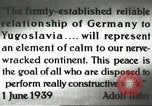
Tripartite Pact signed by Germany, Italy and Japan in Berlin, Germany. Ensuing attacks by Germany and Japan in World War II
This film is a scattering montage of World War 2 scenes from 1939 through 1945. Part of an agreement between Nazi Germany and Yugoslavia is shown in English. It is dated June 1, 1939 and ostensibly signed by Adolf Hitler. Next, German Ju 87, Stuka dive bomber aircraft are shown peeling off from formation, on April 6, 1941, to attack Yugoslavia. Bombs bursting on the ground. Closeup of a Stuka airplane in a dive, making its characteristic whine, and dropping bombs. Bombs exploding just outside some concrete walls. German infantry running along railroad tracks and entering backyard of house in a village. German soldiers observing from overlooking hill; climbing over rubble; and marching along a road toward a village. Animated map showing German invasion areas early in World War II, extending through most of Europe and into Norway, by 1941. Animated map shows further invasions into France, Belgium, low countries, the Balkans, and Eastern front towards the Soviet Union. Map highlights Tokyo, Rome, and Berlin. Delegations walking in hall of Reich Chancellery in Berlin, to sign Tripartite pact, on September 27, 1940. The group is led by by Count Galeazzo Ciano (Italian Foreign Minister, and Mussolini's son-in-law); Joachim von Ribbentrop, Germany's Foreign Minister and Japan’s Ambassador Saburō Kurusu. The diplomats are seen, next, standing near a table as Adolf Hitler enters rendering Nazi salute. He shakes hands with Count Ciano and Ambassador Kurusu. Hitler is seated to watch the proceedings. Von Ribbontrop is seen signing for Germany. Next scenes show German armored units heading East in Operation Barbarossa (June of 1941). A sign identifies the town of Eydtkau (Eydtkuhnen) on the German-Lithuanian border. German armor and artillery moving eastward. German troops destroying international crossing barriers. German troops firing siege guns. Montage with glimpses of German battle scenes showing tanks, guns, rockets in action with attendant explosions, fires, and destruction. Formations of German warplanes in flight, including Junkers Ju-52s that carry troops, including paratroops. View from above of Junkers Ju-87 Stuka dive bombers in formation. Battle of Britain scenes, with view of St. Paul's Cathedral in London, England (which miraculously survived the Blitz). The Tower Bridge in London, seen through a haze following blitzkrieg. German Junkers 87 Stuka dive bombers peeling off from formation to attack. British anti-aircraft searchlights shining beams skyward. Diving bombers illuminated by the lights. Anti-aircraft guns firing. Nighttime scenes showing gunfire flashes, explosions, tracer bullets and fires in London. British fire brigades fighting fires in London buildings as some collapse from the German bombing during the so-called "Blitz." Scene shifts to Pearl Harbor, December 7, 1941, as a Japanese bomb explodes on a U.S. Navy warship. The USS Arizona billowing smoke and listing as it succumbs to Japanese bombing. Another view of the Arizona sinking. Smoke rising from Battleship Row, at Pearl Harbor. Glimpse of postwar Nuremberg trial.
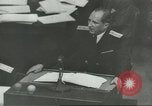
Hans Frank describes the atrocities inflicted on prisoners by the Nazis; Hoess testifies; footage of atrocity evidence.
During Nuremberg trial Hans Frank describes the Nazi policies of exterminating Poles and others. Atrocities inflicted on prisoners in Ourador Sur Glane, France in Bande, Belgium in Catacombe, Italy and in Czechoslovakia. Nazi German soldiers engaged in destruction following massacre of many residents in town of Lidice, Czechoslovakia in 1942 (retaliating for the assassination of SS officer Reinhard Heydrich.) Dead bodies in Nazi concentration camps, including Auschwitz, in 1945. Bones visible in crematory ovens. Victims inside crowded barracks including women prisoners who have been liberated. Large piles of items taken from victims before their deaths, including luggage, hair locks, toothbrushes, shaving cream brushes, shoes, clothing. Bones of victims piled at a concentration camp. Rudolf Franz Ferdinand Höss (sometimes spelled Höß or Hoess or Hess) describes concentration camps at Auschwitz in Poland during testimony. Victims in hospitals are shown, as words of Hess describe medical experiments include lowering the body temperature, injecting the body with poisons and infectious diseases and subjecting victims to high altitude pressure chambers. View of mutilated corpses. Sign that reads, "Arbeit Macht Frei" over the Auschwitz concentration camp gated entrance. Corpses of victims in the concentration camps.
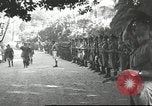
General Dwight D Eisenhower confers with Grand Legion of Honor in North Africa
General Henri Giraud of France and United states General Dwight D Eisenhower inspect Allied troops in North Africa. General Giraud confers Grand Legion of Honor on General Eisenhower as a cameraman records the event. (World War II period).
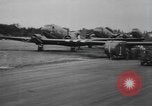
U.S. Paratroopers preparing, and then departing from England, to airdrop over Normandy during World War II
An airfield in England, filled with Waco CG-4A Gliders and their C-47 tow planes, in readiness for the invasion of Normandy, France, in World War 2. U.S. Army Air Forces intelligence officer briefing C-47 and Glider pilots and crews about conditions expected in the drop zones of Normandy before D-Day in World War 2. Brigadier General James Gavin,Commander of the 82nd Airborne Division, giving a final briefing to his paratroopers. A military chaplain holding final religious services for troops. General Dwight D. Eisenhower, visiting paratroopers of the 101st Airborne Division, as they prepare to depart on the night of June 5, 1944. U.S.Army paratroopers boarding their C-47 aircraft to depart for Normandy on June 5, 1944. Several are seen tying parapacks of heavy equipment to the aircraft for separate release. Paratroopers of 101st Airborne Division, loading equipment aboard a CG-4A Glider, and getting final briefing from their pilot. Other 101st Airborne troopers don personal equipment on the ramp near their C-47 airplane, which displays paint-striped wings and fuselage. Jumpmaster makes final check of his troopers. The paratroopers boarding their aircraft with heavy loads of equipment. C-47 aircraft take off towing their gliders.
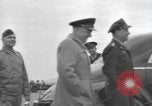
Lieutenant General Brereton with U.S. paratroopers leaving RAF Greenham Common, England to invade Normandy in World War II
U.S. paratroopers depart England, the evening before D-day, to be airdropped over Normandy France, in World War 2. U.S. Lieutenant General Louis H. Brereton, Commander, 9th Air Force, converses with two other officers as they stand by a staff car on RAF Greenham Common airfield, England. He waves a riding crop as he steps into the staff car, which carries three stars on a bumper plate. Scene shifts to the flight line where General Brereton is smoking a cigarette as he converses with American and British officers, standing beside C-47 aircraft number 43-15296. Brereton chats with two paratroopers of the 502nd Parachute Infantry Regiment, 101st Airborne Division, and shakes hands with one. The C-47, named, "That's All...Brother," taxis forward, along with several others, toward the active runway. Many aircraft are then seen taking off, one at a time, in the dusk, with their wingtip lights on.
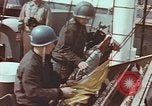
Allied fleet underway in the Atlantic Ocean as a U.S. Coast Guard officer looks through binoculars during World War II.
Allied fleet underway in the Atlantic Ocean towards Normandy, France during World War II. A signal man takes signals out of a flag bag. An LST ( Landing Ship Tank ) convoy underway with the bow of an LST in the foreground. Two officers on the deck of the LST. A man looks through a pair of binoculars. A British LCI ( Landing Craft Infantry ) underway at sea. Men on the bridge of a Coast Guard patrol boat. The flag of the U.S. flies from the mast of a patrol boat with a radar in the background. A Coast Guard officer on the bridge of the patrol boat looks through a pair of binoculars. A Task Force underway in the Atlantic with the bow of a patrol boat in the foreground. British patrol boats tied up alongside a ship with a Coast Guard cutter. The Coast Guard patrol boat and a British patrol boat tied up. A patrol boat getting underway with a cargo ship in the background. An LCVP ( Landing Craft Vehicle Personnel ) in the foreground.
CRITICALPAST.COM: About Us | Contact Us | FAQs - How to Order | License Agreement | My Account | My Lightboxes | Shopping Cart | Advanced Search | Featured Collections | Website Terms & Conditions | Privacy Policy ©2026 CriticalPast LLC.
License Agreement |
Terms & Conditions |
Privacy Policy
©2026 CriticalPast LLC.