


 Francais
 Deutsch
 Italiano

Refine Your Search
Mazamet France 1950 stock footage and images
- Showing 4693 to 4698 of 6223 results more
 Hide
Color Sound
101st Airborne and 4th Armored Division defend Bastogne (WW2)
Map showing Stavelot and Bastogne in Belgium during World War II. A soldier uses binoculars to inspect United States Army Air Force planes in the sky. Soldiers watch aerial combat between United States and German Luftwaffe Air Force planes. Smoke from planes hit by flack lingers in sky. 101st Airborne division soldiers march to the outskirts of Bastogne. Soldiers ride an armored vehicle and march on foot. 4th Armored Division M4 Sherman tanks move on snow covered road. Explosion during battle in Bastogne. Douglas C-47 Skytrain transport planes from bases in Britain and France bring supplies to the defenders of Bastogne. German prisoners of war marching by as the transport planes arrive. The C-47 transport planes airdrop supplies over Bastogne.
Filipino citizens after United States occupation of Philippines
Dramatization of the Second Continental Congress during the American Revolutionary War. The United States Declaration of Independence. The Thomas Jefferson Memorial (16 E Basin Dr SW, Washington, DC 20242, United States) in Washington DC. Bronze statue of Thomas Jefferson. The statue of United States President Abraham Lincoln at the Lincoln Memorial (2 Lincoln Memorial Cir NW, Washington, DC 20002). President Woodrow Wilson meets European leaders in France after World War I. Artistic depiction of United States soldiers fighting in the Spanish-American War. Map showing the Philippines, one of the two territories acquired by the United States after the Spanish-American War. Filipino students attend a class. They listen to the teacher standing in front of them. Behind the teacher are two blackboards. Two American consultants working with a Filipino man at the Manila City Planning. A scale model of Manila. Men constructing a house in the Philippines. Filipino men carry an entire native Kubo nipa house as a form of “Bayanihan”. A parade in Manila in 1946. The United States grants independence to the Philippines on July 4, 1946. Paul V. McNutt, High Commissioner to the Philippines, reads a proclamation at the ceremony held at the Independence Grandstand in front of the Rizal Monument. Filipino women wearing traditional Filipiniana dresses attend the ceremony. The United States flag is lowered as the Philippine flag is raised.
Filthy Thirteen put war paint on their faces before D-Day Night Drop (WW2)
The Filthy Thirteen (inspiration for The Dirty Dozen, officially known as the 1st Demolition Section of the Regimental Headquarters Company of the 506th Parachute Infantry Regiment, 101st Airborne Division) of the United States Army prepare for Invasion of France night drop (D-Day) during World War II. The paratroopers help each other put their equipment on. The men, sporting Mohawk haircuts, apply Native American Indian war paint on each other’s faces. The men, now wearing their helmets, board the aircraft. Some of the men adjust the supply chutes underneath the aircraft. A Filthy Thirteen paratrooper smiles as he puts on his backpack. One of the paratroopers help his comrade adjust his backpack.
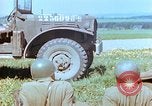
GIs celebrate VE Day with Nazi enactment in Germany (WW2)
Four U.S. Army soldiers sitting in a field in Germany. A GI sticks his head out from behind a U.S. weapon carrier wearing a Daniel Boone fur hat as he starts a funny, humor skit mocking Nazi German forces. He marches out from behind the vehicle carrying several guns and Nazi daggers for a Nazi enactment. He stands before the group, comes to attention and gives a Nazi salute. The GI displays the various guns and daggers for the audience. He gives a bottle, a gun, a dagger and the hat to the GIs sitting on the ground. GIs smile and cavort as they celebrate VE Day or Victory in Europe Day in World War II.
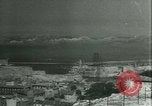
Liberation of several French cities from German Nazi troops in World War II.
Marseilles: View of the French port. British, French and American Naval officers examine German demolition of the port town. Officers survey unfinished U-Boat pens. Toulon: Destroyed German ships in the harbor. Bologne: German coastal guns in ruins. Destroyed artillery. Le Havre: Destroyed buildings and ruins in the town. Unfinished German U-Boat pens. Destroyed artillery. Brest: Destroyed buildings and ruins. German soldiers wave a white flag of surrender on September 18, 1944. U.S, Army Major General. W.M. Robertson , 2nd Infantry Division discusses the surrender with German Colonel E. Pietzonka of the 7th German Parachute Regiment. German soldiers assemble in the main square of the city during the surrender operation.
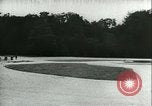
World War 2 German soldiers demolish memorial dedicated to Marshal Ferdinand Foch and the German surrender of 1918.
Germans demolish memorial dedicated to Marshal Ferdinand Foch and the German surrender in 1918. The memorial with Ferdinand Foch's statue at the center. A soldiers stands near an engraved stone on the ground. German soldiers dig with shovels and pickaxes. The memorial and a building there are blown up. Smoke from the explosions.
CRITICALPAST.COM: About Us | Contact Us | FAQs - How to Order | License Agreement | My Account | My Lightboxes | Shopping Cart | Advanced Search | Featured Collections | Website Terms & Conditions | Privacy Policy ©2026 CriticalPast LLC.
License Agreement |
Terms & Conditions |
Privacy Policy
©2026 CriticalPast LLC.