


 Francais
 Deutsch
 Italiano
Refine Your Search
Mekong Delta Vietnam 1968 stock footage and images
- Showing 2065 to 2070 of 4434 results more
more Hide
Hide
Soldiers wade through waist deep water across a stream and struggle up a muddy embankment in South Vietnam.
A search and destroy mission of U.S. 9th Infantry Division, 47th Infantry, 3rd Battalion in South Vietnam during the Vietnam War. Soldiers wade through waist deep water across a stream and struggle up a muddy embankment. They cross a muddy field. The soldiers speak over a radio and check a map. They struggle through mud and water of a rice paddy. The soldiers look at maps. They continue across the muddy field.
U.S. soldiers cross a muddy field and drink and eat in South Vietnam.
A search and destroy mission of U.S. 9th Infantry Division, 47th Infantry, 3rd Battalion in South Vietnam during the Vietnam War. A soldier crosses a muddy field. Soldiers in deep mud. A soldier covered with mud rests. He drinks from a canteen. A soldier wearing a raincoat eats C-rations. The soldiers move across an open field. Soldiers standing on a vehicle. The U.S. flag at mast.
U.S. soldiers search a hut and follow suspects and question them in South Vietnam.
A search and destroy mission of U.S. 9th Infantry Division, 47th Infantry, 3rd Battalion in South Vietnam during the Vietnam War. Soldiers search a hut. Two soldiers sitting on tombstones. Soldiers walk in a rice paddy. Two women walk along on a dike. Vietcong suspects cross a narrow wooden plank across a stream. The soldiers follow the suspects. The suspects are questioned and their papers are checked. They are released. A water buffalo in a paddy. Soldiers standing near a hut. A Viet family in the doorway.
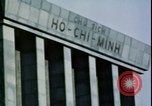
Guards place wreaths and men watch the mummy of Ho Chin Minh preserved at Ho Chin Minh Mausoleum in Hanoi, Vietnam.
Ho Chin Minh Mausoleum in Hanoi, Vietnam. Guards place wreaths at the foot of the mausoleum. Men view the mummy of President of the Democratic Republic of Vietnam, Ho Chin Minh, preserved in the mausoleum. One of the sources of damage to preserved bodies is black spores. A laboratory technician experiments with means to eliminate black spores. A chart shows the position of black spores on face of mummy.
North Vietnamese guards flank U.S. prisoners who are marched through a waiting crowd in Hanoi, Vietnam.
U.S. prisoners of war are marched in Hanoi, Vietnam during the Vietnam War. U.S. prisoners are marched by North Vietnamese soldiers along a street. The prisoners march along the street lined up by screaming spectators. The prisoners are handcuffed in pairs and they wear numbered shirts. One pair of handcuffed Americans wear the numbers 399 (Edward Alan Brudno) and 381 (WIlliam Micahel Tschudy) on their backs. A crowd of North Vietnamese surround soldiers carrying an unconscious injured American captive. The soldiers try to hold back the crowd. One soldier waves a pistol in one hand as he helps carry the American captive with the other. Photographers take pictures as the soldiers place the captive American in a covered truck and drive away through the crowd.

U.S. President Richard Nixon addresses people in the United States on withdrawal of remaining U.S. troops from Vietnam.
Television broadcast of U.S. President Richard Nixon's speech from the White House in Washington DC, United States on the withdrawal of remaining U.S. troops from Vietnam on 29th March 1973 during the Vietnam War. The White House. The Seal of the President of the United States. The President talks about that period of the Vietnam War when he joined the office and speaks about the program he initiated to end the war. He says American prisoners are on their way from Vietnam and people of South Vietnam are now free to choose their government. He says North Vietnam is not complying with few provisions of the Peace Agreement. He says that they should honor all those American soldiers who died during the Vietnam War. He refers to the difficult days of the war including the moratorium to end the war which was organized on October 15, 1969 when millions of Americans took day off from work and schools to participate in local demonstrations against the war. Nixon refers to the period of April 1971 when he ordered attacks on Communist bases in Cambodia. He talks about the period of May 1972 when he ordered air strikes in North Vietnam and the period of December 1972 when he ordered more air strikes.