


 Francais
 Deutsch
 Italiano
Refine Your Search
Melville Rhode Island 1943 stock footage and images
- Showing 2173 to 2178 of 6726 results more
more Hide
Hide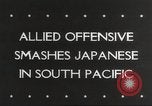
U.S. aircraft bomb Japanese positions and ships in the Pacific Theater during World War II.
U.S. Army Air Forces aircraft bombard Japanese positions in the Pacific Theater during World War II. A map of the area. U.S. Army Air Force B-24 Liberator aircraft in flight over islands in the Pacific. The aircraft fly in formation. A Japanese cruiser underway at sea. The cruiser being bombed. A gun sight aiming point view of the cruiser being strafed. Explosions occur at sea. Enemy barges being attacked by the aircraft. Smoke rises at sea. U.S. aircraft bomb Munda Airfield. Smoke rises from the shoreline of the Munda island. Bombs being released over Bismarck Islands and the Solomon Islands. Bombs impact and columns of smoke rise.
Fighter planes P-51 Mustangs of the U.S. Army Air Forces in the Mariana Islands.
A fighter plane P-51 of the U.S. Army Air Force taxies on ground. Other P-51 Mustang in flight. Army vehicles move as the planes fly overhead. A large number of P-51s parked. A vehicle moves in the background.
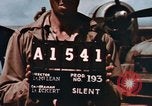
B-29 plane of the U.S. Army Air Forces in the Mariana Islands.
Man refuels B-29 plane. A man on the wing of a bomber B-29 Superfortress of the U.S. Army Air Forces. Another man gives him a hose. The man on the wing refuels the aircraft. Another plane in the background.
U.S. B-29 bombers operating from Northern Marianas Islands (WW2)
Boeing B-29 Superfortress taking off from Isley Field, Saipan, during World War Two. View of Pilot at controls. View from nose of aircraft as it flies very low over ships in the water. Crew members in flight gear plus life vests (also known as Mae West jackets) are sweating from tropical heat at low altitude. B-29s moving as they taxi to line up for takeoff. A Curtiss C-46 Commando flies overhead. Seen are B-29s of Saipan-based 73rd Bomb Wing's 497th Bomb Group (Tail Code "A"), 499th Bomb Group (Tail Code "V") and 500th Bomb Group (Tail Code "Z"). Also seen are aircraft of the 314th Wing, stationed on Guam, including those of 39th Bomb Group (Tail Code "P") as well as B-29s of the Tinian-based 313th Wing's 9th Bomb Group (Tail Code "X") and 6th Bomb Group (Tail Code "R"). Views of the B-29s taking off. Name on one aircraft, "The Rocket," can be seen. B-29 taking off directly over camera. Ground operations and departures being controlled by a controller/dispatcher on radio telephone. Formation of B-29s overhead. Interior of a B-29 in flight, showing gunner relaxing at his position. View of crew inside B-29 bomber.
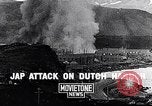
Japanese bombing of Dutch Harbor in the Aleutian Islands, during World War II
Effects of Japanese air attack on Dutch Harbor early in World War 2. Oil supply burning in Aleutians. Large Mountain covered with snow. Foreground shows buildings like air base. Buildings seen burning. Men fighting fires in area. A boat seen burning in harbor. Destruction caused by fire in the area. Burned ship seen in harbor.
U.S. Navy Seabee Construction Battalions build a base at Dutch Harbor in the Aleutian Islands during World War II.
Activities of the Seabees in the Aleutians, during World War II. Units of Seabees are ordered to the Aleutians. An animated map shows the Dutch Harbor. Ship carrying Seabees in a bay, with snow capped mountains in the background. The Seabee Battalions at the base construction site : Surveyers at work. Huge explosion demolishes a cliff. Steam shovels work on cliff face. Bulldozer creating a road. Concrete bucket being loaded. Seabees work on reinforced concrete wall, with frame of reinforcing bar visible. A huge yard filled with construction materials. Carpenters build a structure with lumber, using hand saw and hammer. View of the completed major U.S. Navy base. Seabees work to repair a damaged U.S. destroyer. The USS Ralph Talbot (DD-390) seen at sea. Views of other ships in the region.
CRITICALPAST.COM: About Us | Contact Us | FAQs - How to Order | License Agreement | My Account | My Lightboxes | Shopping Cart | Advanced Search | Featured Collections | Website Terms & Conditions | Privacy Policy ©2026 CriticalPast LLC.
License Agreement |
Terms & Conditions |
Privacy Policy
©2026 CriticalPast LLC.