


 Francais
 Deutsch
 Italiano
Refine Your Search
Melville Rhode Island 1943 stock footage and images
- Showing 2281 to 2286 of 6726 results more
more Hide
Hide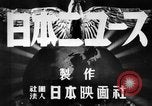
Fall of Corregidor to Japanese, during World War 2, Japanese newsreel.
Japanese newsreel documenting fall of Corregidor, Philippines to attacking Japanese forces. Japanese Betty bomber flying overhead. Guns of a Japanese battleship. Japanese animated map showing Corregidor Island at entrance to Manila Bay and the location of Japanese amphibious assault on the island, during World War 2. Aerial view of Corregidor, from Japanese airplane. Aerial view of bombs striking Corregidor. Japanese troops moving from rocky shore, past obstacles, and climbing steep wooden stairs on Corregidor. One of the soldiers carries a flame thrower. Japanese soldiers engaged in firefights with defenders. Americans surrendering. Views of tattoo on sailor. Barrage balloon aloft nearby.U.S. Army Major General George F. Moore conversing with Japanese Commander. Japanese Lieutenant General Masaharu Homma enters a hut and sits with members of his staff, opposite U.S. Lieutenant General Jonathan Wainwright, Major General Moore, and another officer, to discuss terms of surrender.
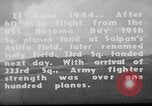
U.S. 19th and 73rd Fighter Squadron P-47s landing on Aslito Airfield, Saipan during World War II
After the battle of Saipan, during World War 2, P-47s of the 318th fighter Group 19th Fighter Squadron are seen flying in from the Carrier, USS Natoma Bay and those of the 73rd Fighter Squadron, flying in from the USS Manila Bay. View from a P-47 approaching Coastline of Saipan Island . Control tower operator on lookout for aircraft. Signal from the tower giving the planes directions for landing. Four P-47s peeling off for landing. P-47s approach and land on Aslito airfield, island of Saipan. Fliers standing around their aircraft watching other planes come in for landing. 19th Fighter Squadron P-47s taxiing into parking area. Pilot talking to the crew chief of his plane. View across airfield showing the demolished hangar building with P-47s in 19th Fighter Squadron's dispersal area. Fuel Trucks and ground crew personnel attend to the arriving aircraft. One of the P-47s carries the name: "Jackie Eilen" and another, the name "Angel." (Note: Although written introduction to this film refers to 11 June, the events depicted occurred after 20 June, 1944. The invasion of Saipan did not begin until 15 June, 1944. Aslito Field was captured on 19 June, 1944. The first P 47 aircraft (a few) arrived on 20 June, 1944 while the Seabees were working to make the field operational.)
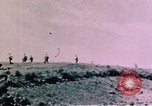
U.S. Marines fire cane fields using flame thrower tanks and grenades during the Battle of Okinawa, Japan.
Activities of the U.S. 1st and the 6th Marine Divisions on the island of Okinawa, Japan during World War II. United States Marines advance on the battlefield. Tank flame throwers and prosperous grenades being used to fire cane fields driving Japanese from cover. Japanese prisoners of war stripped to their loincloths, being marched to the stockade. United States flag flies from a pole after capturing the island of Okinawa.
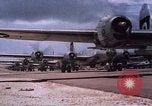
U.S. Army Air Forces B-29s with P-51 fighter escorts, bomb Tokyo, Japan, during World War II.
From "The Last Bomb", showing U.S. Army Air Forces bombing targets in and over Japan during World War 2. B-29s taxi on airfield and take off from runway. Crew in cockpit of aircraft. More B-29s taxi on runway at Tinian airfield. B-29s leave flight lines at Saipan airfield. B-29s taxi and take off from runway. Last B-29 takes off from Saipan airfield. Controller in tower talking into radio. Controller in Guam attends phone call. Take off times of each wing are noted by men at desk. Man attaches copy on report board. B-29 in flight over Pacific Ocean. Crew inside the plane. Navigator marks the chart. Aircraft makes run over Iwo Jima Island. Bulldozer leveling the surface at Sulfur island of Iwo Jima. P51s parked at airfield. Officers discuss around chart. P-51s warm up in flight line. P-51s taking off from airfield. Group of P-51s in flight. Controller at Guam talks over phone. Officer marks positions of each wing on mission board. P-51s fly low over water. Pilot of P-51 speaks. Crewman's hand at instrument panel. P-51s in flight behind B-29s. Smoke marker is dropped from an aircraft. Groups of planes separate. B-29s defend against attacking Japanese planes. A Japanese plane drops phosphorous bomb which explodes in the way of formation of B-29s. P-51 peels off to attack Japanese plane and protect B-29. P-51 fires at Japanese plane. Japanese plane is hit and goes down in flames. Formation of B-29s heading for mission. B-29s dropping bombs on Tokyo.
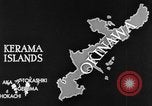
Okinawa is heavily shelled with guns and rockets and then invaded by 10th Army and the Marine 3rd Amphibious Corps.
Invasion of Okinawa. Animated map shows Aka, Tokashiki, Geruma, Hokachi and Okinawa Island. After six days of U.S. troops landing on Kerama Island, 10th Army attacks south west coast of Okinawa. Heavy naval shelling of Okinawa. U.S. fleet shelling coasts of Okinawa. Heavy explosions in Okinawa throw billows of smoke in air. U.S. fleet underway at sea approaching Okinawa. Rocket ships firing rockets on enemy positions on coastline. U.S. amphibious landing on beaches after heavy shelling. (World War II period).
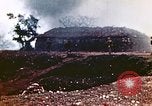
United States Marine troops organize the civilians of Okinawa in Pacific Theater.
Okinawa Operations in Pacific Theater. United States Marine units and 24th Army Corps advance on uneven terrain of Okinawa. Smoke rises up due to firing. The troops organize the civilians of the island. Refugees clog a road. Destructed bridges on the island. Jeeps and tanks advance. Amphitracks and jeeps cross a stream. Bulldozers repair a road. (World War II period).
CRITICALPAST.COM: About Us | Contact Us | FAQs - How to Order | License Agreement | My Account | My Lightboxes | Shopping Cart | Advanced Search | Featured Collections | Website Terms & Conditions | Privacy Policy ©2026 CriticalPast LLC.
License Agreement |
Terms & Conditions |
Privacy Policy
©2026 CriticalPast LLC.